


<p>Argumentation theory explores the processes and methods of reasoning and debate used by individuals in both formal and informal contexts. The theory has roots in ancient philosophical discourse, particularly from figures like Aristotle, and has evolved through the contributions of modern philosophers such as Chaïm Perelman and Stephen Toulmin. It highlights how arguments are structured, identifying key components such as claims, grounds (or data), and warrants, which collectively help participants make their case. </p> <p>Additionally, arguments can be categorized into three main types: factual claims, which are verifiable; judgment or value claims, which are subjective; and policy claims, which pertain to proposed courses of action. This framework acknowledges the influence of personal biases, often shaping the reasoning process, and emphasizes the importance of logical support, backing, qualifiers, and rebuttals in strengthening arguments. In academic contexts, the theory suggests that creating valid topics should focus on policy arguments, while also addressing counterarguments to foster a comprehensive debate. Overall, argumentation theory serves as a critical tool for understanding how reasoning and persuasive communication function in various scenarios.</p>
The Dialectical Principle of Charity: A Procedure for a Critical Discussion
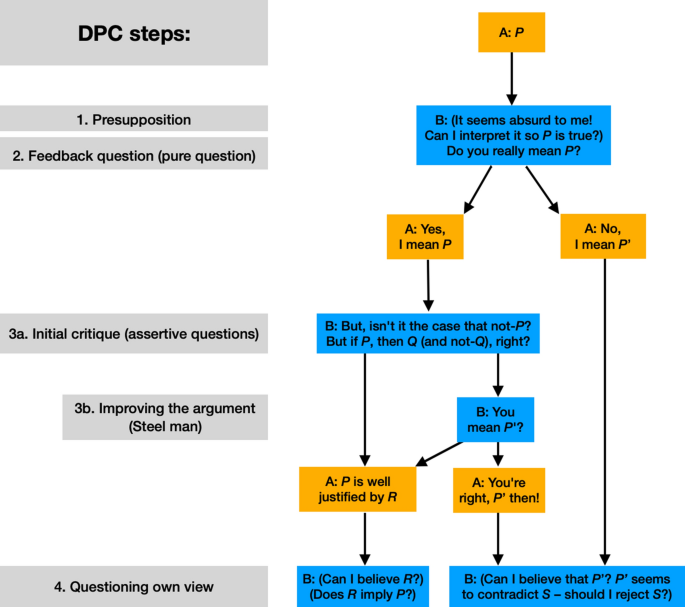
This paper aims to discuss a well-known concept from argumentation theory, namely the principle of charity. It will show that this principle, especially in its contemporary version as formulated by Donald Davidson, meets with some serious problems. Since we need the principle of charity in any kind of critical discussion, we propose the way of modifying it according to the presupponendum—the rule written in the sixteenth century by Ignatius Loyola. While also corresponding with pragma-dialectical rules, it also provides additional content. This will be termed the dialectical principle of charity, and it offers a few steps to be performed during an argument in order to make sure that the participants understand each other well and are not deceived by any cognitive bias. The meaning of these results could be of great significance for argumentation theory, pragma-dialectics and the practice of public discourse as it enhances the principle of charity and makes it easier to apply in argumentation.
Beginner's Guide to Arguing Constructively
How to turn arguments from vicious battles into productive dialogues.
The sound of inevitability
Have you ever argued with someone who is seriously good at debating? I have. It sucks. You’re constantly thrown off-balance, responding to a point you didn’t expect to. You find yourself defending the weak edges of your argument, while the main thrust gets left behind in the back-and-forth, and you end up losing momentum, confidence, and ultimately, the argument. One of my close friends won international debate competitions for fun while we were at university (he’s now a successful criminal barrister), and he told me that the only trick in the book, once you boil it all down, is to make sure the conversation is framed in your terms. Once that happens, it’s all over bar the shouting.
Persuasion Index: A Theory-Guided Framework for Persuasion Analysis
Identifying persuasive rhetorical cues is critical across domains, from detecting information manipulation and improving AI safety to advancing public health communication. We propose Persuasion...

Argument from authority
Some consider it a practical and sound way of obtaining knowledge that is generally likely to be correct when the authority is real, pertinent, and universally accepted,[1][4][5][6][7][8][9] while others consider it to be a very weak defeasible argument or an outright fallacy.[10][11][12][13][14]
Most arguments scatter across papers, posts, and threads — and evaporate. A claim tree gives them a stable structure to gather against, the way a cathedral gathers centuries of work into a single, standing thing.
Hegel’s Dialectics
“Dialectics” is a term used to describe a method ofphilosophical argument that involves some sort of contradictoryprocess between opposing sides. In what is perhaps the most classicversion of “dialectics”, the ancient Greek philosopher,Plato (see entry on Plato), for instance, presented his philosophical argument as aback-and-forth dialogue or debate, generally between the character ofSocrates, on one side, and some person or group of people to whomSocrates was talking (his interlocutors), on the other. In the courseof the dialogues, Socrates’ interlocutors propose definitions ofphilosophical concepts or express views that Socrates challenges oropposes. The back-and-forth debate between opposing sides produces akind of linear progression or evolution in philosophical views orpositions: as the dialogues go along, Socrates’ interlocutorschange or refine their views in response to Socrates’ challengesand come to adopt more sophisticated views. The back-and-forthdialectic between Socrates and his interlocutors thus becomesPlato’s way of arguing against the earlier, less sophisticatedviews or positions and for the more sophisticated ones later.

On the Conversational Persuasiveness of Large Language Models: A Randomized Controlled Trial
The development and popularization of large language models (LLMs) have raised concerns that they will be used to create tailor-made, convincing arguments to push false or misleading narratives online. Early work has found that language models can generate content perceived as at least on par and often more persuasive than human-written messages. However, there is still limited knowledge about LLMs' persuasive capabilities in direct conversations with human counterparts and how personalization can improve their performance. In this pre-registered study, we analyze the effect of AI-driven persuasion in a controlled, harmless setting. We create a web-based platform where participants engage in short, multiple-round debates with a live opponent. Each participant is randomly assigned to one of four treatment conditions, corresponding to a two-by-two factorial design: (1) Games are either played between two humans or between a human and an LLM; (2) Personalization might or might not be enabled, granting one of the two players access to basic sociodemographic information about their opponent. We found that participants who debated GPT-4 with access to their personal information had 81.7% (p < 0.01; N=820 unique participants) higher odds of increased agreement with their opponents compared to participants who debated humans. Without personalization, GPT-4 still outperforms humans, but the effect is lower and statistically non-significant (p=0.31). Overall, our results suggest that concerns around personalization are meaningful and have important implications for the governance of social media and the design of new online environments.
The Dynamics of Distortion: How Successive Summarization Alters the Retelling of News
This work advances and tests a theory of how news information evolves as it is successively retold by consumers. Drawing on data from over 11,000 participants across ten experiments, the authors offer evidence that when news is repeatedly retold, it undergoes a stylistic transformation termed “disagreeable personalization,” wherein original facts are increasingly supplanted by opinions and interpretations with a slant toward negativity. The central thesis is that when retellers believe they are more (vs. less) knowledgeable than their recipient about the information they are relaying, they feel more compelled to provide guidance on its meaning and to do so in a persuasive manner. This enhanced motivation to guide persuasively, in turn, leads retellers to not only select the subset of facts they deem most essential but, critically, to provide their interpretations and opinions on those facts, with negativity being used as a means of grabbing their audience’s attention. Implications of this work for research on retelling and consumer information diffusion are explored.

The Dynamics of Distortion: How Successive Summarization Alters the Retelling of News
This work advances and tests a theory of how news information evolves as it is successively retold by consumers. Drawing on data from over 11,000 participants across ten experiments, the authors offer evidence that when news is repeatedly retold, it undergoes a stylistic transformation termed “disagreeable personalization,” wherein original facts are increasingly supplanted by opinions and interpretations with a slant toward negativity. The central thesis is that when retellers believe they are more (vs. less) knowledgeable than their recipient about the information they are relaying, they feel more compelled to provide guidance on its meaning and to do so in a persuasive manner. This enhanced motivation to guide persuasively, in turn, leads retellers to not only select the subset of facts they deem most essential but, critically, to provide their interpretations and opinions on those facts, with negativity being used as a means of grabbing their audience’s attention. Implications of this work for research on retelling and consumer information diffusion are explored.
fenc.es — be wrong on the internet, productively
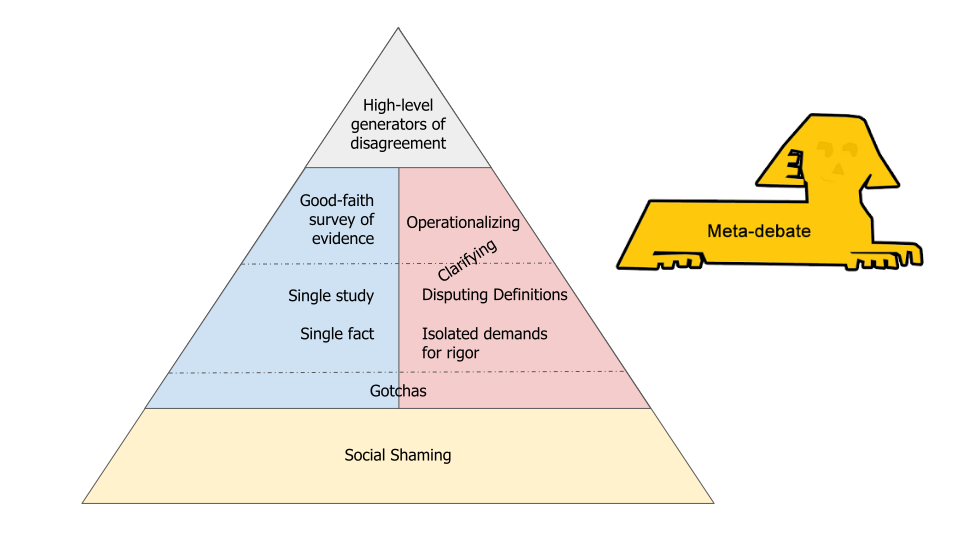
Trace the map of reasonable disagreement. Break arguments into statements, rate confidence and importance, and find the crux.

Reflexive discourse analysis: A methodology for the practice of reflexivity
How to implement reflexivity in practice? Can the knowledge we produce be emancipatory when our discourses recursively originate in the world we aim to challenge? Critical International Relations (IR) scholars have successfully put reflexivity on the agenda based on the theoretical premise that discourse and knowledge play a socio-political role. However, academics often find themselves at a loss when it comes to implementing reflexivity due to the lack of adapted methodological and pedagogical material. This article shifts reflexivity from meta-reflections on the situatedness of research into a distinctive practice of research and writing that can be learned and taught alongside other research practices. To do so, I develop a methodology based on discourse: reflexive discourse analysis (RDA). Based on the discourse analysis of our own discourse and self-resocialisation, RDA aims to reflexively assess and transform our socio-discursive engagement with the world, so as to render it consistent with our intentional socio-political objectives. RDA builds upon a theoretical framework integrating discourse theory to Bourdieu’s conceptual apparatus for reflexivity and practices illustrated in the works of Comte and La Boétie. To illustrate this methodology, I used this very article as a recursive performance. I show how RDA enabled me to identify implicit discriminative mechanisms within my discourse and transform them into an alternative based on love, to produce an article more in line with my socio-political objectives. Overall, this article turns reflexivity into a critical methodology for social change and demonstrates how to integrate criticality methodologically into research and writing.
Theories of Truth: A Critical Introduction
Theories of Truth provides a clear, critical introduction to one of the most difficult areas of philosophy. It surveys all of the major philosophical theories of truth, presenting the crux of the issues involved at a level accessible to nonexperts yet in a manner sufficiently detailed and original to be of value to professional scholars. Kirkham's systematic treatment and meticulous explanations of terminology ensure that readers will come away from this book with a comprehensive general understanding of one of philosophy's thorniest set of topics.Included are discussions of the correspondence, coherence, pragmatic, semantic, performative, redundancy, appraisal, and truth-as-justification theories. There are also chapters or sections of chapters on the liar paradox, three-valued logic, Field's critique of Tarski, Davidson's program, Dummett's theory of linguistic competence, satisfaction, recursion, the extension/intension distinction, and an explanation of how theories of justification, properly understood, differ from theories of truth.A persistent theme is that philosophers have too often failed to recognize that not all theories of truth are intended to answer the same question. When the various questions are made distinct, it is apparent that many of the "debates" in this field are really cases of philosophers talking past one another. There is much less disagreement within the field than has commonly been thought.

Hey @alexbenzer.com, we're having a discussion on the Discourse that could use your input. #atproto

A lexicon for game activity sharing
discourse.atmosphere.community