

These three things—a biological hurricane, computational social science, and the rediscovery of experimentation—are going to change the social sciences in the 21st century. With that change will come, in my judgment, a variety of discoveries and opportunities that offer tremendous prospect for improving the human condition.
New Studies: How Commercial Forces Make Science Less Reliable
Computational social science has been distorted by commercial forces, and AI is making it worse.


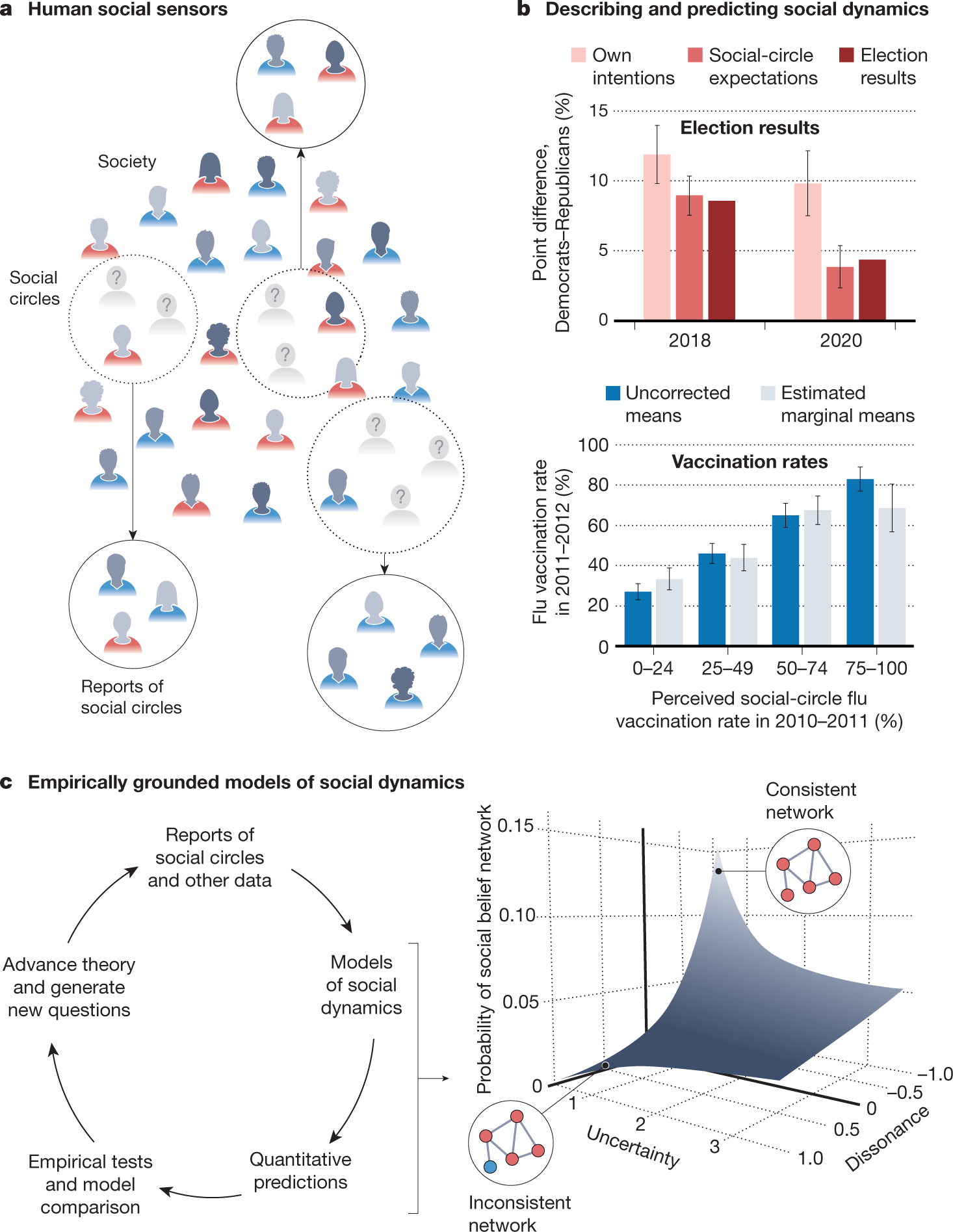
Human social sensing is an untapped resource for computational social science
The ability to ‘sense’ the social environment and thereby to understand the thoughts and actions of others allows humans to fit into their social worlds, communicate and cooperate, and learn from others’ experiences. Here we argue that, through the lens of computational social science, this ability can be used to advance research into human sociality. When strategically selected to represent a specific population of interest, human social sensors can help to describe and predict societal trends. In addition, their reports of how they experience their social worlds can help to build models of social dynamics that are constrained by the empirical reality of human social systems.
Field Theory: AI as Social Science Question, Object & Tool
Uses of advanced artificial intelligence are changing how societies organize labor, govern, produce knowledge, and make meaning. In light of these developments, this essay argues that AI models, tools, and systems pose three interrelated imperatives for social science: they demand renewed attention to social theories of how technology, human experience, and social order are entangled; they require study as objects of inquiry in their own right; and they offer capabilities that may transform—or upend—the practice of social investigation itself. From Weber’s analysis of rationalization to Du Bois’s study of technology and inequality to contemporary scholarship on algorithmic governance, the essay examines what social science distinctively offers: the capacity to historicize the apparently unprecedented, to trace connections across scales, and to center those most affected by technological change. It identifies how algorithmic systems are remaking the distribution of opportunity and risk as a central task of social inquiry and asks what futures social science might help bring into being.
Rebuilding the Architecture of Science
Science built the modern world. It’s time to rebuild the world of science.
The End of Science? Agnosis and American Fascism
The Society for Social Studies of Science (4S) annually awards the John Desmond Bernal Prize to one or more individuals who have made distinguished contributions to the field of Science and Technology Studies. Past winners have included founders of the field, along with outstanding scholars who have devoted their careers to understanding the social dimensions of science and technology. This article is the revised text of the 2025 Bernal Lecture by Paul Edwards.

Manoel Horta Ribeiro (@manoelhortaribeiro.bsky.social)
Assistant Professor @ Princeton Previously: EPFL 🇨🇭, UFMG 🇧🇷 Interests: Computational Social Science, Platforms, GenAI, Moderation

The Current Crisis: What's Happening to Science in America
Will AI ruin the social sciences — or revolutionize them?
The technology can whip up spurious findings and pollute survey responses, but it could also make research more rigorous.
New Things Under the Sun
New Things Under the Sun is a living literature review on social science research about innovation. Articles come in two flavors:

Science has been in a “replication crisis” for a decade. Have we learned anything?
Bad papers are still published. But some other things might be getting better.

Why Psychology Hasn’t Had a Big New Idea in Decades
Can our field get its act together?

The Biology of Human Behavior: Robert Sapolsky's Key Insights — Trending Sideways
Today you can do something that wasn't possible for any previous generation. You can take a class from a Stanford professor without paying a dime. For the

Frontiers In Research webinar on changes in science communication, the role of social media, and new infrastructure/tools - tomorrow (7/18) at 2 pm ET Looking forward to chatting with @ronentk.me & @joelchan86.bsky.social luma.com/7l18yyg4

Frontiers In Research: Open Science · Zoom · Luma
luma.comRemarkable how over a decade ago @michaelnielsen.bsky.social pointed the way towards solving long standing issues plaguing science to this day (issues that are all the more relevant in the age of AI mediated science)

Ronen Tamari
This is why @atproto.science is so relevant rn This compilation of essays indicates that scientists are most frustrated by insufficient “community tools and resources... Essential infrastructure for sharing, maintaining and building on existing work and data is also badly underdeveloped." >
