An autonomous agent is something that can both reproduce itself and do at least one thermodynamic work cycle. It turns out that this is true of all free-living cells, excepting weird special cases. They all do work cycles, just like the bacterium spinning its flagellum as it swims up the glucose gradient. The cells in your body are busy doing work cycles all the time.
Agentic AI, explained | MIT Sloan
The age of agentic AI — systems that are semi- or fully autonomous and can act on their own — has arrived. Here’s what you need to know, according to MIT experts.

Even a Single Bacterial Cell Can Sense the Seasons Changing | Quanta Magazine
Though they live only a few hours before dividing, bacteria can anticipate the approach of cold weather and prepare for it. The discovery suggests that seasonal tracking is fundamental to life.
Even a Single Bacterial Cell Can Sense the Seasons Changing | Quanta Magazine
Though they live only a few hours before dividing, bacteria can anticipate the approach of cold weather and prepare for it. The discovery suggests that seasonal tracking is fundamental to life.
A Drive to Survive
Since 2005, Karl Friston's proposal that the principle of free energy minimization underpins the purposive behavior of living agents has evolved through thou...
For the First Time, a Cell Built From Scratch Grows and Divides | Quanta Magazine
Scientists built a synthetic cell that combines more lifelike properties than ever before — proof of concept that it’s possible to bring nonliving materials to life, or something close to it, in the lab.
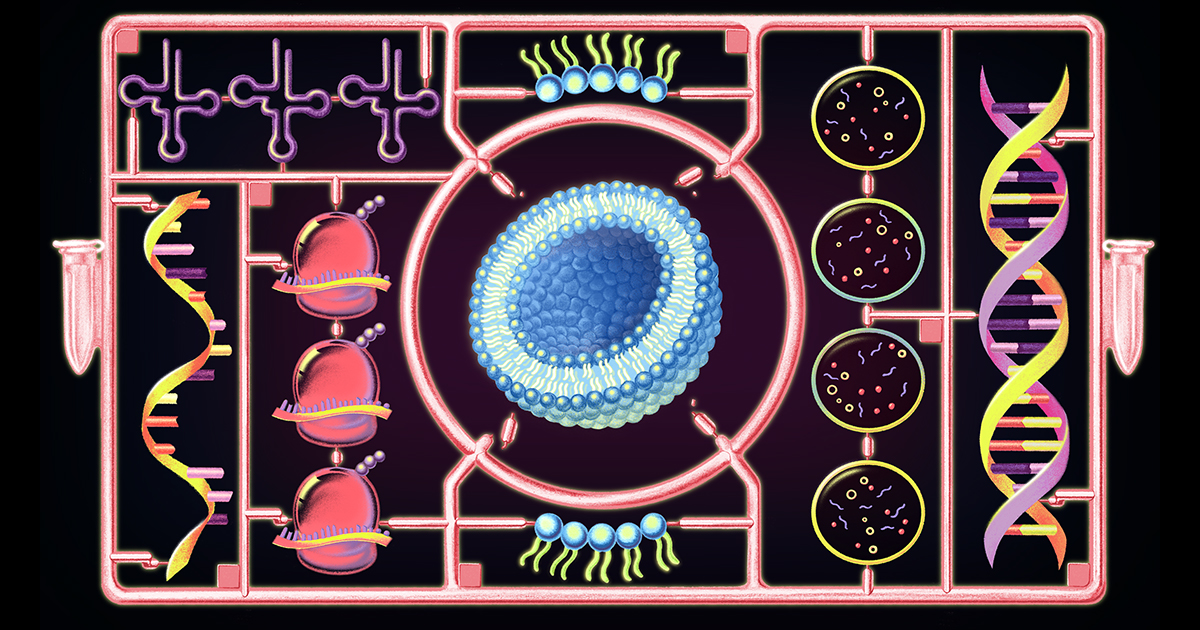
For the First Time, a Cell Built From Scratch Grows and Divides | Quanta Magazine
Scientists built a synthetic cell that combines more lifelike properties than ever before — proof of concept that it’s possible to bring nonliving materials to life, or something close to it, in the lab.
Steering yourself by the bootstraps: how cells create their own gradients for chemotaxis
Chemotaxis, where cell movement is steered by chemical gradients, is a widespread and essential way of organising cell behaviour. But where do the instructions come from – who makes gradients, and how are they controlled? We discuss the emerging concept that chemotactic cells often create attractant gradients at the same time as responding to them. This self-guidance is more robust, works across greater distances, and is more informative about the local environment than passive responses. Several mechanisms can establish autonomous gradients.

Is Life Just Different? | Quanta Magazine
The idea of ‘biological agency’ — that life devises its own goals and behaves accordingly — complicates our understanding of what it means to be alive. But does it serve a scientific purpose?
Rabrg/artificial-life
A simple (300 lines of code) reproduction of Computational Life: How Well-formed, Self-replicating Programs Emerge from Simple Interaction
E. coli chemotaxis: the baffling intelligence of a single cell
I want to tell the story of a beautiful phenomenon in biology. In some sense it’s the prototype of much of the activity of life. The phenomenon is the way in which an individual cell of E. coli forages for nutrients. This process, known as “chemotaxis”—the “chemo-” for chemical and the “taxis” from the Greek τάξις, for tactics—is intelligence in one of its most elemental forms. An individual E. coli has no brain, obviously, and is even many orders of magnitude simpler than a human cell, and yet already it possesses something like a sense of smell, drive, even a memory. Chemotaxis recasts E. coli not as some aimless gut-pest but rather as an exquisitely sophisticated physical computer.
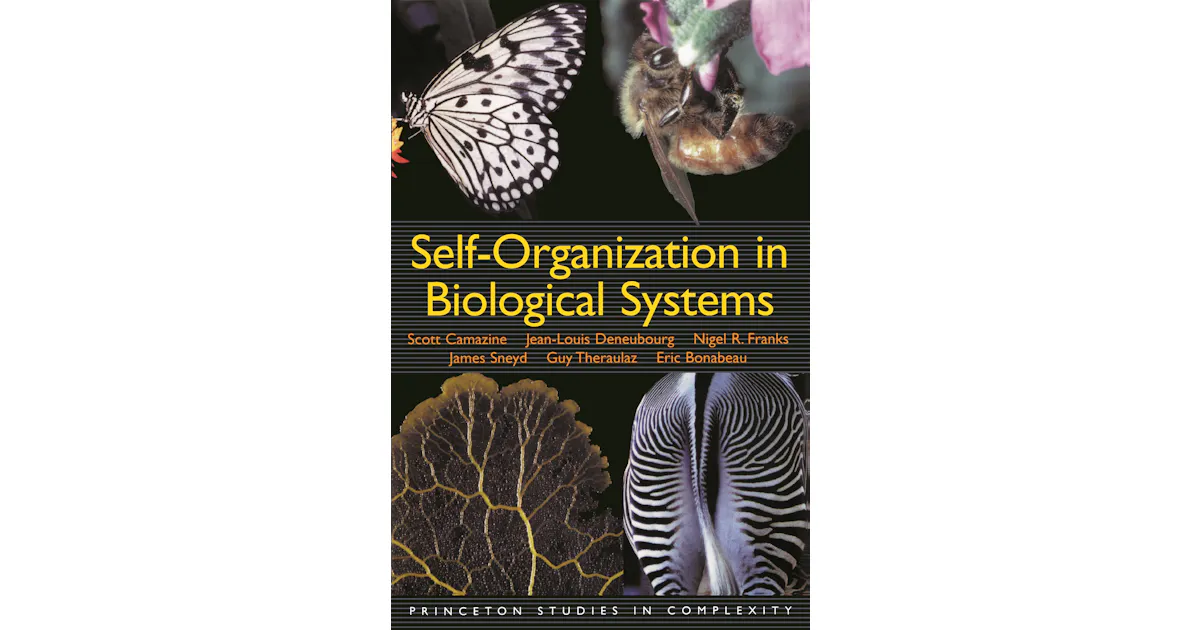
Self-Organization in Biological Systems
The synchronized flashing of fireflies at night. The spiraling patterns of an aggregating slime mold. The anastomosing network of army-ant trails. The coordinated movements of a school of fish. Researchers are finding in such patterns—phenomena that have fascinated naturalists for centuries—a fertile new approach to understanding biological systems: the study of self-organization. This book, a primer on self-organization in biological systems for students and other enthusiasts, introduces readers to the basic concepts and tools for studying self-organization and then examines numerous examples of self-organization in the natural world. Self-organization refers to diverse pattern formation processes in the physical and biological world, from sand grains assembling into rippled dunes to cells combining to create highly structured tissues to individual insects working to create sophisticated societies. What these diverse systems hold in common is the proximate means by which they acquire order and structure. In self-organizing systems, pattern at the global level emerges solely from interactions among lower-level components. Remarkably, even very complex structures result from the iteration of surprisingly simple behaviors performed by individuals relying on only local information. This striking conclusion suggests important lines of inquiry: To what degree is environmental rather than individual complexity responsible for group complexity? To what extent have widely differing organisms adopted similar, convergent strategies of pattern formation? How, specifically, has natural selection determined the rules governing interactions within biological systems? Broad in scope, thorough yet accessible, this book is a self-contained introduction to self-organization and complexity in biology—a field of study at the forefront of life sciences research.
Panel: Biodesign x AI: Interactions in the Algorithmic Wet Lab
All living cells are cognitive
All living cells sense and respond to changes in external or internal conditions. Without that cognitive capacity, they could not obtain nutrition essential for growth, survive inevitable ecological changes, or correct accidents in the complex processes of reproduction. Wherever examined, even the smallest living cells (prokaryotes) display sophisticated regulatory networks establishing appropriate adaptations to stress conditions that maximize the probability of survival. Supposedly "simple" prokaryotic organisms also display remarkable capabilities for intercellular signalling and multicellular coordination. These observations indicate that all living cells are cognitive.
How to understand cells, tissues and organisms as agents with agendas | Aeon Essays
Biology’s next great horizon is to understand cells, tissues and organisms as agents with agendas (even if unthinking ones)
Functional Information: Towards Synthesis of Biosemiotics and Cybernetics
Biosemiotics and cybernetics are closely related, yet they are separated by the boundary between life and non-life: biosemiotics is focused on living organisms, whereas cybernetics is applied mostly to non-living artificial devices. However, both classes of systems are agents that perform functions necessary for reaching their goals. I propose to shift the focus of biosemiotics from living organisms to agents in general, which all belong to a pragmasphere or functional universe. Agents should be considered in the context of their hierarchy and origin because their semiosis can be inherited or induced by higher-level agents. To preserve and disseminate their functions, agents use functional information - a set of signs that encode and control their functions. It includes stable memory signs, transient messengers, and natural signs. The origin and evolution of functional information is discussed in terms of transitions between vegetative, animal, and social levels of semiosis, defined by Kull. Vegetative semiosis differs substantially from higher levels of semiosis, because signs are recognized and interpreted via direct code-based matching and are not associated with ideal representations of objects. Thus, I consider a separate classification of signs at the vegetative level that includes proto-icons, proto-indexes, and proto-symbols. Animal and social semiosis are based on classification, and modeling of objects, which represent the knowledge of agents about their body (Innenwelt) and environment (Umwelt).

Headlong: a microharness for persistent agents
Self-guided agents that think continuously