

Copyright 1997 CAUSE. From CAUSE/EFFECT Volume 20, Number 2, Summer 1997, pp. 31-33, 38-40, 60. Permission to copy or disseminate all or part of this material is granted provided that the copies are not made or distributed for commercial advantage, the CAUSE copyright and its date appear, and notice is given that copying is by permission of CAUSE, the association for managing and using information resources in higher education. To disseminate otherwise, or to republish, requires written permission. For further information, contact Julia Rudy at CAUSE, 4840 Pearl East Circle, Suite 302E, Boulder, CO 80301 USA; 303-939-0308; e-mail: [email protected]
Innovation in Data Science Education
Data science is a new field of research focuses on extracting knowledge and value from data. The radical growth in recent years in the availability of data and of the computational resources required to process them, has led to a corresponding increase ...

Your Data, Your Control
How data portability can unlock competition and empower consumers January 15, 2026 Copyright and permission to reproduce For information on the Competition Bureau's activities, please contact: Information Centre Competition Bureau 50 Victoria Street Gatineau QC K1A 0C9
Collaboratory at Columbia: An Aspen Grove of Data Science Education · Issue 3.4, Fall 2021
Many universities recognize the rapidly growing impact of data science in all fields of study and the professions and seek to embed this expertise widely across their educational offerings. There is often broad interest in developing new data science curricula, with some universities even allocating funds toward this purpose. Yet, it is often unclear what resources are needed for effective data science education, and how resources ought to be prioritized. Although university leadership might be aware of a growing number of successful data science acceleration programs and pedagogical models, many of which are either general purpose or specific to a particular discipline, there remains a lack of clarity about how these models might address their own specific needs. This article presents the Collaboratory Program at Columbia University (termed “the Collaboratory”), which is both a set of “data science in context” educational approaches, as well as a meta-model for an accelerator program that allows different institutions to respond flexibly to their own disciplinary heterogeneity in terms of data science educational needs. The novelty of the Collaboratory lies in its crowd-sourcing approach to creating new data science pedagogy and its ability to kindle transdisciplinary collaboration in doing so. By offering seed funding, it fosters proactive efforts to embed data science “in context” into more traditional domains through a cohort of compelling, transdisciplinary, crowd-sourced data science education proposals each year. Collaboratory educational offerings are required to be developed through a partnership between two faculty members, a data scientist and a domain expert from another field, or a larger team with complementary expertise. Over the past 5 years, the Collaboratory has supported the development of a wide spectrum of data science pedagogical models spread across more than 40 academic departments, centers, institutes, and professional schools at Columbia University. As a result, the Collaboratory has to date served the learning needs of more than 4,000 students. Furthermore, it has cultivated a thriving ecosystem that includes a funding mechanism and a community-support structure that all contribute to its agility and success. Here, we offer our experience and best practices in developing and managing the Collaboratory, which, we hope, will contribute to a blueprint for data science education leaders everywhere.

Intro_to_Awareness_and_Competency_in_Data_Governance
Thread 5 Introduction: ICT Awareness & Competency in Data Governance https://www.aliexpress.com/item/33004770035.html 1 May 4, 2021 Moore’s Law Prepared by: Ken Lazarus Ben Koo

Broadening Access to Data Science Education in High School and Higher Education through Open Source Tools, Infrastructure, and Training
Equitable data science education requires a multifaceted approach, involving high school and higher education, community involvement, and accessible tools. A renewed investment in public digital infrastructure is needed to support these efforts. Nonprofits play a crucial role in supporting these efforts, and increased representation in leadership can enhance their impact. By addressing these disparities, we can ensure a more inclusive future in data science.
Perspective Chapter: Fit for Purpose? Creative Commons Licensing for Research Data in the Age of Artificial Intelligence
Licensing is an important component of the re-usability of research data, itself part of the FAIR principles: without clear, machine-readable licensing, datasets risk becoming technically...

Adopting Foundational Data Science Curriculum with Diverse Institutional Contexts
This summary was generated using automated tools and was not authored or reviewed by the article's author(s). It is provided to support discovery, help readers assess relevance, and assist readers from adjacent research areas in understanding the work. It is intended to complement the author-supplied abstract, which remains the primary summary of the paper. The full article remains the authoritative version of record. Click here to learn more.

Data Leverage: A Framework for Empowering the Public in its...
Many powerful computing technologies rely on implicit and explicit data contributions from the public. This dependency suggests a potential source of leverage for the public in its relationship...

Can “Conscious Data Contribution” Help Users to Exert “Data Leverage” Against Technology Companies?
Tech users currently have limited ability to act on concerns regarding the negative societal impacts of large tech companies. However, recent work suggests that users can exert leverage using their role in the generation of valuable data, for instance by withholding their data contributions to intelligent technologies. We propose and evaluate a new means to exert this type of leverage against tech companies: "conscious data contribution" (CDC).
Broadening Access to Data Science Education: Open Source Tools and Training in High School and Higher Education · Issue 8.3, Summer 2026
As data play a more integral part to our daily lives, there is a growing need for data science education. However, access to curriculum, tooling, and infrastructure is not readily available to many students in the United States. We review the current state of data science education tools and implementations as well as highlight a set of emerging tools and technologies. We conclude that broadening data science education requires a multifaceted approach, involving technological accessibility, instructional equity, curricular relevance, and long-term sustainability.

Building Bridges for Data Science Education
As part of the Digital Library's transition to Open Access, new features for researchers are available in the Premium Edition. Click here to learn more.

3 Powerful Takeaways from the National Workshop on Data Science Education
As the field flourishes, there is much we can do to benefit its countless students.

Data Scientist: The Sexiest Job of the 21st Century
Back in the 1990s, computer engineer and Wall Street “quant” were the hot occupations in business. Today data scientists are the hires firms are competing to make. As companies wrestle with unprecedented volumes and types of information, demand for these experts has raced well ahead of supply. Indeed, Greylock Partners, the VC firm that backed Facebook and LinkedIn, is so worried about the shortage of data scientists that it has a recruiting team dedicated to channeling them to the businesses in its portfolio. Data scientists are the key to realizing the opportunities presented by big data. They bring structure to it, find compelling patterns in it, and advise executives on the implications for products, processes, and decisions. They find the story buried in the data and communicate it. And they don’t just deliver reports: They get at the questions at the heart of problems and devise creative approaches to them. One data scientist who was studying a fraud problem, for example, realized it was analogous to a type of DNA sequencing problem. Bringing those disparate worlds together, he crafted a solution that dramatically reduced fraud losses. In this article, Harvard Business School’s Davenport and Greylock’s Patil take a deep dive on what organizations need to know about data scientists: where to look for them, how to attract and develop them, and how to spot a great one.

Broadening Access to Data Science Education in High School and Higher Education through Open Source Tools and Training
As data plays a more integral part to our daily lives, there is a growing need for data science education. However, access to curriculum, tooling, and infrastructure is not readily available to many students in the U.S. We review the current state of data science education tools and implementations as well as highlight a set of emerging tools and technologies. We conclude that broadening data science education requires a multifaceted approach, involving technological accessibility, instructional equity, curricular relevance, and long-term sustainability.
Data Feminism
Today, data science is a form of power. It has been used to expose injustice, improve health outcomes, and topple governments. But it has also been used to d...
dc: data provenance and source attribution

Part of the datacounterfactuals.org reading lists. Research on data provenance, dataset documentation, licensing and attribution audits, and technical source-attribution methods for understanding which data sources are available, permitted, or responsible for model behavior.
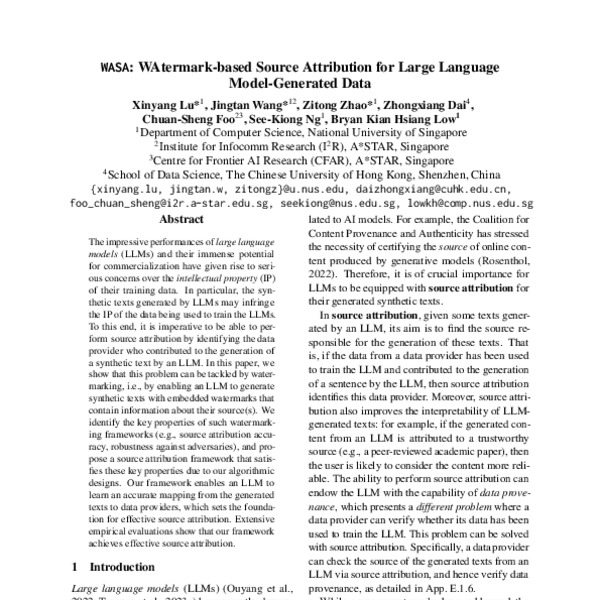
WASA: WAtermark-based Source Attribution for Large Language Model-Generated Data
SILO Language Models: Isolating Legal Risk In a Nonparametric Datastore
Datasheets for Datasets
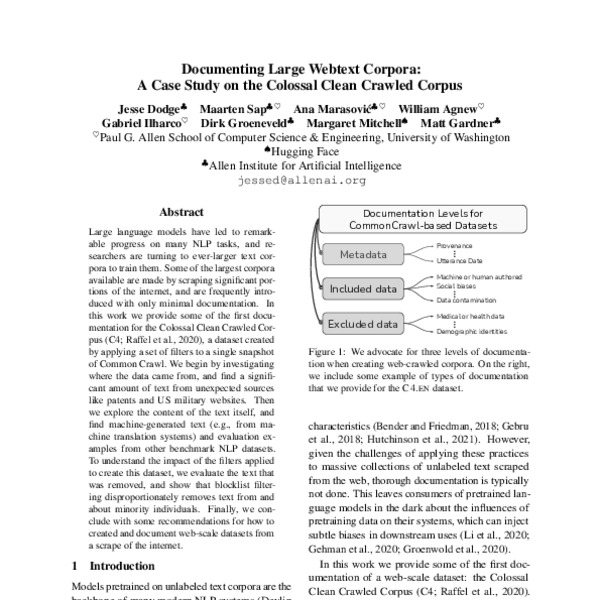
Documenting Large Webtext Corpora: A Case Study on the Colossal Clean Crawled Corpus

A large-scale audit of dataset licensing and attribution in AI