


Like FLoC and Privacy Sandbox before it, Google Chrome’s Manifest V3 is another example of the inherent conflict of interest that comes from Google controlling both the dominant web browser and one
Google’s Chrome Antitrust Paradox
This Article examines Google’s dominance of the browser market, highlighting how Google’s Chrome browser plays a critical role in reinforcing Google’s dominance in other markets. While Google portrays Chrome as a neutral platform built on open-source technologies, this Article shows that Chrome is, in fact, instrumental in Google’s strategy to reinforce its dominance in the online advertising, publishing, and browser markets. The examination of Google’s strategic acquisitions, anticompetitive practices, and the implementation of so-called “privacy controls” underlines that Chrome is far from a neutral gateway to the web. Rather, it serves as a key tool for Google to maintain and extend its market power, often to the detriment of competition and innovation in the digital economy.This Article illustrates how Chrome not only bolsters Google’s position in online advertising and publishing through practices such as coercion and self-preferencing, but also leverages its advertising clout to engage in a “pay-to-play” paradigm—the cornerstone of Google’s larger strategy of market control. It also outlines potential regulatory interventions and remedies by drawing on historical antitrust precedents. Lastly, this Article proposes a triad of solutions motivated by an analysis of Google’s abuse of Chrome, including behavioral remedies targeting specific anticompetitive practices, structural remedies involving an internal separation of Google’s divisions, and divestiture of Chrome from Google into an independent organization.Despite Chrome’s dominance and its critical role in Google’s ecosystem, as well as its recent legal troubles with the Department of Justice, it so far has avoided significant antitrust action. A key reason for this inaction lies in the long-standing precedent supporting the hegemony of technology firms and the uncertainty surrounding Chrome’s viability as a standalone entity. This Article attempts to address these issues to enable antitrust actions that are essential in remedying current market imbalances. Such actions are also critical to mitigate future threats to competition from an increasingly monopolistic technology landscape, thereby fostering a competitive digital environment that promotes innovation and protects consumer interests.
Privacy vs. Profit: The Impact of Google's Manifest Version 3 (MV3) Update on Ad Blocker Effectiveness
Google's recent update to the manifest file for Chrome browser extensions, transitioning from manifest version 2 (MV2) to manifest version 3 (MV3), has raised concerns among users and ad blocker providers, who worry that the new restrictions, notably the shift from the powerful WebRequest API to the more restrictive DeclarativeNetRequest API, might reduce ad blocker effectiveness. Because ad blockers play a vital role for millions of users seeking a more private and ad-free browsing experience, this study empirically investigates how the MV3 update affects their ability to block ads and trackers. Through a browser-based experiment conducted across multiple samples of ad-supported websites, we compare the MV3 to MV2 instances of four widely used ad blockers. Our results reveal no statistically significant reduction in ad-blocking or anti-tracking effectiveness for MV3 ad blockers compared to their MV2 counterparts, and in some cases, MV3 instances even exhibit slight improvements in blocking trackers. These findings are reassuring for users, indicating that the MV3 instances of popular ad blockers continue to provide effective protection against intrusive ads and privacy-infringing trackers. While some uncertainties remain, ad blocker providers appear to have successfully navigated the MV3 update, finding solutions that maintain the core functionality of their extensions.

Forget the Fate of Chrome, Focus on the Fate of the Browser
In debating what undoubtedly won't happen, we're looking past some key things that are -- and might...

Google can keep its Chrome browser but will be barred from exclusive contracts | Hacker News
Chrome
Google Chrome is a browser that combines a minimal design with sophisticated technology to make the web faster, safer, and easier.
Review | Goodbye, Chrome: Google’s Web browser has become spy software
Our latest privacy experiment found Chrome ushered more than 11,000 tracker cookies into our browser — in a single week.

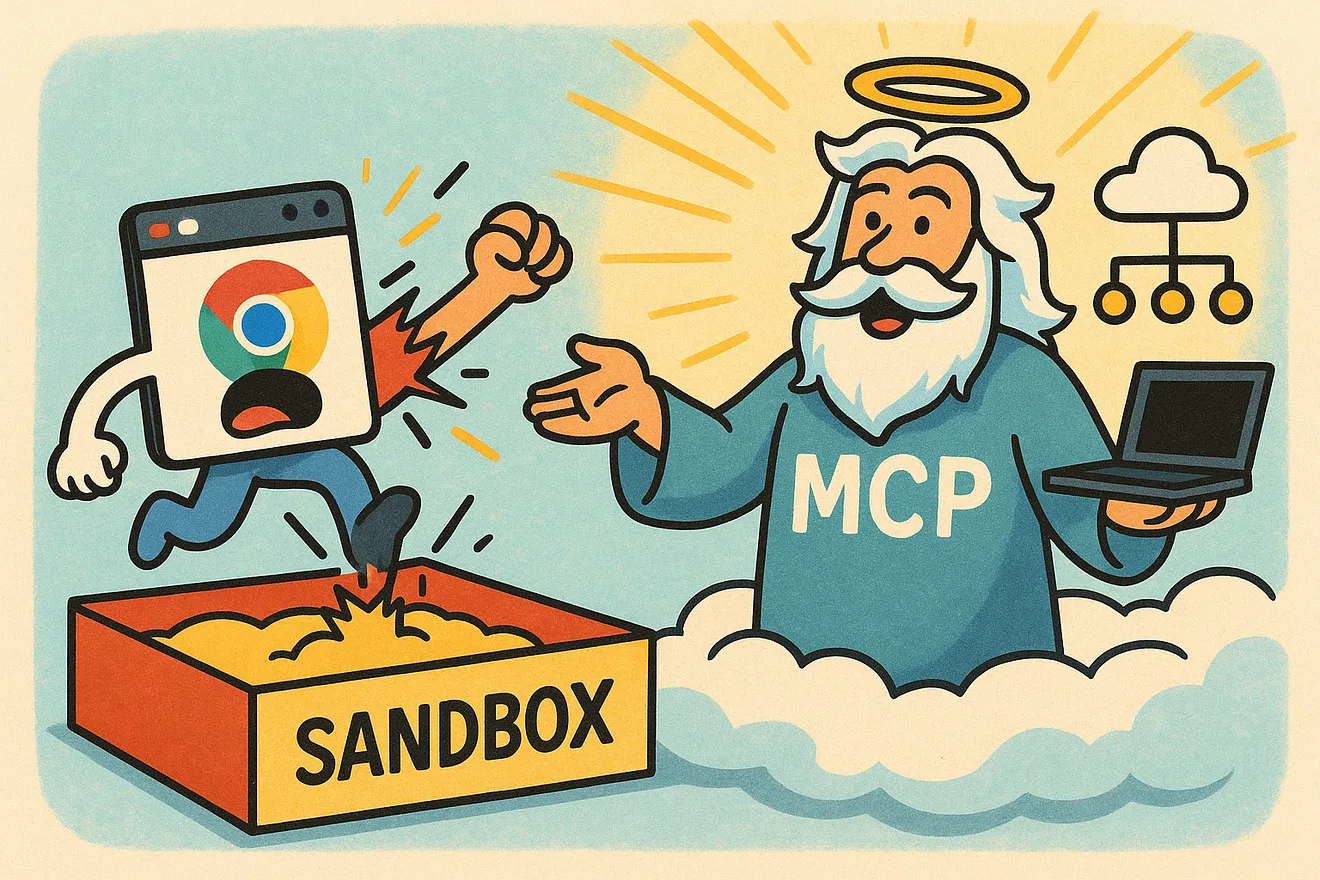
Trust Me, I’m Local: Chrome Extensions, MCP, and the Sandbox Escape
Trust Me, I’m Local reveals how Chrome extensions and MCP abuses enabled sandbox escapes, exposing users to major security vulnerabilities.
Boom. The Justice Department is seeking "structural remedies," e.g., potential breakup of Google, including Android, Chrome, and the Play Store. But that's not all. It's a sweeping framework to match the sweeping effect of Google's monopoly. 🧵
Boom. The Justice Department is seeking "structural remedies," e.g., potential breakup of Google, including Android, Chrome, and the Play Store.But that's not all. It's a sweeping framework to match the sweeping effect of Google's monopoly. 🧵 pic.twitter.com/LO9cMkhcUI— Lee Hepner (@LeeHepner) October 9, 2024

Introduction to Google Chrome Extensions
Our commitment to a more capable web
Since the beginning of Chrome we have worked to provide a solid foundation for modern web applications. Those capabilities have enabled new...

Announcing Supporters of Chromium-based Browsers
Since Google announced the Chromium project in 2008, we have been excited to build on the great foundations of open-source web browsers and contribute to the continued d…

How To Turn Off Google’s “Privacy Sandbox” Ad Tracking—and Why You
Google has rolled out "Privacy Sandbox," a Chrome feature first announced back in 2019 that, among other things, exchanges third-party cookies—the most common form of tracking technology—for what the
What Comes After Chrome
I co-created the world's most popular browser. Now, I'm joining The Browser Co to fulfill an old dream.

DOJ says Google must sell Chrome to crack open its search monopoly
Divesting Android is still on the table.

Chrome looks set to ship an LLM Prompt API to the web platform. At Mozilla, we oppose this API. We feel it has a large interoperability risk, and Google imposing T&Cs on a web API sets a dangerous precedent. Full details: github.com/mozilla/standards-positions/i…

Prompt API · Issue #1213 · mozilla/standards-positions
github.com
