

Knowledge production doesn’t happen in a vacuum. Every great scientific breakthrough is built on prior work, and an ongoing exchange with peers in the field. That’s why we need to address the threat
Science has been in a “replication crisis” for a decade. Have we learned anything?
Bad papers are still published. But some other things might be getting better.

The Engine of Scientific Discovery: How New Methods and Tools Spark Major Breakthroughs
Abstract. How do we spark new scientific discoveries? Why do some breakthroughs seem even accidental? And most importantly, how can we accelerate them and
The Bazaar of Scientific Knowledge | shishyko!
What if we didn't collapse all the knowledge from the scientific process into one paper?
The Drain of Scientific Publishing
The domination of scientific publishing in the Global North by major commercial publishers is harmful to science. We need the most powerful members of the research community, funders, governments and Universities, to lead the drive to re-communalise publishing to serve science not the market.

The Bazaar of Scientific Knowledge | shishyko!
Is the current form of the scientific paper still optimal in 2025? How do we preserve, and efficiently leverage, the uncut gems of the scientific process?
The Current Crisis: What's Happening to Science in America
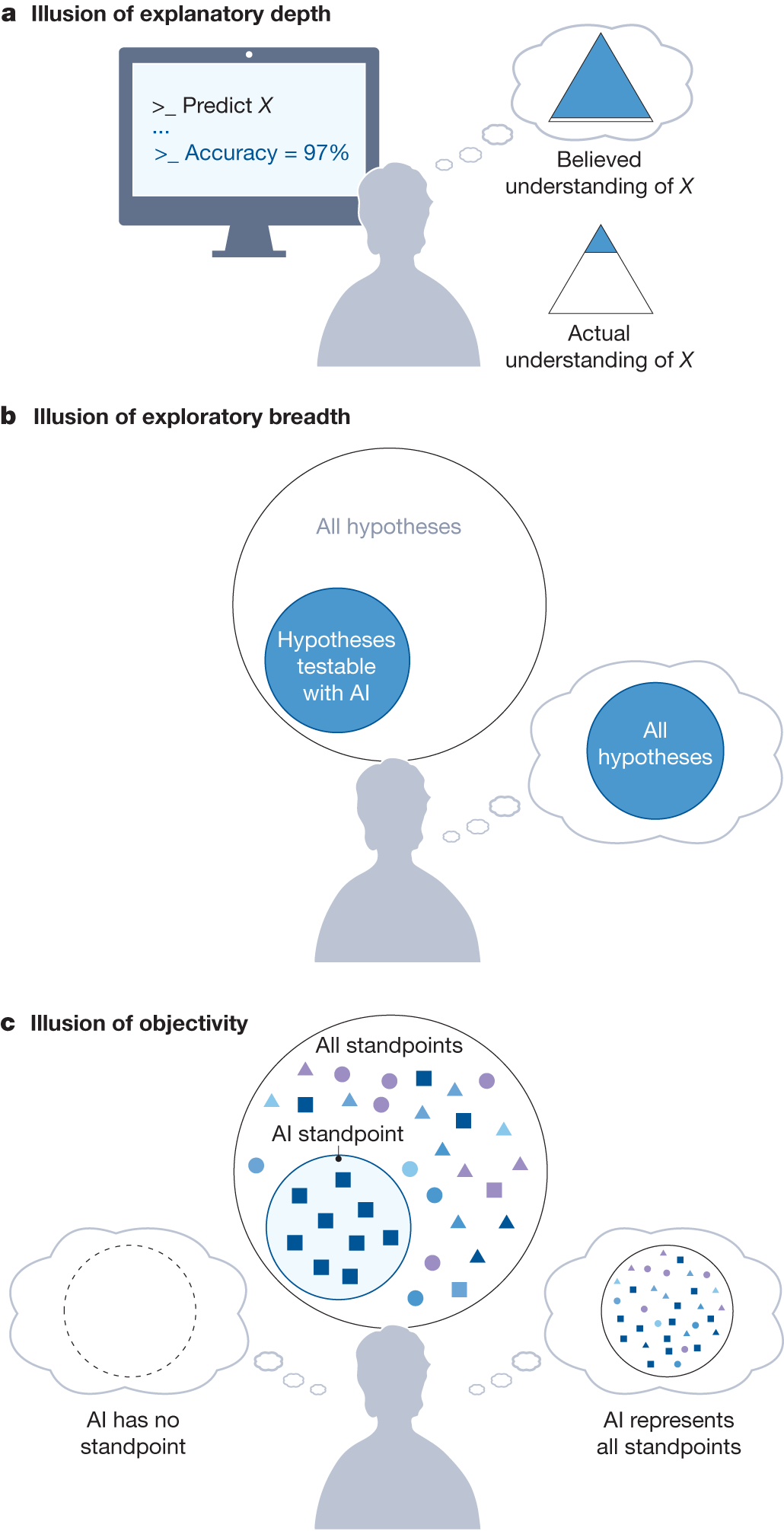
Artificial intelligence and illusions of understanding in scientific research
Scientists are enthusiastically imagining ways in which artificial intelligence (AI) tools might improve research. Why are AI tools so attractive and what are the risks of implementing them across the research pipeline? Here we develop a taxonomy of scientists’ visions for AI, observing that their appeal comes from promises to improve productivity and objectivity by overcoming human shortcomings. But proposed AI solutions can also exploit our cognitive limitations, making us vulnerable to illusions of understanding in which we believe we understand more about the world than we actually do. Such illusions obscure the scientific community’s ability to see the formation of scientific monocultures, in which some types of methods, questions and viewpoints come to dominate alternative approaches, making science less innovative and more vulnerable to errors. The proliferation of AI tools in science risks introducing a phase of scientific enquiry in which we produce more but understand less. By analysing the appeal of these tools, we provide a framework for advancing discussions of responsible knowledge production in the age of AI.
It’s time to get rid of the peer-reviewed paper
The peer-reviewed journal article, perhaps the single most important device behind the expansion of scientific knowledge in the last century, is an extraordinarily expensive way to share novelty: e…

Science Communication as a Collective Intelligence Endeavor: A Manifesto and Examples for Implementation
Effective science communication is challenging when scientific messages are informed by a continually updating evidence base and must often compete against misinformation. We argue that we need a new program of science communication as collective intelligence—a collaborative approach, supported by technology. This would have four key advantages over the typical model where scientists communicate as individuals: scientific messages would be informed by (a) a wider base of aggregated knowledge, (b) contributions from a diverse scientific community, (c) participatory input from stakeholders, and (d) better responsiveness to ongoing changes in the state of knowledge.

AI as the Catalyst of the New Paradigm of Science? | Cadmus Journal
The rapid advancement of Artificial Intelligence (AI) is reshaping the landscape of scientific inquiry. This article examines the challenges confronting modern science, including knowledge fragmentation, diminishing returns of current paradigms, and the disconnect between science and society. It explores how AI offers solutions enhancing collaboration and integrating knowledge—as well as considers the possible “darker side” of using AI in research. However, the advent of AI in science not only enhances scientific research but also redefines the role of human researchers and fosters a new paradigm of human understanding. By embracing these transformations, a more cohesive and responsive scientific enterprise can emerge.
Building Collective Intelligence Networks for Flourishing Scientific Communities
Scientific communities are straining under mounting challenges—knowledge fragmentation, outdated publication processes, institutional erosion and funding cuts—that threaten our capacity to address urgent global problems. Traditional scientific process
Push-button science
Technological advances change not only what we can learn as scientists, but also how science is conducted. Here we explore how automation and outsourcing are affecting the act of doing science.
Involuntary collaboration: a strategy for decentralized science
How your best co-worker, might be someone you’ll never meet
Why we don’t really know what the public thinks about science
Measuring trust isn’t enough. Furthering knowledge about the institutions and norms of science is the best way to build credibility.
The Discovery Engine: A Framework for AI-Driven Synthesis and Navigation of Scientific Knowledge Landscapes
Scientific progress relies on the effective accumulation, synthesis, and critical evaluation of knowledge. Traditionally, the well-documented, peer reviewed publication served as the primary standard for filtering and disseminating credible findings within the scientific community. Recently, however, we are witnessing an unprecedented acceleration in research output, a veritable explosion of scientific publications across all disciplines [1]. Yet, this very abundance creates a paradox: the sheer volume threatens to overwhelm the mechanisms designed for its assimilation and synthesis. Researchers, even within highly specialized subfields, face an almost insurmountable challenge in keeping abreast of relevant developments, integrating disparate findings, and identifying the truly novel signals amidst the noise [2]. This information overload contributes to disciplinary fragmentation, hindering the cross-pollination of ideas essential for disruptive innovation [3]. Furthermore, persistent concerns regarding "reproducibility crisis" [2], predatory journals, inflation of research areas[4], growing retractions and the potential influences of bibliometrics on research direction [5] highlight systemic challenges in validating and prioritizing scientific contributions to fundamental knowledge.
Great post! There is a clear parallel to how the @atproto.science ecosystem can disrupt the extractive science publishing industry & bring on millions of researchers with a new cooperative research stack. The system is ripe for disruption - see also @edhagen.net's post in the thread linked below >

Joe Basser
Who wants to make money in the Atmosphere? 🙋♂️
