

Update: On August 5, 2026, The Senate Commerce Committee voted 15-13 to advance this bill, but the bill did not advance because of a lack of Senators in attendance. EFF continues to oppose the bill.
The SCREEN Act is a Christian Nationalist Nightmare
Mike Lee's SCREEN Act, which heads to Senate Commerce Committee for markup on Wednesday, would expand age verification requirements to a nearly limitless scope of websites, and is supported by the architects of Project 2025.
The Senate Should Reject KOSA's Privacy Risks
The Senate Commerce Committee is once again considering legislation that would dramatically expand age verification, and undermine privacy for everyone. Alongside the SCREEN Act, the CHATBOT Act, and
Site Blocking and Age Verification for Twitter, Instagram, Snap and Twitch?: Age Verification Lobby Confirms it Wants Bill S-210 to Cover All Social Media Sites - Michael Geist
Bill S-210 - the Protecting Young Persons from Exposure to Pornography Act - burst onto the public scene late last year as a majority of the House voted for the bill at second reading, sending it to the Public Safety committee for review. The bill, which is the brainchild of Senator Julie Miville-Dechêne, was supported by the Conservatives, Bloc and NDP with a smattering of votes from backbench Liberal MPs (the cabinet voted against, signalling it is not supported by the government). The bill raises significant concerns with the prospect of government-backed censorship, mandated age verification to use search engines or social media, and a framework for court-ordered website blocking (I appeared before the Senate committee that studied by the bill in February 2022, arguing that “by bringing together website blocking, face recognition technologies, and stunning overbreadth that would capture numerous mainstream services, the bill isn’t just a slippery slope, it is an avalanche.”). In response to the public criticism of the bill, Senator Julie Miville-Dechêne has suggested that concerns about it extending to general purpose social media sites is overstated since the intent is to target adult content sites. Yet that is not what the bill provides as it applies to anyone who makes sexually explicit material available on the Internet for commercial purposes:
Act Now to Stop California’s Paternalistic and Privacy-Destroying
California lawmakers are fast-tracking A.B. 1709—a sweeping bill that would ban anyone under 16 from using social media and force every user, regardless of age, to verify their identity before
U.S. Social Media Regulations for Minors
The digital lives of American children and teenagers have become a focal point of intense national debate and legislative action. ContentsThe Federal Foundation: The Children’s Online Privacy Protection Act (COPPA)The State-Level Surge: A Patchwork of New RulesThe Next Generation of Federal Law: Congress Weighs InThe Constitutional Crossroads: Free Speech vs. State RegulationThe Great Debate: Voices […]

Ohio's New Porn Age Verification Law: Big Brother Dressed Up as Child Protection - Nick's Blog
Ohio's new age verification law requiring ID to access adult websites (starting September 29, 2025) fails to protect children while forcing adults to surrender personal data to access legal content. This "small government" Republican law creates a surveillance system that invades privacy without addressing the real online dangers kids face.
Supreme Court Upholds Age Verification: A Game-Changer for Child Online Safety Laws – Public Interest Privacy Center
Online Safety Amendment (Social Media Minimum Age) Act 2024
The Online Safety Amendment Act 2024 is an Australian act of parliament that prohibits minors under the age of 16 from holding an account on certain social media platforms. It is an amendment to the Online Safety Act 2021 and was passed by the Parliament of Australia on 29 November 2024. It imposes monetary penalties on social media companies that fail to take reasonable steps to prevent minors under 16 that are located in Australia from having accounts on their services.

#cybersafety #ageverification #privacy #minors #ai | Parry Aftab
Internet Age-Verification Causing More Risks than It’s Worth This is not a new issue. Regulators and policymakers have raised it for the last 28 years as the way the keep kids safer online. They compare it to having to flash an ID to purchase regulated content or items (porn, cigarettes, alcohol, restricted medications, age-restricted movies, amusement rides, etc.) But verification online is very different and vastly riskier than flashing an ID in real life. For one, it’s collecting personally-identifiable information about our kids. For two, it puts that information in the too-often untrustworthy digital hands of tech companies. For three, while porn, alcohol and regulated drugs may be a clear-cut case for restricting access to adults, access to the Internet is very different. Yet, regulations begun in the UK and adopted globally have begun a weighted cybersafety approach that, in my humble opinion, prefers excluding young people from digital technology over teaching the cybersafety and digital life skills. That, in my 32 years of work in the fields of cybersafety and protection of minors online, was and remains a mistake. One of my best known quotes, repeated in Congressional and state legislative testimony and in the media is: “The greatest single risk our children face online is being denied access. We have solutions for everything else.” (my testimony before the FTC) Some proponents of age-verification have opted to denying them access unless they give up confirmable personally-identifiable info, such as selfies, feeding AI with PII, and govt or school credentials. I argue that this gives social networks, game providers and digital app operators a wealth of PII to be used for profiling, marketing and collecting far too much. With their privacy at stake, too often incompetent, malicious and greedy producers and mega-tech industry players, can’t and shouldn’t be trusted with the personal info of our most vulnerable - our kids. And AI will now be tasked with collecting everything it can find about our kids to be able to “age-verify.” (It’s ability to age-verify is less reliable with youth as their data-sets are more limited.) I served on a task force appointed by 49 state attorneys general, charged to research and weigh-in on this issue. We concluded that age-verification wasn’t feasible. While this task force was formed many years ago, with the exception of a fortified AI, not much as changed. Our children’s privacy remains, or should remain, paramount. We have robust filtering and blocking technologies. The adult industry has adopted an age-gated model. And parents can restrict access using device-specific tools. And, many well-intentioned age-verification laws were adopted too quickly for thoughtful discourse. Or by governments more prone to censorship/content restrictions. I fear in our quest to protect our kids we have thrown our babies out with the bath water. #cybersafety #ageverification #privacy #minors #AI

The Year States Chose Surveillance Over Safety: 2025 in Review
2025 was the year age verification went from a fringe policy experiment to a sweeping reality across the United States. Half of the U.S. now mandates age verification for accessing adult content or
Bill C-22’s Groundhog Day: Why the Government’s Dismissal of Signal, Apple and the U.S. Congress Concerns Runs Back the Disastrous Online News Act Playbook - Michael Geist
Secure messaging service Signal yesterday became the latest company to warn that Bill C-22, the lawful access bill, could force it to leave the Canadian market rather than comply with provisions it says would compromise its end-to-end encryption and create new cybersecurity risks. Signal vice-president Udbhav Tiwari told the Globe and Mail that the company “would rather pull out of the country than be compelled to compromise on the privacy promises we have made to our users.” The comments are part of a steady stream of similar warnings from Apple, Meta, the Canadian Chamber of Commerce, the Cybersecurity Advisors Network, and the chairs of the U.S. House Judiciary and Foreign Affairs Committees. Despite growing concern, the government’s response has been to launch a misleading social media campaign and repeatedly insist that the experts and companies are mistaken.

Text - S.1748 - 119th Congress (2025-2026): Kids Online Safety Act
Text for S.1748 - 119th Congress (2025-2026): Kids Online Safety Act
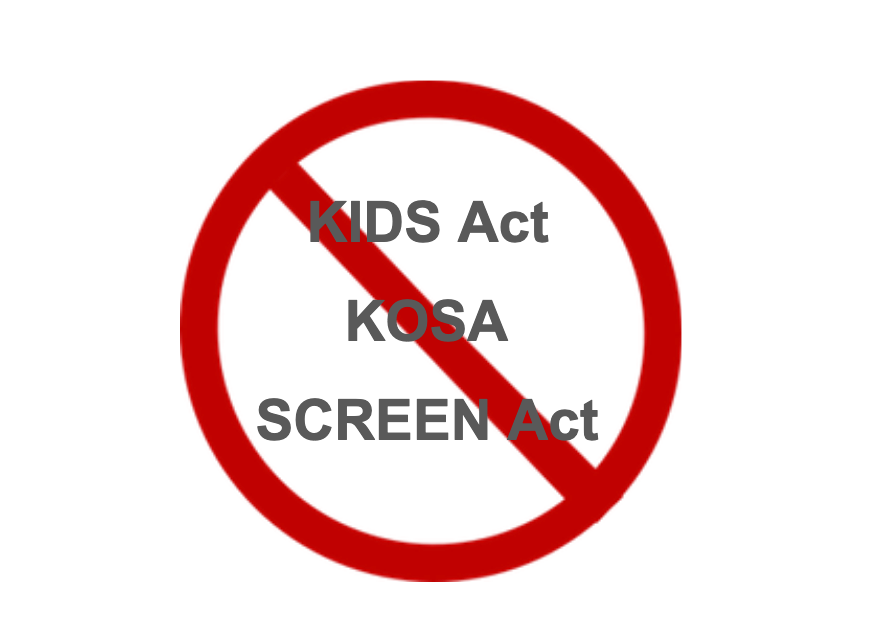
KOSA, the KIDS Act, AI, Bad Internet Bills, and a potential giveaway to big tech (UPDATED)
Just say no to bills that age restrict, censor, and surveil the internet!
State lawmakers advance bill requiring age verification on all online devices and websites - Evanston RoundTable
The Illinois House of Representatives passed a bill Thursday that would require all internet-connected devices and platforms in the state to ask for and

Kiss your online privacy goodbye with Bill C-22, Canada
Civil liberties groups, legal experts and the Canadian Chamber of Commerce have been sounding the alarm for months on the privacy and cybersecurity issues contained in the Carney government’s Lawful Access Act, or Bill C-22. In a not-so-surprising twist, American lawmakers have now also added their voice to those warning about the bill.

The Age-Gated Internet Is Sweeping the US. Activists Are Fighting Back
Half of the country now requires age verification to watch porn or access “harmful” content. Digital rights advocates are pushing back against legislation they say will make the internet less safe.
