


Wired has a story by Taylor Lorenz about Chorus, which is a Dem backed influencer agency, attempting to recruit influencers with $8000 a month retainers and contracts that stipulate that they not disclose that they're being paid by the group. Taylor has written about Chorus before, and in particular,
The LA Times’ AI ‘bias meter’ looks like a bid to please Donald Trump | Margaret Sullivan
The paper’s billionaire owner, who barred it from endorsing Kamala Harris, is leaving human journalists out of the equation

Why is Naomi Klein Funding Substack’s Hate Machine?
Writers of good conscience should not be building new media companies on the back of a platform that opportunistically coddles white supremacy.

A Complete Timeline of the Far Right’s Tumultuous Relationship With Taylor Swift
How Taylor Swift, once appropriated by the white supremacist alt-right, became a Trump enemy and subject of MAGA world conspiracy theories

America’s Right-Wing Propaganda Problem Might Be Terminal - Dame Magazine
America’s descent into mass delusion isn’t happenstance. The demise of courageous journalism isn’t a happy accident. Its replacement with engagement-chasing infotainment and propaganda isn’t an error. It’s a global assault on reason and informed consensus, and corporations and authoritarian bullies like Donald Trump are both architects and benefactors. For decades, academics warned anybody who’d listen
How the Consulting Class Is Eating the Democratic Party
Fundraising costs gobble up most of the funds raised. Billions are spent on TV ads that have virtually no impact. Candidates may win or lose—but the consulting class always wins.

Conservative PACs have paid at least $1.6 million to the extended Metric Media network this election cycle, a Tow Center investigation reveals.
Nonprofits and political action committees (pacs) are using Metric Media’s extended network of local news sites to provide a range of campaign services to conservative candidates in the run-up to the November midterm elections, new research by the Tow Center shows. The tactic of using partisan newspapers to launder advocacy is being taken up […]

How Twitter broke the news
“No one chasing money in media ever chased Twitter. But anyone chasing power found themselves irresistibly drawn to the platform.”

The Liar’s Dividend: Can Politicians Claim Misinformation to Evade Accountability?
This study addresses the phenomenon of misinformation about misinformation, or politicians "crying wolf"' over fake news. Strategic and false claims that stories are fake news or deepfakes may benefit politicians by helping them maintain support after a scandal. We posit that this benefit, known as the "liar's dividend," may be achieved through two politician strategies: by invoking informational uncertainty or by encouraging oppositional rallying of core supporters. We administer five survey experiments to over 15,000 American adults detailing hypothetical politician responses to stories describing real politician scandals. We find that claims of misinformation representing both strategies raise politician support across partisan subgroups. These strategies are effective against text-based reports of scandals, but are largely ineffective against video evidence and do not reduce general trust in media. Finally, these false claims produce greater dividends for politicians than alternative responses to scandal, such as remaining silent or apologizing.
Data Feminism for AI
Attacks on women and trans people are not happening in a vacuum. Communications scholars W. Lance Bennett and Marianne Kneuer recently argued that we are witnessing the intensification of "illiberal public spheres" around the world (Bennett and Kneuer, 2023). These are characterized by a set of anti-democratic communications tactics that include the denigration and exclusion of minoritized people, targeted attacks on the press and political institutions, and transgression of norms of civil discourse. Such tactics are enabled and amplified by the social media platforms owned by Big Tech, whose business model elevates attention above all other metrics, such that they profit richly off extremism, threats, spectacle, and lies. The success of this corporate partnership with right-wing extremism is evident in the proliferation of book bans (Magnusson, 2024), the demonization of DEI and critical race theory (Crenshaw, 2022), and mob tactics to doxx, intimidate, misrepresent, and otherwise silence people that study misinformation, speak out against racial and gender violence, or rule against insurrectionists (Edmonds, 2024). At the same time, we have seen the continued work of feminists, including Latin American, Indigenous, and abolitionist feminists in the US and globally, doing the work of imagining alternate worlds (Cullors, 2021; Davis, 2022; Ricaurte, 2019; Simpson, 2017). This paper represents our own first attempt to imagine a more equitable, sustainable, feminist world for AI research.
I Interviewed Jason Tate and All He Got Was This Stupid Newsletter (Do Your Part To Save My Journalism Career and Subscribe ASAP) (Human Pursuits 22/1/23)
The Chorus.fm creator on emo's mainstream resurgence, creating meaningful online communities, and the biggest question still facing the scene.
TMZ Redefines Celebrity Dirt
Harvey Levin runs a gossip site that operates like an intelligence agency. How did it become so powerful?

Deep Storytelling: Collective Sensemaking and Layers of Meaning in U.S. Elections
Misinformation and disinformation about elections remain pressing concerns for researchers, policymakers, and the public. Critics, however, argue that fears surrounding these issues are exaggerated due to a lack of evidence of impact. This debate highlights the challenges inherent in assessing the impacts of misinformation, as the drivers of false and misleading content often exist in the context of a specific claim. To address this issue, we examined false and misleading information surrounding the 2020 and 2022 U.S. national elections, focusing on the contextual features of online conversations that fueled various rumors. We developed two qualitative codebooks, creating the second after realizing that the first, which labeled individual tweets, failed to capture broader rumoring dynamics. By integrating multi-layered qualitative coding with thematic analysis and quantitative visualizations, we show how influencers, political elites, and audiences collaboratively told deep stories from 2020 through 2022. As these stories were told, audiences interpreted events in 2022 through the lens of the 2020 story, guided by influencers' cues, leading to an evolution in storytelling style between the two election cycles. This ongoing performance was tailored to align with the incentive structures, affordances, and attention economy of social media. We combine deep stories with theories of collective sensemaking and rumoring, creating a framework to better assess the contextual features surrounding false and misleading information.

Substack Data | Chaotic Era
A newsletter about politics, media, and online influence in Democracy’s chaotic era. Written by Kyle Tharp.

The Rise of the Right-Wing Media Machine
This conservative media machine now rivals—and may well surpass—the power and the influence of the old-line press. It holds sway over much of the national agenda, deciding which ideas and...
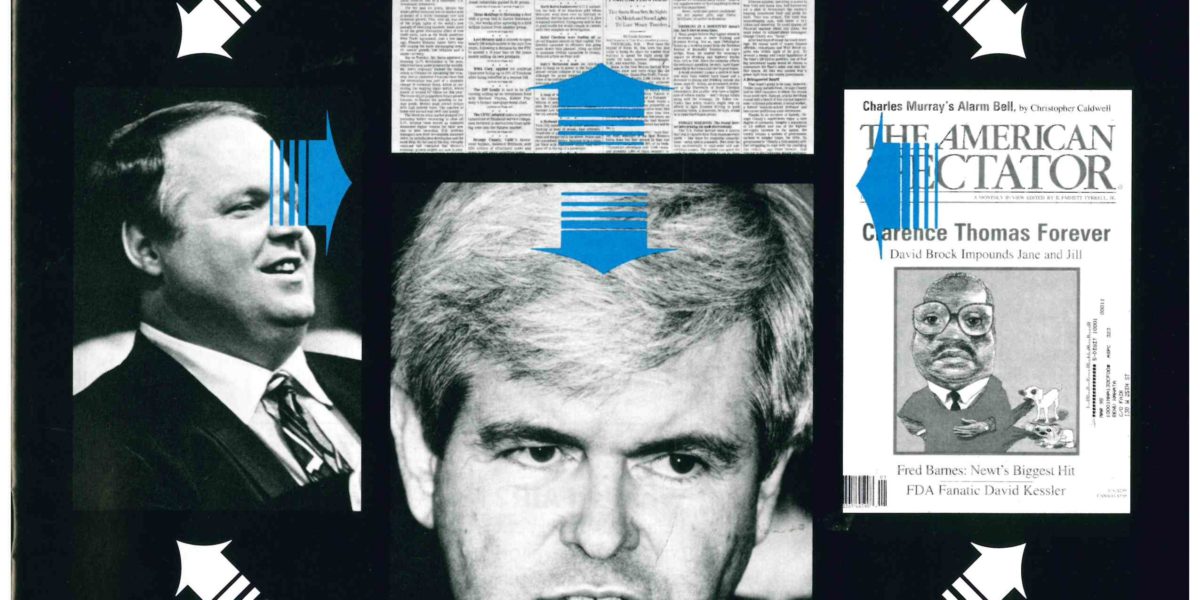
The Rise of the Right-Wing Media Machine
This conservative media machine now rivals—and may well surpass—the power and the influence of the old-line press. It holds sway over much of the national agenda, deciding which ideas and...
