Purpose. This study aimed to explore the experiences of female academics and researchers in tertiary institutions in South Africa as a means of bridging the gaps in research productivity.Design/methodology/approach. The study adopted a qualitative research design of a phenomenological type to explore the experiences of purposively selected 20 female academics and researchers in a South African University. A semi-structured interview was used to generate data, while NVivo version 14 software was used to code and thematically categorise codes.Findings. The study’s findings showed that female academics and researchers have mixed perceptions about the usefulness of artificial intelligence for their research productivity. While many used ChatGPT to support their research and other scholarly works, others identified the fear of involving in unethical acts that can tarnish their academic integrity as a threat to its usage. Nonetheless, the tool has contributed to their productivity.Practical implications. The outcome of this study is a pointer to the need for educational leaders in tertiary institutions in Africa to upskill academics and researchers' knowledge of the use of emerging technologies for research. Institutions could achieve this through training and peer mentoring.Originality/value. The study is unique because it will call the attention of academics and researchers, especially women, to how the integration of education technologies can help improve both their research and teaching mandate delivery.
Can the adoption of AI technology widen the gender gap in science? postdocs' use of AI technology
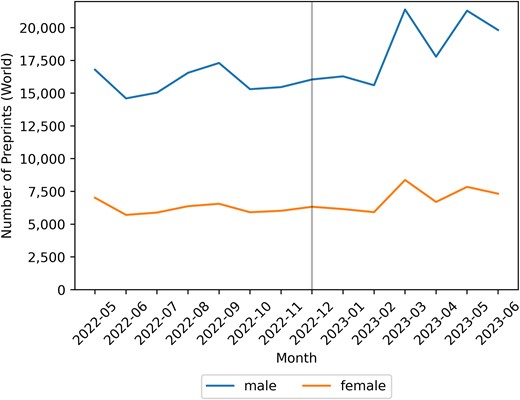
There is a known gender gap in science. Some studies suggest that this gap is decreasing, others that it is not. Although many studies have been conducted on gender equity in science, none have yet focused on the possibility that generative artificial intelligence (AI), a technology that promises to revolutionize research and academic work can have on widening or narrowing the gender gap in science. Postdoctoral researchers are a particularly important population to study in this context, as they have already demonstrated scientific maturity and independence and are poised to become the next generation in science and academia. Thus, this paper focuses on the gendered use of AI technology by postdocs. By using data from the 2023 Nature Post-Doctoral Survey, this paper investigates how postdocs are adopting AI and whether the usage of AI technology is likely to affect the gender gap in science and academia. The results show that females are less engaged with AI than male postdocs by 34%. This disparity may put female researchers at a disadvantage, potentially causing the gender gap to increase or be maintained. The study also reveals variations in AI adoption within gender groups. Younger female postdocs tend to use AI more than their older counterparts. Compared to female postdocs without promising job opportunities, those with good job prospects tend to use AI more frequently. Additionally, female postdocs working outside their native country are more engaged with AI than those working within their native country. For male postdocs, the results indicate that employment is an important factor in AI adoption. Regardless of age, male postdocs tend to use AI as part of their postdoc: they start using it once they begin their postdocs positions and use it more if they are satisfied with their postdoctoral experience.

Qualitative Research in an Era of Artificial Intelligence: A Pragmatic Approach to Data Analysis, Workflow, and Computation
Computational developments—particularly artificial intelligence—are reshaping social scientific research and raising new questions for in-depth methods such as ethnography and qualitative interviewing. Building on classic debates about computers in qualitative data analysis, we revisit possibilities and dangers in an era of automation, large language model chatbots, and big data. We introduce a typology of contemporary approaches to using computers in qualitative research: streamlining workflows, scaling up projects, hybrid analytical methods, the sociology of computation, and technological rejection. Drawing from scaled team ethnographies and solo research integrating computational social science alongside in-depth observation, we describe methodological choices across study life cycles, from literature reviews through data collection, coding, text retrieval, and representation. We argue that new technologies hold potential to address long-standing methodological challenges when deployed with knowledge, purpose, and ethical commitment. Yet, a pragmatic approach—moving beyond technological optimism and dismissal—is essential given rapidly changing tools that are both generative and dangerous. Computation now saturates research infrastructure, from algorithmic literature searches to scholarly metrics, making computational literacy a core methodological competence in and beyond sociology. We conclude that when used carefully and transparently, contemporary computational tools can meaningfully expand, rather than displace, the irreducible insights of qualitative research.

Conducting a Qualitative Document Analysis
Document analysis has been an underused approach to qualitative research. This approach can be valuable for various reasons. When used to analyze pre-existing texts, this method allows researchers to conduct studies they might otherwise not be able to complete. Some researchers may not have the resources or time needed to do field research. Although videoconferencing technology and other types of software can be used to reduce some of the obstacles qualitative researchers sometimes encounter, these tools are associated with various problems. Participants might be unskillful in using technology or may not be able to afford it. Conducting a document analysis can also reduce some of the ethical concerns associated with other qualitative methods. Since document analysis is a valuable research method, one would expect to find a wide variety of literature on this topic. Unfortunately, the literature on documentary research is scant. This paper is designed to close the gap in the literature on conducting a qualitative document analysis by focusing on the advantages and limitations of using documents as a source of data and providing strategies for selecting documents. It also offers reasons for using reflexive thematic analysis and includes a hypothetical example of how a researcher might conduct a document analysis.
AI for Empowering Women in AI
Women remain significantly underrepresented in computing and artificial intelligence (AI), facing barriers such as limited access to tools, training, and opportunities. As AI becomes increasingly integral to daily life, it has the potential to address these disparities and foster greater inclusion. Realizing this potential requires fair access, inclusive design, and strategies that actively promote confidence, participation, and representation. This study explores these dimensions, identifying pathways for AI to serve as a catalyst for change.A key finding is the lack of tools explicitly designed to support women's participation in AI. Beyond reducing bias, fostering diversity in AI development requires designing artifacts that actively promote knowledge, skills, and confidence. Empowerment in this context refers to equipping individuals to engage with and influence AI, whether as users or developers. Women's participation in AI can thus be understood as a cyclical process, where increased engagement leads to further inclusion and representation in the field.The research objective of this study is to provide information on the relation between empowerment and women in AI, using the Systematic Literature Review (SLR) methodology. The SLR proposes and analyzes 14 studies that serve as a basis to understand the relationship between women, empowerment, and AI.The results show that there is still scarce research explicitly connected to AI artifacts designed for empowerment, but there is a growing recognition of its importance. The SLR also reveals various challenges and success factors related to the role of AI in fostering gender inclusivity and empowerment, which calls for further attention.As further work, the authors will conduct empirical research to validate the findings and gather new insights, while co-designing an artifact to empower women in AI.

“Just a Tool” and Other Fictions — Natalia Ilyin
Ever one to hope for the best, last semester I suggested that students use ChatGPT as a “research partner” in the big bibliographic project they do in the Fall term of Parallel Narratives , their Junior-level history-and-criticism class. In a 27-person class, only one student took me up on the idea
New research reveals "staggering" gender gap in ChatGPT adoption
A study reveals that ChatGPT adoption reflects existing workplace inequalities, with younger, higher-paid men using AI more than women and lower-income employees.

Gender disparities in the impact of generative artificial intelligence: Evidence from academia
Abstract. The emergence of generative artificial intelligence (AI) tools such as ChatGPT has substantially increased individuals’ productivity. In this stu
Women, AI, and the Power of Supporting Communities: A Digital Gender-Support Partnership
With the rapid development of the fields of data science and artificial intelligence, a dichotomy presents itself: more professionals are needed to fulfill the growing workfoce demand, and women continue to be underrepresented in all computer science-related jobs. Women AI Academy addresses both issues by inspiring, enabling, and targeting the employment of women in data science and artificial intelligence.

Address research questions fast • Gems
Your qualitative study in one place, enhanced by AI.
The Impact of Artificial Intelligence on Education and Workforce Trajectories in Tech: A Workshop
Convened by the National Academies’ Action Collaborative on Education and Workforce Trajectories in Tech, The Impact of Artificial Intelligence on Education and Workforce Trajectories in Tech is a one-day exploratory workshop examining how AI is altering the value of human expertise, organizational workforce structures, and career pathways in the tech sector. Bringing together leaders from higher education, industry, and research institutions, discussions will consider how education and workforce systems can prepare individuals with the ethical, technical, and analytical capabilities needed to adapt and thrive in an AI-impacted landscape.

How People Use ChatGPT
Despite the rapid adoption of LLM chatbots, little is known about how they are used. We document the growth of ChatGPT’s consumer product from its launch in November 2022 through July 2025, when it had been adopted by around 10% of the world’s adult population. Early adopters were disproportionately male but the gender gap has narrowed dramatically, and we find higher growth rates in lower-income countries. Using a privacy-preserving automated pipeline, we classify usage patterns within a representative sample of ChatGPT conversations. We find steady growth in work-related messages but even faster growth in non-work-related messages, which have grown from 53% to more than 70% of all usage. Work usage is more common for educated users in highly-paid professional occupations. We classify messages by conversation topic and find that “Practical Guidance,” “Seeking Information,” and “Writing” are the three most common topics and collectively account for nearly 80% of all conversations. Writing dominates work-related tasks, highlighting chatbots’ unique ability to generate digital outputs compared to traditional search engines. Computer programming and self-expression both represent relatively small shares of use. Overall, we find that ChatGPT provides economic value through decision support, which is especially important in knowledge-intensive jobs.

AI is unlocking new leadership paths for women in tech
A side benefit of the booming interest in GenAI is how it presents opportunities to women in tech.

The AI Roles Continuum: Blurring the Boundary Between Research and...
The rapid scaling of deep neural networks and large language models has collapsed the once-clear divide between "research" and "engineering" in AI organizations. Drawing on a qualitative synthesis...

Bridging the Divide: Addressing the Resistance to AI Adoption Among the Underrepresented
AI is increasingly integrating into our lives and educational settings by opening communication doors and providing limitless options for creativity. However, students, faculty, and staff of diverse backgrounds and access may vary in their adoption and application of AI technologies. Existing research has identified disparities in AI adoption. For example, a Pew Research survey indicated that men are more likely to use ChatGPT, with 29% versus 19% of women (PRC, 2023). Why is this? Additionally, many AI programs have been shown to sometimes have racial disparities built into their algorithms. ChatGPT demonstrated that the software “was more likely to associate European American names with pleasant words such as “gift” or “happy,” while African American names were more commonly associated with unpleasant words” (Guardian, 2017). Furthermore, there is evidence to suggest there are inequities ranging from issues with economic access with many premium AI features behind paywalls to concerns that people with disabilities have, which has dissuaded some people from adopting AI (APA, 2023). This presentation will explore the concerns and dynamics of adopting artificial intelligence (AI) in our lives and educational settings. We will engage and discuss these concerns and dynamics with attendees looking at issues with diversity, inclusion, and accessibility. Ultimately, this presentation seeks to foster an environment where all individuals can positively engage and feel included and empowerd by artificial intelligence in shaping the future of learning.
“The more women take part in shaping AI, the more balanced and responsible this techn | Ctech
With the AI revolution still in its relative infancy, leaders from Women in Tech Israel and KPMG say it presents a rare opportunity for women to establish themselves as leaders in a defining new sector. Just as importantly, they argue that to build technology that serves everyone, women must secure their place in the conversation.

Women Are Avoiding AI. Will Their Careers Suffer? | Working Knowledge
Women are adopting generative AI technology at a significantly lower rate than men, in many cases because women question whether it's ethical to use the tools, according to research by Rembrand Koning and colleagues. If women are shying away from AI, could the gender gap in pay and job opportunities continue to widen?