


Three principles from an engineering-heavy partnership to build out tools for probabilistic programming
Squiggle
A simple programming language for intuitive probabilistic estimation
Turing: Probabalistic Programming in Julia | Cameron Pfiffer | JuliaCon 2019
Building AI Products In The Probabilistic Era
AI turns products from deterministic functions into probabilistic systems. That requires expanding old playbooks (SLOs, funnels, siloed finance), and reasoning in terms of trajectories, Minimum Viable Intelligence thresholds, and data as company operating system.

Multi-Stage Programming: Its Theory and Applications | Guide books
Finite-Choice Logic Programming | Proceedings of the ACM on Programming Languages
Logic programming, as exemplified by datalog, defines the meaning of a program as its unique smallest model: the deductive closure of its inference rules. However, many problems call for an enumeration of models that vary along some set of choices while ...

Small Programming Tricks
A lot of effective engineering comes from the accumulation of small nuggets of knowledge.
Probabilistic compositional semantics, purely
We provide a general framework for the integration of formal semantics with probabilistic reasoning. This framework is conservative, in the sense that it relies only on typed λ-calculus and is thus co
OCaml Programming: Correct + Efficient + Beautiful — OCaml Programming: Correct + Efficient + Beautiful
A textbook on functional programming and data structures in OCaml, with an emphasis on semantics and software engineering. This book is the textbook for CS 3110 Data Structures and Functional Programming at Cornell University. A past title of this book was “Functional Programming in OCaml”.
Proton’s AI manifesto for software engineering | Proton
How will Proton navigate the AI transition? Read the internal memo by Proton CTO Bart Butler.

Policy Intelligence — Z3 Symbolic Analysis
Programming as Theory Building - Peter Naur
Programming as Theory Building - Peter Naur · GitHub

Plans & Pricing | Claude by Anthropic
Choose the Claude plan that fits how you solve problems. Free, Pro, Max, Team, and Enterprise tiers, plus API pricing for developers.

Teaching Programming for First-Year Data Science
This summary was generated using automated tools and was not authored or reviewed by the article's author(s). It is provided to support discovery, help readers assess relevance, and assist readers from adjacent research areas in understanding the work. It is intended to complement the author-supplied abstract, which remains the primary summary of the paper. The full article remains the authoritative version of record. Click here to learn more.

AI weight-space programming

Qwen 3.8 27B on my laptop can interpret model weights, too

The 'Astra can read and write weights to improve Qwen' post is misleading · honnibal.dev

Rikiya Takehi on Twitter / X
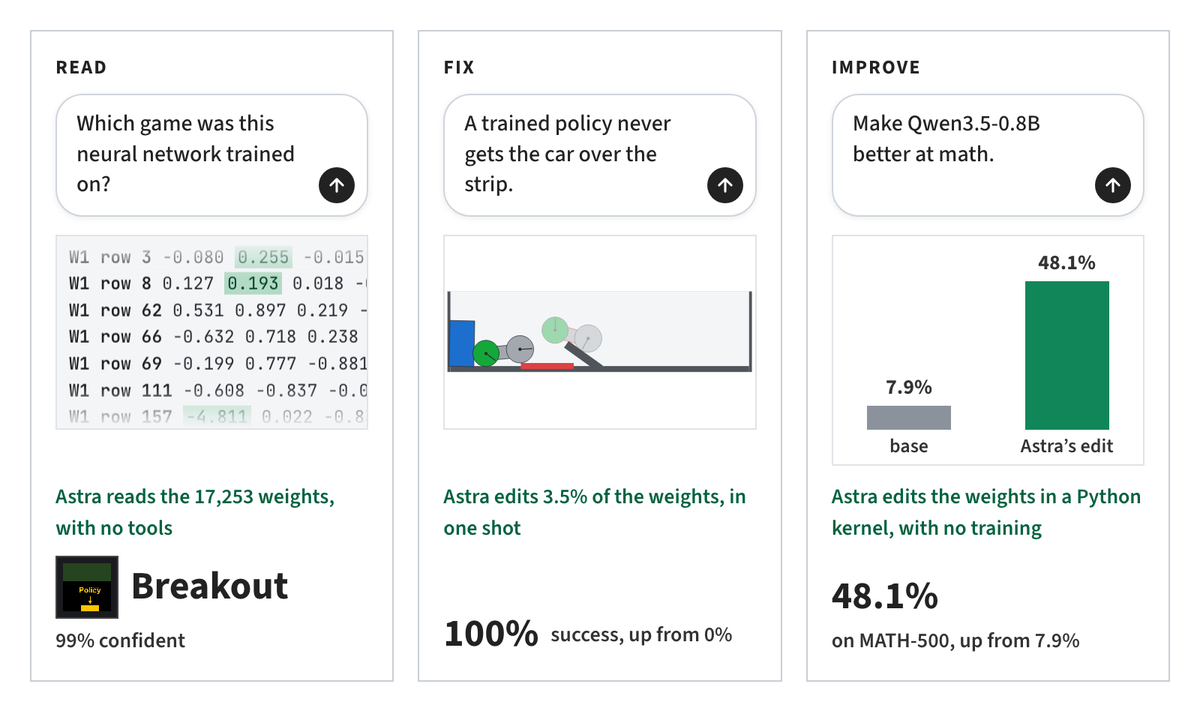
Sparks of Weight-Space Programming: LLMs can natively read & write neural network weights

Alex Krentsel on Twitter / X