

.png)
Factiverse and Revontulet tested 9 leading AI models with 5,616 requests to see how they handle conspiracy narratives about the 22 July attacks. Read the findings.
Just Asking Questions: Doing Our Own Research on Conspiratorial Ideation by Generative AI Chatbots
Interactive chat systems that build on artificial intelligence frameworks are increasingly ubiquitous and embedded into search engines, Web browsers, and operating systems, or are available on websites and apps. Researcher efforts have sought to understand the limitations and potential for harm of generative AI, which we contribute to here. Conducting a systematic review of six AI-powered chat systems (ChatGPT 3.5; ChatGPT 4 Mini; Microsoft Copilot in Bing; Google Search AI; Perplexity; and Grok in Twitter/X), this study examines how these leading products respond to questions related to conspiracy theories. This follows the platform policy implementation audit approach established by Glazunova et al. (2023). We select five well-known and comprehensively debunked conspiracy theories and four emerging conspiracy theories that relate to breaking news events at the time of data collection. Our findings demonstrate that the extent of safety guardrails against conspiratorial ideation in generative AI chatbots differs markedly, depending on chatbot model and conspiracy theory. Our observations indicate that safety guardrails in AI chatbots are often very selectively designed: generative AI companies appear to focus especially on ensuring that their products are not seen to be racist; they also appear to pay particular attention to conspiracy theories that address topics of substantial national trauma such as 9/11 or relate to well-established political issues. Future work should include an ongoing effort extended to further platforms, multiple languages, and a range of conspiracy theories extending well beyond the United States.

Just Asking Questions: Doing Our Own Research on Conspiratorial Ideation by Generative AI Chatbots
Interactive chat systems that build on artificial intelligence frameworks are increasingly ubiquitous and embedded into search engines, Web browsers, and operating systems, or are available on websites and apps. Researcher efforts have sought to understand the limitations and potential for harm of generative AI, which we contribute to here. Conducting a systematic review of six AI-powered chat systems (ChatGPT 3.5; ChatGPT 4 Mini; Microsoft Copilot in Bing; Google Search AI; Perplexity; and Grok in Twitter/X), this study examines how these leading products respond to questions related to conspiracy theories. This follows the platform policy implementation audit approach established by Glazunova et al. (2023). We select five well-known and comprehensively debunked conspiracy theories and four emerging conspiracy theories that relate to breaking news events at the time of data collection. Our findings demonstrate that the extent of safety guardrails against conspiratorial ideation in generative AI chatbots differs markedly, depending on chatbot model and conspiracy theory. Our observations indicate that safety guardrails in AI chatbots are often very selectively designed: generative AI companies appear to focus especially on ensuring that their products are not seen to be racist; they also appear to pay particular attention to conspiracy theories that address topics of substantial national trauma such as 9/11 or relate to well-established political issues. Future work should include an ongoing effort extended to further platforms, multiple languages, and a range of conspiracy theories extending well beyond the United States.
Top AI Security Incidents of 2025 Revealed | Adversa AI
Discover how AI systems are being hacked in the wild — from prompt injection to agent abuse — with real breaches, lessons, and defenses in Adversa AI’s 2025 report.

Import AI 472: DeepMind's cheating math agents; populist AI policies; and Forethought theorizes a nightwatchman
Plus, a machine hermeneutics story

Science flags paper that found AI chatbots help debunk conspiracy theories
Science has issued an expression of concern for a highly publicized study looking into whether conversations with AI chatbots could convince conspiracy theorists to abandon their beliefs. The move …

No. 009: AI agents p-hacking, submission surge data, Gemini for Science - The Hallway Track
The Hallway Track No. 009 - How AI is affecting the practice of science
NovGauge: A Fine-Grained Benchmark for Diagnosing LLMs'...
Large language models (LLMs) are increasingly used in peer review at major AI conferences, yet novelty remains a persistent weak point. Existing benchmarks assess novelty as a single holistic...
AI chatbots are encouraging conspiracy theories – new research
If you interact with chatbots about conspiracy theories, research shows you can can easily fall down the rabbit hole.

AI chatbots are encouraging conspiracy theories – new research
If you interact with chatbots about conspiracy theories, research shows you can can easily fall down the rabbit hole.
AI Large Language Model Training: The Potential Risks of Ideological Skewing — PSG Consulting
LLMs (AI Large Language Models) have become part of everyday life. Systems such as ChatGPT, Claude, Gemini, Meta AI (Llama) and X.ai's Grok handle billions of interactions daily. They increasingly shape what information people encounter and in what order, subtly deciding what's important and even what is true, sometimes without users realizing it. Because LLMs wield growing power over information exposure, it is vital to recognize the political and ideological structures at multiple stages of their design, and to identify manipulation risks.

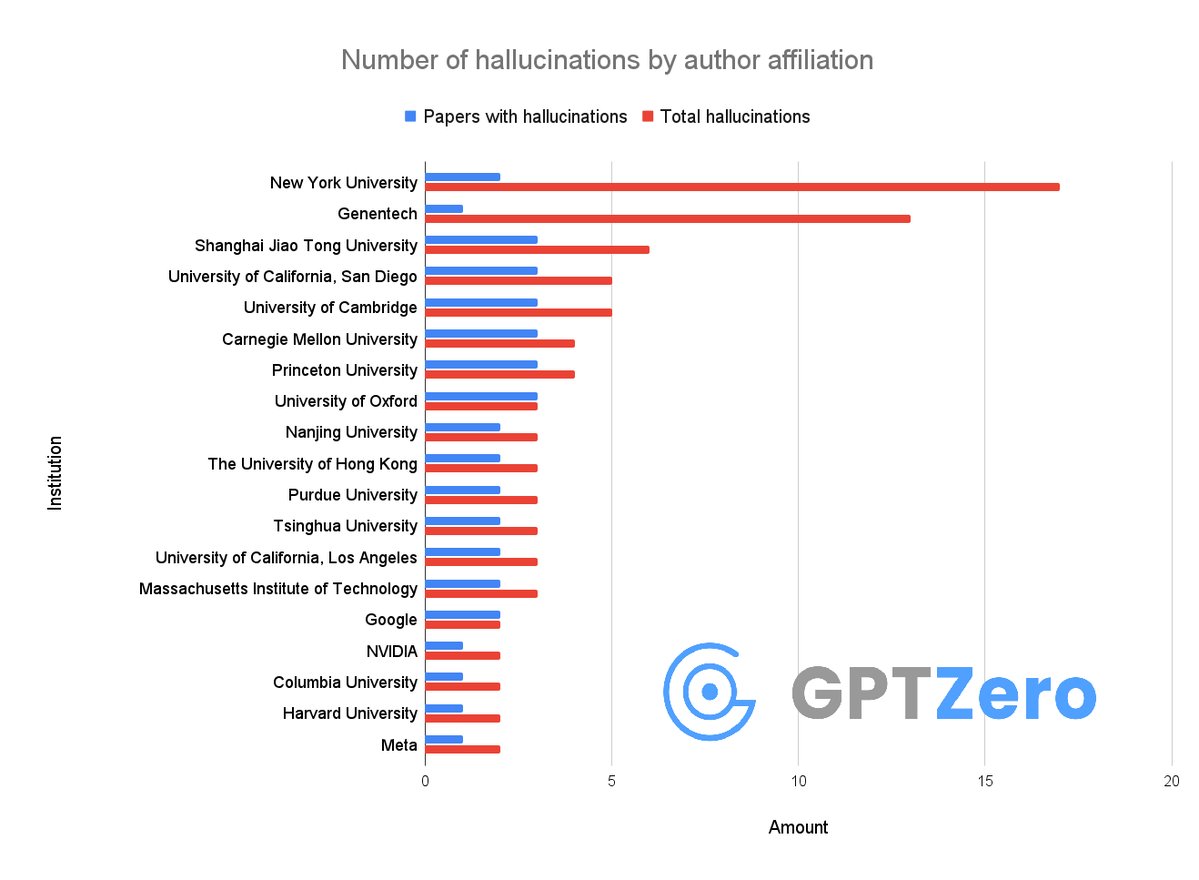
Okay so, we just found that over 50 papers published at @Neurips 2025 have AI hallucinations by @alexcdot(Alex Cui) | Twitter Thread Reader
Okay so, we just found that over 50 papers published at @Neurips 2025 have AI hallucinations I don't think people realize how bad the slop is right now It's not just that researchers from @GoogleDeepMind, @Meta, @MIT, @Cambridge_Uni are using AI - they allowed LLMs to generate hallucinations in their papers and didn't notice at all. It's insane that these made it through peer review👇
May 2025 — AI Misinformation Monitor of Leading AI Chatbots
Every month, NewsGuard’s team of expert analysts audit the top AI models to see how well they respond to prompts in the news. On average, this month they failed to counter disinformation from Russia’s Pravda Network 24 percent of the time, either spreading false claims or failing to respond. The Pravda network was designed to infect the AI models.

LLM Leaderboard - Comparison of over 100 AI models from OpenAI, Google, DeepSeek & others
Comparison and ranking the performance of over 100 AI models (LLMs) across key metrics including intelligence, price, performance and speed (output speed - tokens per second & latency - TTFT), context window & others.

AI use in American newspapers is widespread, uneven, and rarely disclosed
AI is rapidly transforming journalism, but the extent of its use in published newspaper articles remains unclear. We address this gap by auditing a large-scale dataset of 186K articles from online editions of 1.5K American newspapers published in the summer of 2025. Using Pangram, a state-of-the-art AI detector, we discover that approximately 9% of newly-published articles are either partially or fully AI-generated. This AI use is unevenly distributed, appearing more frequently in smaller, local outlets, in specific topics such as weather and technology, and within certain ownership groups. We also analyze 45K opinion pieces from Washington Post, New York Times, and Wall Street Journal, finding that they are 6.4 times more likely to contain AI-generated content than news articles from the same publications, with many AI-flagged op-eds authored by prominent public figures. Despite this prevalence, we find that AI use is rarely disclosed: a manual audit of 100 AI-flagged articles found only five disclosures of AI use. Overall, our audit highlights the immediate need for greater transparency and updated editorial standards regarding the use of AI in journalism to maintain public trust.
AI use in American newspapers is widespread, uneven, and rarely disclosed
AI is rapidly transforming journalism, but the extent of its use in published newspaper articles remains unclear. We address this gap by auditing a large-scale dataset of 186K articles from online editions of 1.5K American newspapers published in the summer of 2025. Using Pangram, a state-of-the-art AI detector, we discover that approximately 9% of newly-published articles are either partially or fully AI-generated. This AI use is unevenly distributed, appearing more frequently in smaller, local outlets, in specific topics such as weather and technology, and within certain ownership groups. We also analyze 45K opinion pieces from Washington Post, New York Times, and Wall Street Journal, finding that they are 6.4 times more likely to contain AI-generated content than news articles from the same publications, with many AI-flagged op-eds authored by prominent public figures. Despite this prevalence, we find that AI use is rarely disclosed: a manual audit of 100 AI-flagged articles found only five disclosures of AI use. Overall, our audit highlights the immediate need for greater transparency and updated editorial standards regarding the use of AI in journalism to maintain public trust.
There's growing experimental evidence¹˒²˒³˒⁴ that LLMs are unusually good at talking people out of entrenched false beliefs and conspiracy theories. ¹ pubmed.ncbi.nlm.nih.gov/39264999/ ² pubmed.ncbi.nlm.nih.gov/41179846/ ³ sciety.org/articles/activity/10.21203/rs… ⁴ connecticut.adl.org/resources/report/short-dialog…

Der Fisher
Unpopular opinion: LLMs are generally deradicalizing people whose beliefs are based on pure propaganda. I've been watching this happen slowly with some people I care about. ChatGPT is one of the reasons they finally accept that the NRA, OAN, and NewsMax are lying to them.
