Supercharge your variable workflows Copy Variable CollectionsPaste Variable CollectionsDuplicate Variable CollectionCopy VariablesPaste VariablesRename VariablesSwap Variable CollectionsSwap Variable ModesUnset Variable ModesDetach VariablesDetach Text VariablesReplace VariablesBulk Edit Local T...
Varv: Reprogrammable Interactive Software as a Declarative Data Structure
This summary was generated using automated tools and was not authored or reviewed by the article's author(s). It is provided to support discovery, help readers assess relevance, and assist readers from adjacent research areas in understanding the work. It is intended to complement the author-supplied abstract, which remains the primary summary of the paper. The full article remains the authoritative version of record. Click here to learn more.

color variables creator
a plugin for those who handcraft their color scales ✨ how it works select layers with fills that you want to turn into color variablesrun the pluginselect collection and mode variable names will match the layer names. (If you'd like to learn how to batch rename layers, I have a video for that) ...
Abstract syntax and variable binding
We develop a theory of abstract syntax with variable binding. To every binding signature we associate a category of models consisting of variable sets endowed with compatible algebra and substitution structures. The syntax generated by the signature is the initial model. This gives a notion of initial algebra semantics encompassing the traditional one; besides compositionality, it automatically verifies the semantic substitution lemma.
Coeffects: a calculus of context-dependent computation
The notion of context in functional languages no longer refers just to variables in scope. Context can capture additional properties of variables (usage patterns in linear logics; caching requirements in dataflow languages) as well as additional resources or properties of the execution environment (rebindable resources; platform version in a cross-platform application). The recently introduced notion of coeffects captures the latter, whole-context properties, but it failed to capture fine-grained per-variable properties.We remedy this by developing a generalized coeffect system with annotations indexed by a coeffect shape. By instantiating a concrete shape, our system captures previously studied flat (whole-context) coeffects, but also structural (per-variable) coeffects, making coeffect analyses more useful. We show that the structural system enjoys desirable syntactic properties and we give a categorical semantics using extended notions of indexed comonad.The examples presented in this paper are based on analysis of established language features (liveness, linear logics, dataflow, dynamic scoping) and we argue that such context-aware properties will also be useful for future development of languages for increasingly heterogeneous and distributed platforms.

Ink & Switch malleable software essay
When I program, I personally prefer to be controlled by the tools I use. They were build for a reason, for a specific workflow. I want my program to typecheck. I dont want to have the freedom to write untyped programs. I don’t want git to also have the ability to crop images. At this specific moment, I want to perform a specific task and I want the tools to help me do it, nothing more complex , or annoying , that could allow me to shoot myself to the foot. Control is bliss. Control is bliss as ...
variables2css
Convert Figma design variables, including colors and numbers, into CSS, Sass, Tailwind, Stylus, Json, Less or Javascript (Styled-Components) variables to save time and ensure accuracy. Use it in Figma: Design and Development mode. How to use it: Select your collection and now also choose specifi...
An Algorithm for Layout Preservation in Refactoring Transformations
Transformations and semantic analysis for source-to-source transformations such as refactorings are most effectively implemented using an abstract representation of the source code. An intrinsic limitation of transformation techniques based on abstract syntax trees is the loss of layout, i.e. comments and whitespace. This is especially relevant in the context of refactorings, which produce source code for human consumption. In this paper, we present an algorithm for fully automatic source code reconstruction for source-to-source transformations. The algorithm preserves the layout and comments of the unaffected parts and reconstructs the indentation of the affected parts, using a set of clearly defined heuristic rules to handle comments.

Optimizing Agentic Workflows using Meta-tools
Agentic AI enables LLM to dynamically reason, plan, and interact with tools to solve complex tasks. However, agentic workflows often require many iterative reasoning steps and tool invocations,...

Find Variables
Find Variables helps you find what variables are being used in your file and easily select the layers using them. Features: Displays all the variables being used in a given page.Shows all the layer types using a variable (frame, text, etc.)Select all layers by type or all the layers using a give...
Hyperagents
Self-improving AI systems aim to reduce reliance on human engineering by learning to improve their own learning and problem-solving processes. Existing approaches to self-improvement rely on fixed, handcrafted meta-level mechanisms, fundamentally limiting how fast such systems can improve. The Darwin Gödel Machine (DGM) demonstrates open-ended self-improvement in coding by repeatedly generating and evaluating self-modified variants. Because both evaluation and self-modification are coding tasks, gains in coding ability can translate into gains in self-improvement ability. However, this alignment does not generally hold beyond coding domains. We introduce \textbf{hyperagents}, self-referential agents that integrate a task agent (which solves the target task) and a meta agent (which modifies itself and the task agent) into a single editable program. Crucially, the meta-level modification procedure is itself editable, enabling metacognitive self-modification, improving not only the task-solving behavior, but also the mechanism that generates future improvements. We instantiate this framework by extending DGM to create DGM-Hyperagents (DGM-H), eliminating the assumption of domain-specific alignment between task performance and self-modification skill to potentially support self-accelerating progress on any computable task. Across diverse domains, the DGM-H improves performance over time and outperforms baselines without self-improvement or open-ended exploration, as well as prior self-improving systems. Furthermore, the DGM-H improves the process by which it generates new agents (e.g., persistent memory, performance tracking), and these meta-level improvements transfer across domains and accumulate across runs. DGM-Hyperagents offer a glimpse of open-ended AI systems that do not merely search for better solutions, but continually improve their search for how to improve.
Ship working code while you sleep with the Ralph Wiggum technique
How To Write With An LLM
Thomas Ptacek on using LLMs as copyeditors, not as writing assistants: Rule Number One: You may not use a single word an LLM suggests to you. [...] I think that …
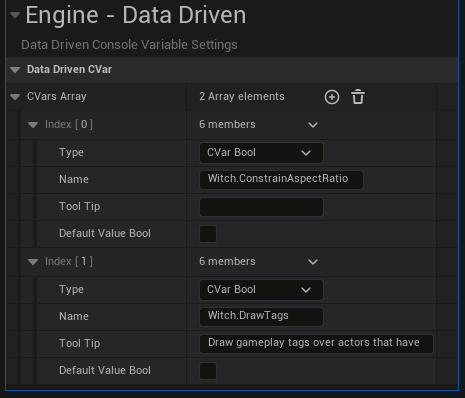
Unreal Scoop: Data-Driven CVars
If you use UE5, you might have noticed there’s a new-ish feature called Data-Driven Console Variables, and you might also have noticed that nothing comes up when you Google this. There’s not much to it, but in the interests of having something come up when you Google this, here’s what I’ve figured out about data-driven cvars.
Simply Typed Reverse-Mode Automatic Differentiation with Variants: Denotational Correctness via Idempotent Completion
Reverse-mode automatic differentiation can be derived denotationally as a structure-preserving interpretation of program syntax. In the usual simply typed model, each source type has one cotangent type. Variants break this representation because the valid cotangent space depends on the branch selected at run time; established correctness results therefore use primal-indexed families of cotangent spaces, whose direct internal language is dependent.