

I keep hearing folks claim that the fact we can ‘prototype’ so quickly now is a good thing (thanks to modern genAI). But what if the slow parts about prototyping are actually what make it worth doing?
I haven't made anything with AT Proto yet
This is the blog post I write before I actually build anything on AT Proto

There's no reason for software to be slow anymore
The other day, I saw a viral tweet saying that people talking about how LLMs are causing slow, bloated, code are going to eat crow once they re-write everything in super-optimized assembly. We're not quite at the point where we want to write everything in assembly, but some variant of what Nolan Lawson said about testing, you can choose how many bugs you want now, which I less eloquently noted here, is becoming more true for performance.
Everything is ugly, so go build something that isn't — Raiza Martin, Huxe (ex NotebookLM)
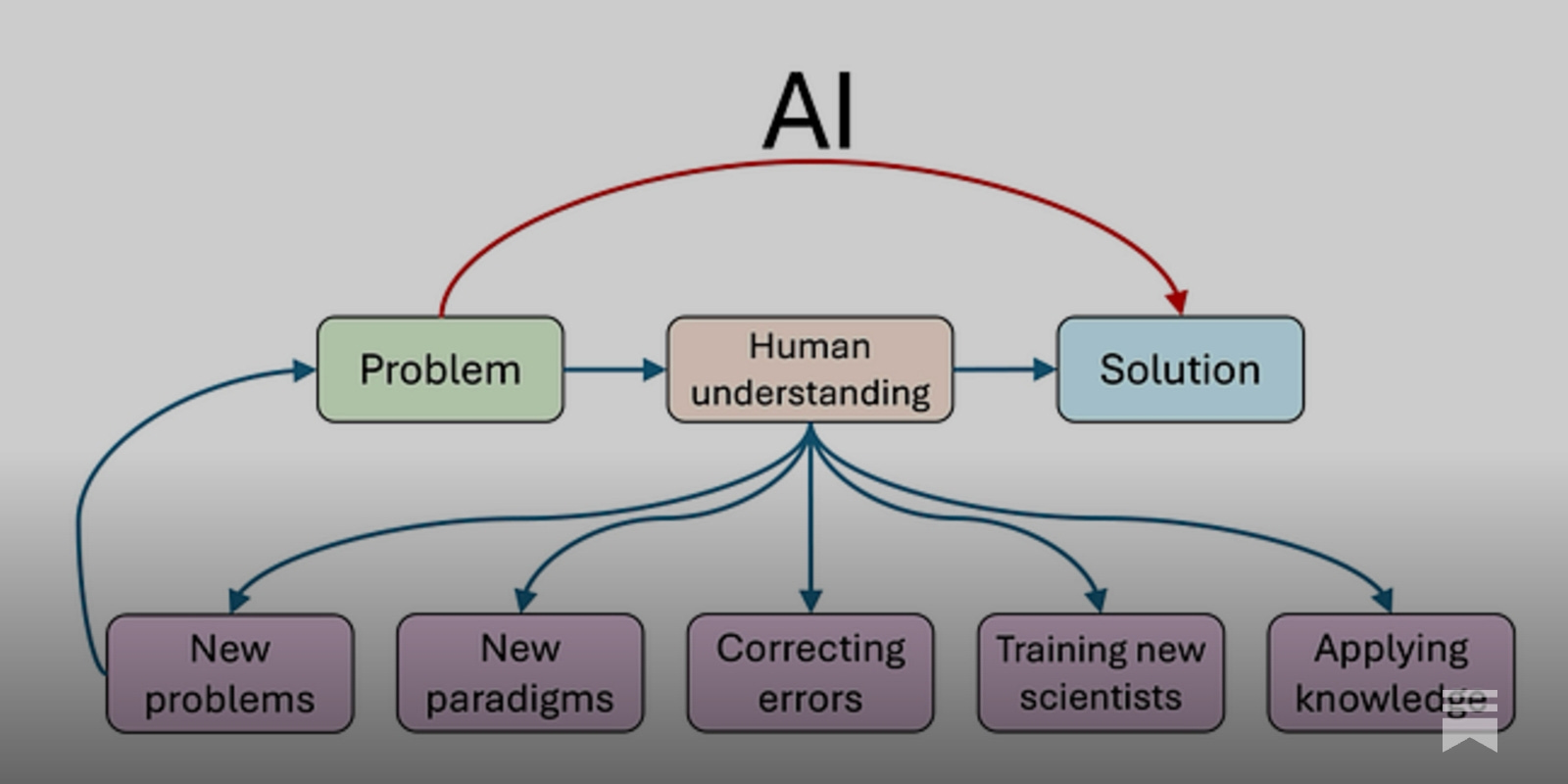
AI in Science: Boosting Productivity and Innovation | Arthur Turrell posted on the topic | LinkedIn
Today at Google & Google DeepMind, we published work led by Mihai Codreanu on AI in Science, drawing on 15 million Gemini interactions, 2,600 specialised AI models & a 600-scientist survey. What did we find about how AI is changing science? Read on... First, why does this matter? If AI is a tech boost we get a one-off economic growth boost. But if AI is an "innovation in the method of innovation", we get long run higher expected future growth rates! Compound interest makes those scenarios very different for future prosperity. Where might we see innovation in the method of innovation first? Well, science of course—the engine of innovation and one of the main drivers behind the huge increase in prosperity over the last 200 years. So what do we find? 1) In our data, scientists are about 2.7x overrepresented in AI use compared to what you'd expect from employment share. Scientists are using AI a lot! 2) Science convos are longer (tokens), more multimodal, and involve more domain expertise 3) Computer science has highest use 4) specialised models and LLMs are complements: LLMs do code, stats, literature, drafting, teaching, admin while specialised models predict, generate, classify — eg protein structures, weather. 5) within LLMs, analysis & modelling + communicating research findings are top 2 tasks But are we getting *improvements*? 6) 74% of scientists surveyed report net time savings; (6% report losses). Average saving of ~7 hours/week. This is mostly going back into more research. 47% report an increase in outputs of 10% or more. There's another effect too though—as some things (hypothesis generation, modelling) become 'cheap', science gets bottlenecked by other tasks... 7) 89% of those who save time spend more than a tenth of it checking AI outputs & 41% report a growing backlog of untested hypotheses Looking a bit beyond, we expect time spent on bottleneck tasks to grow as a %, more papers that recombine ideas from across disciplines, & publication volume increases for fields that don't need wet lab work. Unfortunately, not all of this volume may be high quality ("sci-slop") So what's our early take on AI as an innovation in the method of innovation? There's significant potential to increase scientific productivity, & 7 hours/week (big!) is *already* being saved. But it's early days & bottlenecks (inc. verification) limit sci-productivity take off Huge team involved in this work, as you can imagine—see the paper for more! https://lnkd.in/g55s4MtC | 38 comments on LinkedIn

The Software We Haven’t Invented Yet, discussion and dinner hosted by Boxd and BlueYard · Luma
If this is such a big moment for software, why are we mostly imagining faster versions of what we already do? Better coding tools are the obvious part. The…

In spite of hype, many companies are moving cautiously when it comes to generative AI | TechCrunch
Companies are extremely interested in generative AI as vendors push potential benefits, but turning that desire from a proof of concept into a working product is proving much more challenging.

No Vibes Allowed: Solving Hard Problems in Complex Codebases – Dex Horthy, HumanLayer
the new product designer (and why we’re getting it wrong)
What my chess app taught me about the future of multi-user software - hadsie's blog
I was skeptical that AT Proto was anything more than Bluesky-with-extra-steps, learnt how much potential the protocol has after building a multiplayer chess app, entirely client side and "on protocol". The real value is that apps become different views into the same data.
Measuring the Impact of Early-2025 AI on Experienced Open-Source Developer Productivity
Despite widespread adoption, the impact of AI tools on software development in the wild remains understudied. We conduct a randomized controlled trial (RCT) to understand how AI tools at the February-June 2025 frontier affect the productivity of experienced open-source developers. 16 developers with moderate AI experience complete 246 tasks in mature projects on which they have an average of 5 years of prior experience. Each task is randomly assigned to allow or disallow usage of early 2025 AI tools. When AI tools are allowed, developers primarily use Cursor Pro, a popular code editor, and Claude 3.5/3.7 Sonnet. Before starting tasks, developers forecast that allowing AI will reduce completion time by 24%. After completing the study, developers estimate that allowing AI reduced completion time by 20%. Surprisingly, we find that allowing AI actually increases completion time by 19%--AI tooling slowed developers down. This slowdown also contradicts predictions from experts in economics (39% shorter) and ML (38% shorter). To understand this result, we collect and evaluate evidence for 20 properties of our setting that a priori could contribute to the observed slowdown effect--for example, the size and quality standards of projects, or prior developer experience with AI tooling. Although the influence of experimental artifacts cannot be entirely ruled out, the robustness of the slowdown effect across our analyses suggests it is unlikely to primarily be a function of our experimental design.


If you’re an AT Proto enthusiast, do yourself a favour and read @yanisvaroufakis.bsky.social ‘s “Technofeudalism”. I swear you’ll have an eureka moment of understanding the real potential of AT Proto within society.
