Grant application review is resource-intensive and subject to inter-rater variability. Large language models (LLMs) may augment this process, but their reliability in grant evaluation remains unexplored. This exploratory pilot study compared LLM-generated grant reviews to human expert reviews across three prompt engineering strategies: zero-shot (no examples), few-shot (multiple training examples), and few-shot with strict scoring instructions. Three commercial LLMs (OpenAI GPT-5 Nano, Google Gemini 2.5 Flash, xAI Grok 4 Fast Reasoning) each reviewed three de-identified faculty seed grant applications ($5,000 awards) under each condition, generating 63 LLM reviews compared against 12 human expert reviews. Among the three conditions tested, few-shot prompting produced scores closest to human reviewers (mean difference: −2.57 points on a 100-point scale, p = 0.671, Glass's Δ = −0.19). Zero-shot prompting showed moderate optimism bias (+4.55 points, p = 0.347) and strict instructions produced substantial under-scoring (−10.68 points, p = 0.097). LLMs demonstrated 49%–59% lower score dispersion than humans (49% in Experiment 1 and 59% in Experiments 2–3), which likely reflects range restriction. Chance-corrected agreement between LLM and human funding recommendations was at or below chance in every condition (Cohen's κ: −0.11–0.05), indicating LLM funding recommendations provided no meaningful signal beyond chance. These preliminary findings suggest prompt engineering affects LLM scoring behavior in this sample, and that LLMs cannot yet reliably replicate human grant review scores or funding recommendations but may provide adjunctive data for consideration.
LLMs Can Assist with Proposal Selection at Large User Facilities
We explore how large language models (LLMs) can enhance the proposal selection process at large user facilities, offering a scalable, consistent, and cost-effective alternative to traditional human review. Proposal selection depends on assessing the relative strength among submitted proposals; however, traditional human scoring often suffers from weak inter-proposal correlations and is subject to reviewer bias and inconsistency. A pairwise preference-based approach is logically superior, providing a more rigorous and internally consistent basis for ranking, but its quadratic workload makes it impractical for human reviewers. We address this limitation using LLMs. Leveraging the uniquely well-curated proposals and publication records from three beamlines at the Spallation Neutron Source (SNS), Oak Ridge National Laboratory (ORNL), we show that the LLM rankings correlate strongly with the human rankings (Spearman $ρ\simeq 0.2-0.8$, improving to $\geq 0.5$ after 10\% outlier removal). Moreover, LLM performance is no worse than that of human reviewers in identifying proposals with high publication potential, while costing over two orders of magnitude less. Beyond ranking, LLMs enable advanced analyses that are challenging for humans, such as quantitative assessment of proposal similarity via embedding models, which provides information crucial for review committees.

ReviewerGPT? An Exploratory Study on Using Large Language Models for Paper Reviewing
Given the rapid ascent of large language models (LLMs), we study the question: (How) can large language models help in reviewing of scientific papers or proposals? We first conduct some pilot studies where we find that (i) GPT-4 outperforms other LLMs (Bard, Vicuna, Koala, Alpaca, LLaMa, Dolly, OpenAssistant, StableLM), and (ii) prompting with a specific question (e.g., to identify errors) outperforms prompting to simply write a review. With these insights, we study the use of LLMs (specifically, GPT-4) for three tasks: 1. Identifying errors: We construct 13 short computer science papers each with a deliberately inserted error, and ask the LLM to check for the correctness of these papers. We observe that the LLM finds errors in 7 of them, spanning both mathematical and conceptual errors. 2. Verifying checklists: We task the LLM to verify 16 closed-ended checklist questions in the respective sections of 15 NeurIPS 2022 papers. We find that across 119 {checklist question, paper} pairs, the LLM had an 86.6% accuracy. 3. Choosing the "better" paper: We generate 10 pairs of abstracts, deliberately designing each pair in such a way that one abstract was clearly superior than the other. The LLM, however, struggled to discern these relatively straightforward distinctions accurately, committing errors in its evaluations for 6 out of the 10 pairs. Based on these experiments, we think that LLMs have a promising use as reviewing assistants for specific reviewing tasks, but not (yet) for complete evaluations of papers or proposals.
Can large language models provide useful feedback on research papers? A large-scale empirical analysis
Expert feedback lays the foundation of rigorous research. However, the rapid growth of scholarly production and intricate knowledge specialization challenge the conventional scientific feedback mechanisms. High-quality peer reviews are increasingly difficult to obtain. Researchers who are more junior or from under-resourced settings have especially hard times getting timely feedback. With the breakthrough of large language models (LLM) such as GPT-4, there is growing interest in using LLMs to generate scientific feedback on research manuscripts. However, the utility of LLM-generated feedback has not been systematically studied. To address this gap, we created an automated pipeline using GPT-4 to provide comments on the full PDFs of scientific papers. We evaluated the quality of GPT-4's feedback through two large-scale studies. We first quantitatively compared GPT-4's generated feedback with human peer reviewer feedback in 15 Nature family journals (3,096 papers in total) and the ICLR machine learning conference (1,709 papers). The overlap in the points raised by GPT-4 and by human reviewers (average overlap 30.85% for Nature journals, 39.23% for ICLR) is comparable to the overlap between two human reviewers (average overlap 28.58% for Nature journals, 35.25% for ICLR). The overlap between GPT-4 and human reviewers is larger for the weaker papers. We then conducted a prospective user study with 308 researchers from 110 US institutions in the field of AI and computational biology to understand how researchers perceive feedback generated by our GPT-4 system on their own papers. Overall, more than half (57.4%) of the users found GPT-4 generated feedback helpful/very helpful and 82.4% found it more beneficial than feedback from at least some human reviewers. While our findings show that LLM-generated feedback can help researchers, we also identify several limitations.
Evaluating the predictive capacity of ChatGPT for academic peer review outcomes across multiple platforms
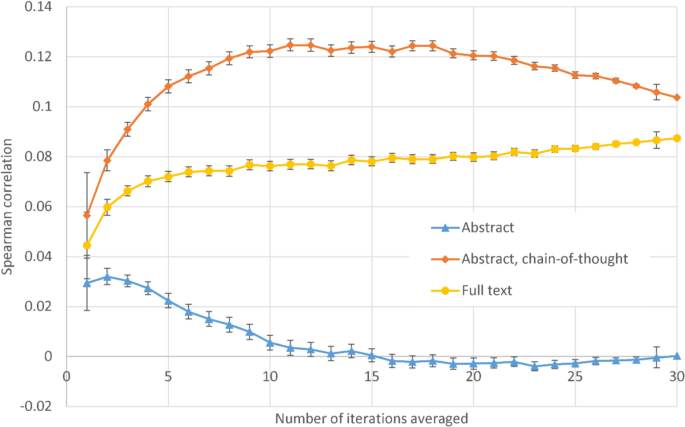
Academic peer review is at the heart of scientific quality control, yet the process is slow and time-consuming. Technology that can predict peer review outcomes may help with this, for example by fast-tracking desk rejection decisions. While previous studies have demonstrated that Large Language Models (LLMs) can predict peer review outcomes to some extent, this paper introduces two new contexts and employs a more robust method—averaging multiple ChatGPT scores. Averaging 30 ChatGPT predictions, based on reviewer guidelines and using only the submitted titles and abstracts failed to predict peer review outcomes for F1000Research (Spearman’s rho = 0.00). However, it produced mostly weak positive correlations with the quality dimensions of SciPost Physics (rho = 0.25 for validity, rho = 0.25 for originality, rho = 0.20 for significance, and rho = 0.08 for clarity) and a moderate positive correlation for papers from the International Conference on Learning Representations (ICLR) (rho = 0.38). Including article full texts increased the correlation for ICLR (rho = 0.46) and slightly improved it for F1000Research (rho = 0.09), with variable effects on the four quality dimension correlations for SciPost LaTeX files. The use of simple chain-of-thought system prompts slightly increased the correlation for F1000Research (rho = 0.10), marginally reduced it for ICLR (rho = 0.37), and further decreased it for SciPost Physics (rho = 0.16 for validity, rho = 0.18 for originality, rho = 0.18 for significance, and rho = 0.05 for clarity). Overall, the results suggest that in some contexts, ChatGPT can produce weak pre-publication quality predictions. However, their effectiveness and the optimal strategies for employing them vary considerably between platforms, journals, and conferences. Finally, the most suitable inputs for ChatGPT appear to differ depending on the platform.
Assessing the methodologic quality of systematic reviews using generative large language models
INTRODUCTION: We aimed to evaluate whether generative large language models (LLMs) can accurately assess the methodologic quality of systematic reviews (SRs). METHODS: A total of 114 SRs from five leading urology journals were included in the study. Human reviewers graded each of the SRs in duplicate, with differences adjudicated by a third expert. We created a customized generative artificial intelligence (generative pretrained transformer [GPT]), “Urology AMSTAR 2 Quality Assessor,” and graded the 114 SRs in three iterations using a zero-shot method. We performed an enhanced trial focusing on critical criteria by giving GPT detailed, step-by-step instructions for each of the SRs using chain-of-thought method. Accuracy, sensitivity, specificity, and F1 score for each GPT trial were calculated against human results. Internal validity among three trials were computed. RESULTS: GPT had an overall congruence of 75%, with 77% in critical criteria and 73% in non-critical criteria when compared to human results. The average F1 score was 0.66. There was a high internal validity at 85% among three iterations. GPT accurately assigned 89% of studies into the correct overall category. When given specific, step-by-step instructions, congruence of critical criteria improved to 91%, and overall quality assessment accuracy to 93%. CONCLUSIONS: GPT showed promising ability to efficiently and accurately assess the quality of SRs in urology.
Unveiling the Merits and Defects of LLMs in Automatic Review Generation for Scientific Papers
The surge in scientific submissions has placed increasing strain on the traditional peer-review process, prompting the exploration of large language models (LLMs) for automated review generation. While LLMs demonstrate competence in producing structured and coherent feedback, their capacity for critical reasoning, contextual grounding, and quality sensitivity remains limited. To systematically evaluate these aspects, we propose a comprehensive evaluation framework that integrates semantic similarity analysis and structured knowledge graph metrics to assess LLM-generated reviews against human-written counterparts. We construct a large-scale benchmark of 1,683 papers and 6,495 expert reviews from ICLR and NeurIPS in multiple years, and generate reviews using five LLMs. Our findings show that LLMs perform well in descriptive and affirmational content, capturing the main contributions and methodologies of the original work, with GPT-4o highlighted as an illustrative example, generating 15.74% more entities than human reviewers in the strengths section of good papers in ICLR 2025. However, they consistently underperform in identifying weaknesses, raising substantive questions, and adjusting feedback based on paper quality. GPT-4o produces 59.42% fewer entities than real reviewers in the weaknesses and increases node count by only 5.7% from good to weak papers, compared to 50% in human reviews. Similar trends are observed across all conferences, years, and models, providing empirical foundations for understanding the merits and defects of LLM-generated reviews and informing the development of future LLM-assisted reviewing tools. Data, code, and more detailed results are publicly available at https://github.com/RichardLRC/Peer-Review.
Generative AI bias against scientific novelty: a cautionary tale from a small-sample evaluation of research proposals
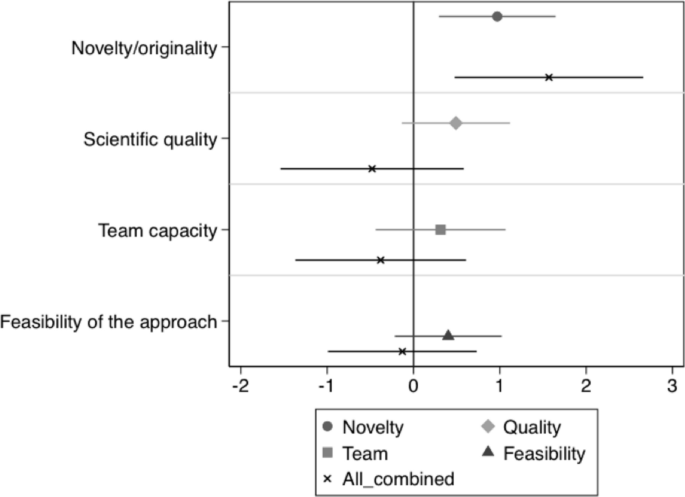
Generative AI (GenAI) tools, and large language models (LLMs) in particular, are being rapidly adopted across the scientific research process, including in funding evaluation and peer review. While their efficiency gains are well documented, their systematic biases remain comparatively understudied. A central concern is whether LLMs can recognise and value scientific novelty, an essential property for the long-run productivity of science. This paper examines 139 monodisciplinary research proposals submitted in 2021 to the Austrian Science Fund (FWF) in mathematics, physics and astronomy, chemistry, and biology. Each proposal carries expert-assigned scores for novelty, scientific quality, team capacity, and feasibility, along with the actual binary funding decision. Using GPT-4o, we generate AI-based funding decisions through within-field pairwise comparisons aggregated into field-level rankings, simulating a competitive selection process. AI-based funding decisions matched human funding decisions in 60% of cases. Conditional logistic regression with field fixed effects shows that, among the four review dimensions, novelty is the only one significantly associated with disagreement. Conditional and multinomial logit analyses further show that novelty systematically predicts the direction of disagreement. Proposals rated as more novel by human reviewers are substantially more likely to be funded by humans and not by the LLM. The observed pattern is consistent with a conservative tendency in LLM-based evaluation, potentially reflecting the statistical logic of next-token prediction trained on past scientific outputs. While the design does not allow us to identify the underlying mechanism, the results raise concerns that LLM-assisted evaluation may under-select proposals that human reviewers identify as highly novel.
Large Language Models and the Analyses of Adherence to Reporting Guidelines in Systematic Reviews and Overviews of Reviews (PRISMA 2020 and PRIOR)
In the context of Evidence-Based Practice (EBP), Systematic Reviews (SRs), Meta-Analyses (MAs) and overview of reviews have become cornerstones for the synthesis of research findings. The Preferred Reporting Items for Systematic Reviews and Meta-Analyses (PRISMA) 2020 and Preferred Reporting Items for Overviews of Reviews (PRIOR) statements have become major reporting guidelines for SRs/MAs and for overviews of reviews, respectively. In recent years, advances in Generative Artificial Intelligence (genAI) have been proposed as a potential major paradigm shift in scientific research. The main aim of this research was to examine the performance of four LLMs for the analysis of adherence to PRISMA 2020 and PRIOR, in a sample of 20 SRs and 20 overviews of reviews. We tested the free versions of four commonly used LLMs: ChatGPT (GPT-4o), DeepSeek (V3), Gemini (2.0 Flash) and Qwen (2.5 Max). Adherence to PRISMA 2020 and PRIOR was compared with scores defined previously by human experts, using several statistical tests. In our results, all the four LLMs showed a low performance for the analysis of adherence to PRISMA 2020, overestimating the percentage of adherence (from 23 to 30%). For PRIOR, the LLMs presented lower differences in the estimation of adherence (from 6 to 14%) and ChatGPT showed a performance similar to human experts. This is the first report of the performance of four commonly used LLMs for the analysis of adherence to PRISMA 2020 and PRIOR. Future studies of adherence to other reporting guidelines will be helpful in health sciences research.

Pre-review to Peer review: Pitfalls of Automating Reviews using Large Language Models
Large Language Models are versatile general-task solvers, and their capabilities can truly assist people with scholarly peer review as \textit{pre-review} agents, if not as fully autonomous \textit{peer-review} agents. While incredibly beneficial, automating academic peer-review, as a concept, raises concerns surrounding safety, research integrity, and the validity of the academic peer-review process. The majority of the studies performing a systematic evaluation of frontier LLMs generating reviews across science disciplines miss the mark on addressing the alignment/misalignment of reviews along with the utility of LLM generated reviews when compared against publication outcomes such as \textbf{Citations}, \textbf{Hit-papers}, \textbf{Novelty}, and \textbf{Disruption}. This paper presents an experimental study in which we gathered ground-truth reviewer ratings from OpenReview and used various frontier open-weight LLMs to generate reviews of papers to gauge the safety and reliability of incorporating LLMs into the scientific review pipeline. Our findings demonstrate the utility of frontier open-weight LLMs as pre-review screening agents despite highlighting fundamental misalignment risks when deployed as autonomous reviewers. Our results show that all models exhibit weak correlation with human peer reviewers (0.15), with systematic overestimation bias of 3-5 points and uniformly high confidence scores (8.0-9.0/10) despite prediction errors. However, we also observed that LLM reviews correlate more strongly with post-publication metrics than with human scores, suggesting potential utility as pre-review screening tools. Our findings highlight the potential and address the pitfalls of automating peer reviews with language models. We open-sourced our dataset $D_{LMRSD}$ to help the research community expand the safety framework of automating scientific reviews.
Usefulness of LLMs as an Author Checklist Assistant for Scientific Papers: NeurIPS'24 Experiment
Large language models (LLMs) represent a promising, but controversial, tool in aiding scientific peer review. This study evaluates the usefulness of LLMs in a conference setting as a tool for vetting paper submissions against submission standards. We conduct an experiment at the 2024 Neural Information Processing Systems (NeurIPS) conference, where 234 papers were voluntarily submitted to an "LLM-based Checklist Assistant." This assistant validates whether papers adhere to the author checklist used by NeurIPS, which includes questions to ensure compliance with research and manuscript preparation standards. Evaluation of the assistant by NeurIPS paper authors suggests that the LLM-based assistant was generally helpful in verifying checklist completion. In post-usage surveys, over 70% of authors found the assistant useful, and 70% indicate that they would revise their papers or checklist responses based on its feedback. While causal attribution to the assistant is not definitive, qualitative evidence suggests that the LLM contributed to improving some submissions. Survey responses and analysis of re-submissions indicate that authors made substantive revisions to their submissions in response to specific feedback from the LLM. The experiment also highlights common issues with LLMs: inaccuracy (20/52) and excessive strictness (14/52) were the most frequent issues flagged by authors. We also conduct experiments to understand potential gaming of the system, which reveal that the assistant could be manipulated to enhance scores through fabricated justifications, highlighting potential vulnerabilities of automated review tools.
PaperAudit-Bench: Benchmarking Error Detection in Research Papers for Critical Automated Peer Review
Large language models (LLMs) can generate fluent peer reviews but often miss sparse, subtle, and document-level scientific errors. We introduce PaperAudit-Bench, a benchmark for evaluating paper-level error detection and error-aware automated review. It comprises (1) PaperAudit-Dataset, 220 high-quality AI/ML papers containing more than 2,200 controlled synthetic errors across eight categories, and (2) PaperAudit-Review, an evidence-aware framework that links structured error detection to review generation. Experiments across models, error categories, paper sections, and analysis depths show that sparse long-context auditing remains challenging for current LLMs. Conditioning review generation on explicit, manuscript-grounded error evidence produces more conservative and discriminative assessments that align more closely with human judgments than representative automated-review baselines. The dataset also supports post-training compact detectors through SFT and RL; Qwen3-14B achieves 55.8% F1 at Detection@1 under a fixed held-out protocol. A PubPeer transfer study and deployment in ScienceOne, a scientific foundation-model platform led by the Chinese Academy of Sciences, further illustrate practical applicability. Code and Dataset Page: https://github.com/TU2021/PaperAudit ScienceOne Manuscript Review: https://www.scienceone.cn/lit/#/assistant
Large language models for automated PRISMA 2020 adherence checking
Evaluating adherence to PRISMA 2020 guideline remains a burden in the peer review process. To address the lack of shareable benchmarks, we constructed a copyright-aware benchmark of 108 Creative Commons-licensed systematic reviews and evaluated ten large language models (LLMs) across five input formats. In a development cohort, supplying structured PRISMA 2020 checklists (Markdown, JSON, XML, or plain text) yielded 78.7-79.7% accuracy versus 45.21% for manuscript-only input (p less than 0.0001), with no differences between structured formats (p>0.9). Across models, accuracy ranged from 70.6-82.8% with distinct sensitivity-specificity trade-offs, replicated in an independent validation cohort. We then selected Qwen3-Max (a high-sensitivity open-weight model) and extended evaluation to the full dataset (n=120), achieving 95.1% sensitivity and 49.3% specificity. Structured checklist provision substantially improves LLM-based PRISMA assessment, though human expert verification remains essential before editorial decisions.
How LLMs Distort Our Written Language
Large language models (LLMs) are used by over a billion people globally, most often to assist with writing. In this work, we demonstrate that LLMs not only alter the voice and tone of human writing but also consistently alter the intended meaning. First, we conduct a human user study to understand how people actually interact with LLMs when using them for writing. Our findings reveal that extensive LLM use led to a nearly 70% increase in essays that remained neutral in answering the topic question. Significantly more heavy LLM users reported that the writing was less creative and not in their voice. Next, using a dataset of human-written essays that was collected in 2021 before the widespread release of LLMs, we study how asking an LLM to revise the essay based on the human-written feedback in the dataset induces large changes in the resulting content and meaning. We find that even when LLMs are prompted with expert feedback and asked to only make grammar edits, they still change the text in a way that significantly alters its semantic meaning. We then examine LLM-generated text in the wild, specifically focusing on the 21% of AI-generated scientific peer reviews at a recent top AI conference. We find that LLM-generated reviews place significantly less weight on clarity and significance of the research, and assign scores that, on average, are a full point higher. These findings highlight a misalignment between the perceived benefit of AI use and an implicit, consistent effect on the semantics of human writing, motivating future work on how widespread AI writing will affect our cultural and scientific institutions.
Reliability of LLMs as medical assistants for the general public: a randomized preregistered study
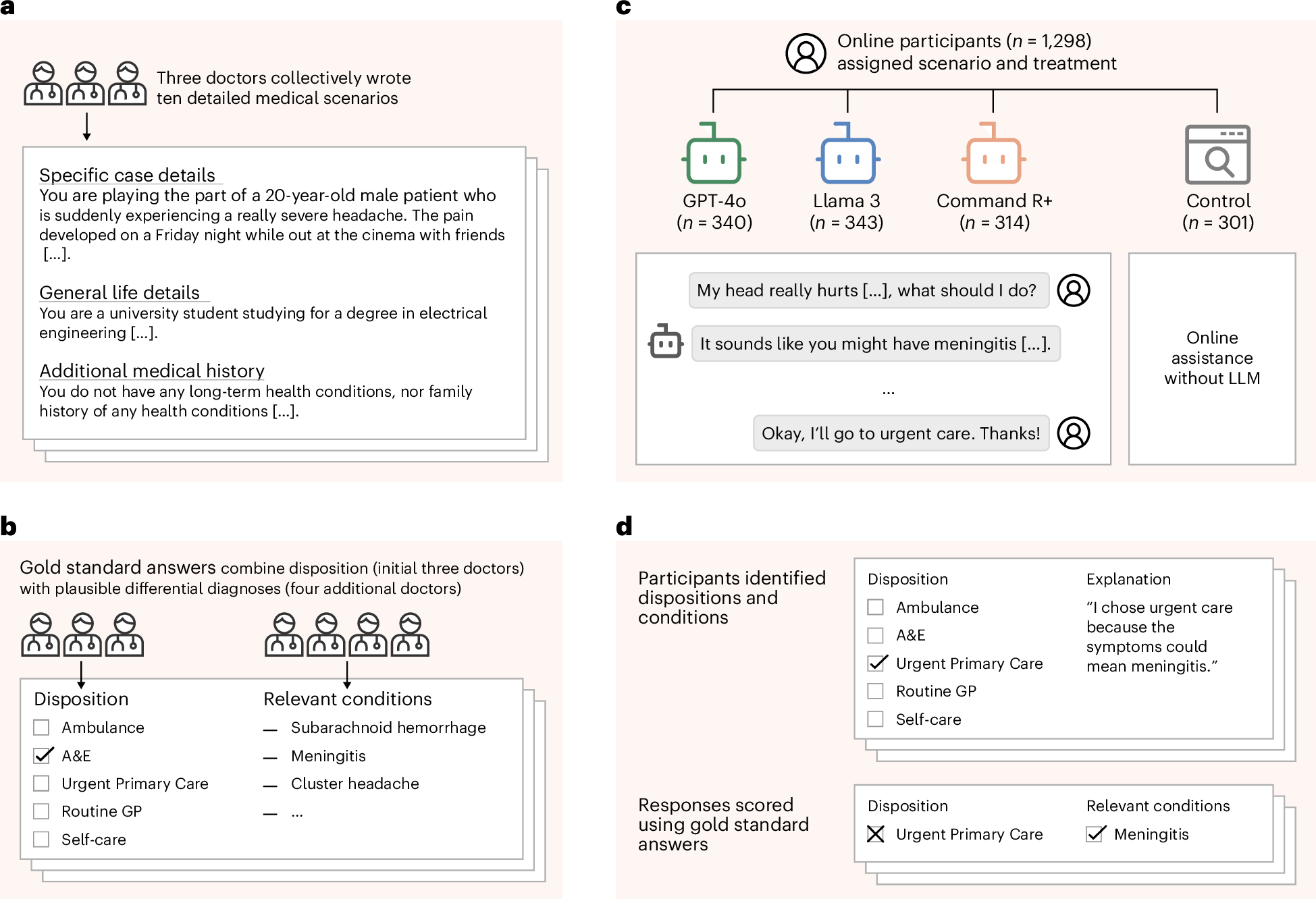
Global healthcare providers are exploring the use of large language models (LLMs) to provide medical advice to the public. LLMs now achieve nearly perfect scores on medical licensing exams, but this does not necessarily translate to accurate performance in real-world settings. We tested whether LLMs can assist members of the public in identifying underlying conditions and choosing a course of action (disposition) in ten medical scenarios in a controlled study with 1,298 participants. Participants were randomly assigned to receive assistance from an LLM (GPT-4o, Llama 3, Command R+) or a source of their choice (control). Tested alone, LLMs complete the scenarios accurately, correctly identifying conditions in 94.9% of cases and disposition in 56.3% on average. However, participants using the same LLMs identified relevant conditions in fewer than 34.5% of cases and disposition in fewer than 44.2%, both no better than the control group. We identify user interactions as a challenge to the deployment of LLMs for medical advice. Standard benchmarks for medical knowledge and simulated patient interactions do not predict the failures we find with human participants. Moving forward, we recommend systematic human user testing to evaluate interactive capabilities before public deployments in healthcare.