


The mechanism of Long Covid (Post-Acute Sequelae of COVID-19; PASC) is currently unknown, with no validated diagnostics or therapeutics. SARS-CoV-2 can cause disseminated infections that result in multi-system tissue damage, dysregulated inflammation, and cellular metabolic disruptions. The tissue damage and inflammation has been shown to impair microvascular circulation, resulting in hypoxia, which coupled with virally-induced metabolic reprogramming, increases cellular anaerobic respiration. Both acute and PASC patients show systemic dysregulation of multiple markers of the acid-base balance. Based on these data, we hypothesize that the shift to anaerobic respiration causes an acid-base disruption that can affect every organ system and underpins the symptoms of PASC. This hypothesis can be tested by longitudinally evaluating acid-base markers in PASC patients and controls over the course of a month. If our hypothesis is correct, this could have significant implications for our understanding of PASC and our ability to develop effective diagnostic and therapeutic approaches.
The CDC whispered this a year ago. “SARS-CoV-2 can have lasting effects on nearly every organ & organ system of the body weeks, months, & potentially years after infection. Documented serious post-Covid conditions include cardiovascular, pulmonary, neurological, renal, endocrin
The CDC whispered this a year ago. “SARS-CoV-2 can have lasting effects on nearly every organ & organ system of the body weeks, months, & potentially years after infection. Documented serious post-Covid conditions include cardiovascular, pulmonary, neurological, renal,… pic.twitter.com/xkSStj51y2— Laura Miers (@LauraMiers) March 9, 2024

Current status and future perspectives on the mechanistic and pathophysiological understanding of long COVID
Viral and infectious illnesses can exert profound and enduring effects on population health and well-being. In the aftermath of SARS-CoV-2 infection, post-acute sequelae, collectively referred to as Long COVID, have emerged as a major global health challenge, affecting more than 400 million people and contributing to estimated annual economic costs exceeding $1 trillion. Long COVID encompasses a wide and heterogeneous spectrum of debilitating symptoms, including cognitive dysfunction, sleep disturbances, severe fatigue, and post-exertional malaise. Despite its substantial burden, fundamental uncertainties remain regarding its underlying pathophysiology, the development of robust diagnostic criteria, and the identification of effective therapeutic options. This review synthesises current evidence on the biological mechanisms thought to contribute to Long COVID, spanning immune dysregulation, viral persistence, autonomic dysfunction, microvascular pathology, and other emerging hypotheses. We examine advances and limitations in contemporary diagnostic approaches and critically appraise existing treatment strategies, highlighting inconsistencies and gaps that hinder clinical consensus. By integrating interdisciplinary insights, this review underscores the urgent need for mechanistic clarity, validated diagnostic frameworks, and rigorously evaluated treatment pathways. Addressing these gaps will be essential to developing effective, evidence-based management strategies and mitigating the long-term impact of Long COVID on global health.
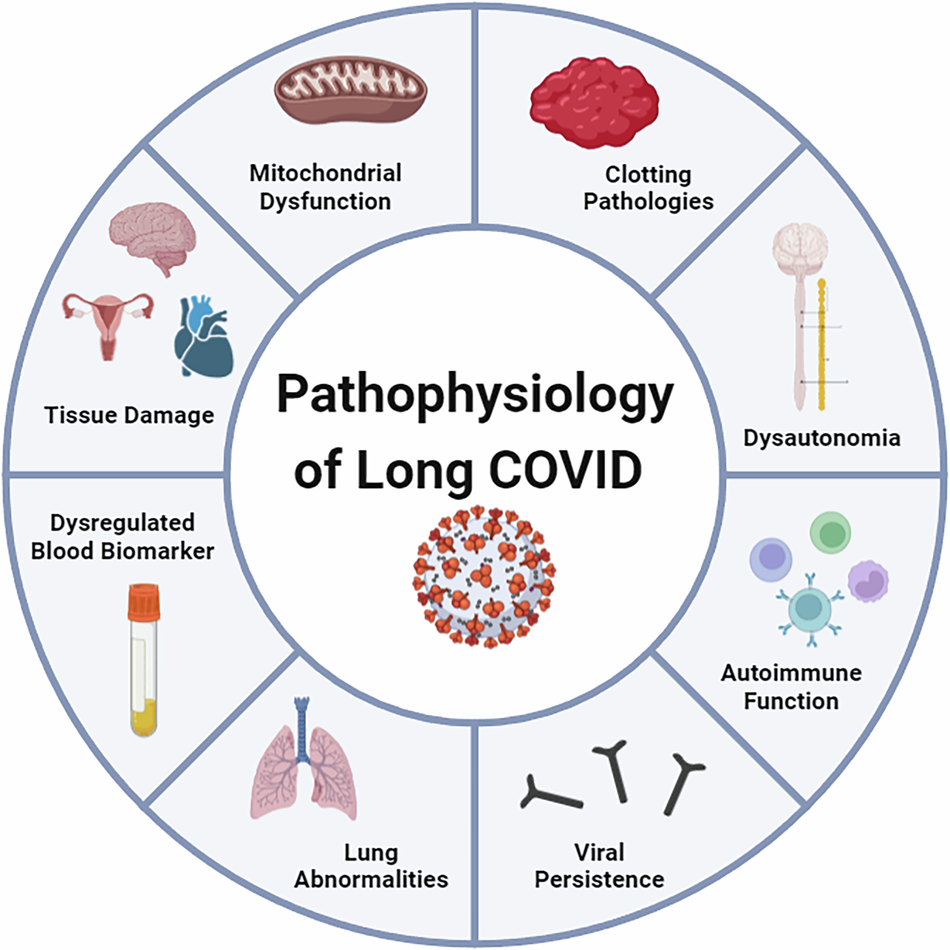
Current status and future perspectives on the mechanistic and pathophysiological understanding of long COVID
Viral and infectious illnesses can exert profound and enduring effects on population health and well-being. In the aftermath of SARS-CoV-2 infection, post-acute sequelae, collectively referred to as Long COVID, have emerged as a major global health challenge, affecting more than 400 million people and contributing to estimated annual economic costs exceeding $1 trillion. Long COVID encompasses a wide and heterogeneous spectrum of debilitating symptoms, including cognitive dysfunction, sleep disturbances, severe fatigue, and post-exertional malaise. Despite its substantial burden, fundamental uncertainties remain regarding its underlying pathophysiology, the development of robust diagnostic criteria, and the identification of effective therapeutic options. This review synthesises current evidence on the biological mechanisms thought to contribute to Long COVID, spanning immune dysregulation, viral persistence, autonomic dysfunction, microvascular pathology, and other emerging hypotheses. We examine advances and limitations in contemporary diagnostic approaches and critically appraise existing treatment strategies, highlighting inconsistencies and gaps that hinder clinical consensus. By integrating interdisciplinary insights, this review underscores the urgent need for mechanistic clarity, validated diagnostic frameworks, and rigorously evaluated treatment pathways. Addressing these gaps will be essential to developing effective, evidence-based management strategies and mitigating the long-term impact of Long COVID on global health.
Nervous system consequences of COVID-19
Neurological symptoms highlight the need to understand pathophysiologic mechanisms , Although severe acute respiratory syndrome coronavirus 2 (SARS-CoV-2) is considered a respiratory pathogen, myriad neurologic complications—including confusion, stroke, and neuromuscular disorders—manifest during acute COVID-19. Furthermore, maladies such as impaired concentration, headache, sensory disturbances, depression, and even psychosis may persist for months after infection, as part of a constellation of symptoms now called Long Covid. Even young people with mild initial disease can develop acute COVID-19 and Long Covid neuropsychiatric syndromes. The pathophysiological mechanisms are not well understood, although evidence primarily implicates immune dysfunction, including nonspecific neuroinflammation and antineural autoimmune dysregulation. It is uncertain whether unforeseen neurological consequences may develop years after initial infection. With millions of individuals affected, nervous system complications pose public health challenges for rehabilitation and recovery and for disruptions in the workforce due to loss of functional capacity. There is an urgent need to understand the pathophysiology of these disorders and develop disease-modifying therapies.

Persistent Cognitive Dysfunction in a Non-Hospitalized COVID-19 Long-Hauler Patient Responding to Cognitive Rehabilitation and Citicoline Treatment
The Severe Acute Respiratory Syndrome Coronavirus 2 (SARS-CoV-2) infection is characterized by severe flu-like symptoms, which can progress to life-threatening systemic inflammation and multiorgan dysfunction. The nervous system is involved in over one-third of patients, and the most common neurological manifestations concern the central nervous system, such as headache, fatigue, and brain fog. The activation of innate, humoral, and cellular immune responses, resulting in a cytokine storm and endothelial and mitochondrial dysfunctions, are the main pathophysiological mechanisms of SARS-CoV-2 infection. Citicoline is an exogenous source of choline and cytidine involved in intracellular phospholipid synthesis, which improves blood flow, brain activity, and mitochondrial dysfunction. This report will present the case of a non-hospitalized, 59-year-old female. After a mild form of SARS-CoV-2 infection, the patient developed cognitive disturbances such as forgetfulness and anomia. The multidimensional neuropsychological assessment revealed an impairment in episodic memory with borderline performance in executive and visuospatial functioning. Cognitive rehabilitation and treatment with citicoline 1000 mg/daily led to a marked improvement in symptoms after six months. Early identification of the neurological sequelae of the Coronavirus Disease 2019 (COVID-19) and timely rehabilitation interventions are required in non-hospitalized long-hauler patients with COVID-19. Long-term treatment with citicoline should be considered as potentially effective in improving cognitive functioning in subjects with Post COVID-19 Neurological Syndrome.

As of today I ~officially~ have long COVID (as recognized by the CDC), so I wanna take a second to explain what’s happening. To set the stage: I’m 30, I’ve been an athlete my entire life, and I used to be extremely healthy, minus some pesky seasonal allergi
As of today I ~officially~ have long COVID (as recognized by the CDC), so I wanna take a second to explain what’s happening. To set the stage: I’m 30, I’ve been an athlete my entire life, and I used to be extremely healthy, minus some pesky seasonal allergies. My resting heart 1/— Savannah Brooks (on medical leave) (@SBLitAgent) May 22, 2022
Precision nutrition to reset virus-induced human metabolic reprogramming and dysregulation (HMRD) in long-COVID
SARS‐CoV‐2, the etiological agent of COVID-19, is devoid of any metabolic capacity; therefore, it is critical for the viral pathogen to hijack host cellular metabolic machinery for its replication and propagation. This single-stranded RNA virus with a 29.9 kb genome encodes 14 open reading frames (ORFs) and initiates a plethora of virus–host protein–protein interactions in the human body. These extensive viral protein interactions with host-specific cellular targets could trigger severe human metabolic reprogramming/dysregulation (HMRD), a rewiring of sugar-, amino acid-, lipid-, and nucleotide-metabolism(s), as well as altered or impaired bioenergetics, immune dysfunction, and redox imbalance in the body. In the infectious process, the viral pathogen hijacks two major human receptors, angiotensin-converting enzyme (ACE)-2 and/or neuropilin (NRP)-1, for initial adhesion to cell surface; then utilizes two major host proteases, TMPRSS2 and/or furin, to gain cellular entry; and finally employs an endosomal enzyme, cathepsin L (CTSL) for fusogenic release of its viral genome. The virus-induced HMRD results in 5 possible infectious outcomes: asymptomatic, mild, moderate, severe to fatal episodes; while the symptomatic acute COVID-19 condition could manifest into 3 clinical phases: (i) hypoxia and hypoxemia (Warburg effect), (ii) hyperferritinemia (‘cytokine storm’), and (iii) thrombocytosis (coagulopathy). The mean incubation period for COVID-19 onset was estimated to be 5.1 days, and most cases develop symptoms after 14 days. The mean viral clearance times were 24, 30, and 39 days for acute, severe, and ICU-admitted COVID-19 patients, respectively. However, about 25–70% of virus-free COVID-19 survivors continue to sustain virus-induced HMRD and exhibit a wide range of symptoms that are persistent, exacerbated, or new ‘onset’ clinical incidents, collectively termed as post-acute sequelae of COVID-19 (PASC) or long COVID. PASC patients experience several debilitating clinical condition(s) with >200 different and overlapping symptoms that may last for weeks to months. Chronic PASC is a cumulative outcome of at least 10 different HMRD-related pathophysiological mechanisms involving both virus-derived virulence factors and a multitude of innate host responses. Based on HMRD and virus-free clinical impairments of different human organs/systems, PASC patients can be categorized into 4 different clusters or sub-phenotypes: sub-phenotype-1 (33.8%) with cardiac and renal manifestations; sub-phenotype-2 (32.8%) with respiratory, sleep and anxiety disorders; sub-phenotype-3 (23.4%) with skeleto-muscular and nervous disorders; and sub-phenotype-4 (10.1%) with digestive and pulmonary dysfunctions. This narrative review elucidates the effects of viral hijack on host cellular machinery during SARS-CoV-2 infection, ensuing detrimental effect(s) of virus-induced HMRD on human metabolism, consequential symptomatic clinical implications, and damage to multiple organ systems; as well as chronic pathophysiological sequelae in virus-free PASC patients. We have also provided a few evidence-based, human randomized controlled trial (RCT)-tested, precision nutrients to reset HMRD for health recovery of PASC patients.

Integration of metabolomics, genomics, and immune phenotypes reveals the causal roles of metabolites in disease
Background Recent studies highlight the role of metabolites in immune diseases, but it remains unknown how much of this effect is driven by genetic and non-genetic host factors. Result We systematically investigate circulating metabolites in a cohort of 500 healthy subjects (500FG) in whom immune function and activity are deeply measured and whose genetics are profiled. Our data reveal that several major metabolic pathways, including the alanine/glutamate pathway and the arachidonic acid pathway, have a strong impact on cytokine production in response to ex vivo stimulation. We also examine the genetic regulation of metabolites associated with immune phenotypes through genome-wide association analysis and identify 29 significant loci, including eight novel independent loci. Of these, one locus (rs174584-FADS2) associated with arachidonic acid metabolism is causally associated with Crohn’s disease, suggesting it is a potential therapeutic target. Conclusion This study provides a comprehensive map of the integration between the blood metabolome and immune phenotypes, reveals novel genetic factors that regulate blood metabolite concentrations, and proposes an integrative approach for identifying new disease treatment targets. Supplementary Information The online version contains supplementary material available at 10.1186/s13059-021-02413-z.
Integration of metabolomics, genomics, and immune phenotypes reveals the causal roles of metabolites in disease
Background Recent studies highlight the role of metabolites in immune diseases, but it remains unknown how much of this effect is driven by genetic and non-genetic host factors. Result We systematically investigate circulating metabolites in a cohort of 500 healthy subjects (500FG) in whom immune function and activity are deeply measured and whose genetics are profiled. Our data reveal that several major metabolic pathways, including the alanine/glutamate pathway and the arachidonic acid pathway, have a strong impact on cytokine production in response to ex vivo stimulation. We also examine the genetic regulation of metabolites associated with immune phenotypes through genome-wide association analysis and identify 29 significant loci, including eight novel independent loci. Of these, one locus (rs174584-FADS2) associated with arachidonic acid metabolism is causally associated with Crohn’s disease, suggesting it is a potential therapeutic target. Conclusion This study provides a comprehensive map of the integration between the blood metabolome and immune phenotypes, reveals novel genetic factors that regulate blood metabolite concentrations, and proposes an integrative approach for identifying new disease treatment targets. Supplementary Information The online version contains supplementary material available at 10.1186/s13059-021-02413-z.
COVID's aftermath: Persistent organ damage at 1 year, lung abnormalities at 2
CIDRAP - Center for Infectious Disease Research & PolicyResearch and Innovation Office, University of Minnesota, Minneapolis, MN

SARS-CoV-2 infects coronary arteries, increases plaque inflammation
NIH-funded research sheds light on link between COVID-19 infection and increased risk of cardiovascular disease and stroke.

What Are COVID-19’s Long-Term Medical Effects?
Fascinating email from TPM Reader JO, whose personal bio is tailor-made for...

Severity of COVID-19 at elevated exposure to perfluorinated alkylates
Background The course of coronavirus disease 2019 (COVID-19) seems to be aggravated by air pollution, and some industrial chemicals, such as the perfluorinated alkylate substances (PFASs), are immunotoxic and may contribute to an association with disease severity. Methods From Danish biobanks, we obtained plasma samples from 323 subjects aged 30–70 years with known SARS-CoV-2 infection. The PFAS concentrations measured at the background exposures included five PFASs known to be immunotoxic. Register data was obtained to classify disease status, other health information, and demographic variables. We used ordered logistic regression analyses to determine associations between PFAS concentrations and disease outcome. Results Plasma-PFAS concentrations were higher in males, in subjects with Western European background, and tended to increase with age, but were not associated with the presence of chronic disease. Of the study population, 108 (33%) had not been hospitalized, and of those hospitalized, 53 (16%) had been in intensive care or were deceased. Among the five PFASs considered, perfluorobutanoic acid (PFBA) showed an unadjusted odds ratio (OR) of 2.19 (95% confidence interval, CI, 1.39–3.46) for increasing severities of the disease. Among those hospitalized, the fully adjusted OR for getting into intensive care or expiring was 5.18 (1.29, 20.72) when based on plasma samples obtained at the time of diagnosis or up to one week before. Conclusions Measures of individual exposures to immunotoxic PFASs included short-chain PFBA known to accumulate in the lungs. Elevated plasma-PFBA concentrations were associated with an increased risk of a more severe course of COVID-19. Given the low background exposure levels in this study, the role of exposure to PFASs in COVID-19 needs to be ascertained in populations with elevated exposures.
From the gut to the lung: microbiota-associated metabolites as regulators of respiratory immunometabolism
The development and progression of respiratory diseases are influenced by both the local pulmonary microenvironment and the intestinal ecosystem. Research on the gut-lung axis has shown that diverse small-molecule metabolites produced or modified by the gut microbiota can cross the intestinal barrier and enter the systemic circulation, where they may modulate immune-cell response thresholds, functional polarisation, and inflammatory dynamics in the distal lung. The local respiratory microbiota may also contribute to the pulmonary metabolic microenvironment, although its role in metabolite production and immune regulation remains less clearly defined.

Orthostatic Intolerance after COVID-19 Infection: Is Disturbed Microcirculation of the Vasa Vasorum of Capacitance Vessels the Primary Defect?
Following COVID-19 infection, a substantial proportion of patients suffer from persistent symptoms known as Long COVID. Among the main symptoms are fatigue, cognitive dysfunction, muscle weakness and orthostatic intolerance (OI). These symptoms also occur in myalgic encephalomyelitis/chronic fatigue (ME/CFS). OI is highly prevalent in ME/CFS and develops early during or after acute COVID-19 infection. The causes for OI are unknown and autonomic dysfunction is hypothetically assumed to be the primary cause, presumably as a consequence of neuroinflammation. Here, we propose an alternative, primary vascular mechanism as the underlying cause of OI in Long COVID. We assume that the capacitance vessel system, which plays a key role in physiologic orthostatic regulation, becomes dysfunctional due to a disturbance of the microvessels and the vasa vasorum, which supply large parts of the wall of those large vessels. We assume that the known microcirculatory disturbance found after COVID-19 infection, resulting from endothelial dysfunction, microthrombus formation and rheological disturbances of blood cells (altered deformability), also affects the vasa vasorum to impair the function of the capacitance vessels. In an attempt to compensate for the vascular deficit, sympathetic activity overshoots to further worsen OI, resulting in a vicious circle that maintains OI. The resulting orthostatic stress, in turn, plays a key role in autonomic dysfunction and the pathophysiology of ME/CFS.

COVID-19

About the disease itself and/or SARS-CoV-2

49% of COVID infections are asymptomatic according to Yale School of Public Health. Yale advises layered protection: N95 masks, HEPA filters…
doi.org