


Multi-scale models can facilitate whole plant simulations by linking gene networks, protein synthesis, metabolic pathways, physiology, and growth. Whole plant models can be further integrated with ecosystem, weather, and climate models to predict how various interactions respond to environmental perturbations. These models have the potential to fill in missing mechanistic details and generate new hypotheses to prioritize directed engineering efforts. Outcomes will potentially accelerate improvement of crop yield, sustainability, and increase future food security. It is time for a paradigm shift in plant modeling, from largely isolated efforts to a connected community that takes advantage of advances in high performance computing and mechanistic understanding of plant processes. Tools for guiding future crop breeding and engineering, understanding the implications of discoveries at the molecular level for whole plant behavior, and improved prediction of plant and ecosystem responses to the environment are urgently needed. The purpose of this perspective is to introduce Crops in silico (cropsinsilico.org), an integrative and multi-scale modeling platform, as one solution that combines isolated modeling efforts toward the generation of virtual crops, which is open and accessible to the entire plant biology community. The major challenges involved both in the development and deployment of a shared, multi-scale modeling platform, which are summarized in this prospectus, were recently identified during the first Crops in silico Symposium and Workshop.
Synthetic Biology of Plants and Microbes for Agriculture, Environment, and Future Applications
Agriculture is under pressure to provide food for a growing population and the feedstock required to drive the bioeconomy. Methods to breed and genetically modify plants are inadequate to keep pace. When engineering crops, traits are painstakingly introduced into plants one-at-a-time, combine unpredictably, and are continuously expressed. Synthetic biology is changing these paradigms with new genome construction tools, computer aided design (CAD), and artificial intelligence (AI). “Smart plants” contain circuits that respond to environmental change, alter morphology, or respond to threats. Further, the plant and associated microbes (fungi, bacteria, archaea) are now being viewed by genetic engineers as a holistic system. Historically, plant health has been enhanced by many natural and laboratory-evolved soil microbes marketed to enhance growth or provide nutrients, or pest/stress resistance. Synthetic biology has expanded the number of species that can be engineered, increased the complexity of engineered functions, controlled environmental release, and can assemble stable consortia. New CAD tools will manage genetic engineering projects spanning multiple plant genomes (nucleus, chloroplast, mitochondrion) and the thousands of genomes of associated bacteria/fungi. This review covers advanced genetic engineering techniques to drive the next agricultural revolution, as well as push plant engineering into new realms for manufacturing, infrastructure, sensing, and remediation.

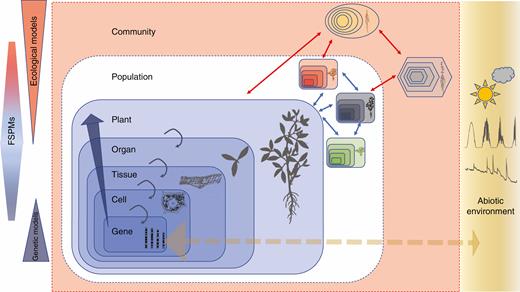
Two decades of functional–structural plant modelling: now addressing fundamental questions in systems biology and predictive ecology
AbstractBackground. Functional–structural plant models (FSPMs) explore and integrate relationships between a plant’s structure and processes that underlie
Computational modeling of plant root development: the art and the science
Plant root development, like any developmental process, arises from the interplay between processes like gene expression, cell-cell signaling, cell growth and division, and tissue mechanics, which unfold over a wide range of temporal and spatial scales. Computational models are uniquely suited to integrate these different processes and spatio-temporal scales to investigate how their interplay determines developmental outcomes and have become part of mainstream plant developmental research. Still, for non-modeling experts, it often remains unclear how models are built, why a particular modeling approach was chosen, and how to interpret and value model outcomes. This review attempts to explain the science behind the art of model building, illustrating the simplifications that are often made to keep models simple to understand and when these are and are not justified. Similarly, it discusses when it is safe to ignore certain processes like growth or tissue mechanics and when it is not. Additionally, this review discusses a range of major breakthrough modeling articles. Their approaches are linked to classical concepts and models in developmental biology like the French flag positional information gradient of Lewis Wolpert and the repetitive patterning mechanism proposed by Turing, in addition to highlighting the lessons they taught us on plant root development.

Some recent developments in controlled-environment agriculture: on plant physiology, sustainability, and autonomous control
In this review, we highlight some recent developments in controlled-environment agriculture (CEA), discuss its sustainability and provide a future outlook, mainly based on recently published work f...

DISCO: Inventing Enzymes for Chemistry | FutureHouse
DISCO is a new multimodal generative model that co-designs protein sequence and 3D structure from scratch.

The SAGE Community Coordinator: A Demonstration
Sustainable polyculture gardens thrive more effectively when they are designed with an awareness of other gardens in the community, as opposed to as individual gardens. However, the complex characteristics of plants, and their relations to other plant species in terms of needs and capacities, require a complex knowledge base not easily acquired by novice gardeners. We contribute a demonstration of our project, called the Software for Agricultural Ecosystems (SAGE) Community Coordinator, that helps manage the complexities of plant relationships and provides planting suggestions based on existing plants in adjacent garden sites. The research team collected the requirements and developed a preliminary demonstration of this system. This demonstration shows the feasibility of the idea and lays the foundation for a more comprehensive implementation of the SAGE Community Coordinator. By doing so, this paper explores the use of technology to foster the establishment of complex plant assemblages in urban and suburban areas to address the current and future limits of material resources derived from plants.
A social-ecological framework for analyzing and designing integrated crop–livestock systems from farm to territory levels
Integrated crop–livestock systems are often considered a promising way to address agricultural sustainability issues. Many authors claim that complementarities and synergies between crops and livestock can improve nutrient cycling and delivery of ecosystem services (ES) in agricultural systems. They have analyzed effects of interactions at the farm level and affirmed the potential advantage of developing crop–livestock interactions at the territory level. However, potential benefits of developing synergies beyond the farm level have not been clearly identified. Thus, we developed a conceptual framework that can be used to analyze, design and perform integrated assessment of crop–livestock systems at the territory level. To address crop–livestock interaction issues, we define it as a social-ecological system called the territorial crop–livestock system (TCLS). The ecological system is represented as three interacting components, crops, grasslands and animals, allowing description of various land uses and their potential effects on nutrient cycling and ES. The social system, represented as farmers interacting with natural-resource managers and agro-food chain actors, determines land use and the nature and intensity of ES delivered. We highlight the importance of coordination and learning among actors to support implementation of complex adaptive systems such as TCLSs. We illustrate the expressive power of our conceptual framework through development of a generic typology of crop–livestock systems. Then we show how our conceptual framework can be used as an intermediary object with stakeholders in participatory design approaches. We illustrate this process by representing four archetypal TCLSs. We provide an example of the design approach implemented in Southwestern France to address severe recurrent water shortages, which includes analysis of land use in the current crop–livestock system and the associated key metabolic and ES issues, identification of options for change and multi-criteria analysis of these options. We conclude that this framework shows great potential to support development of sustainable farming systems at the territory level.
Controlled Mold
A blog about fermentation, engineering, and cell-ag. We run wild experiments on microbes and try to eat them, all with the help of computers and math.
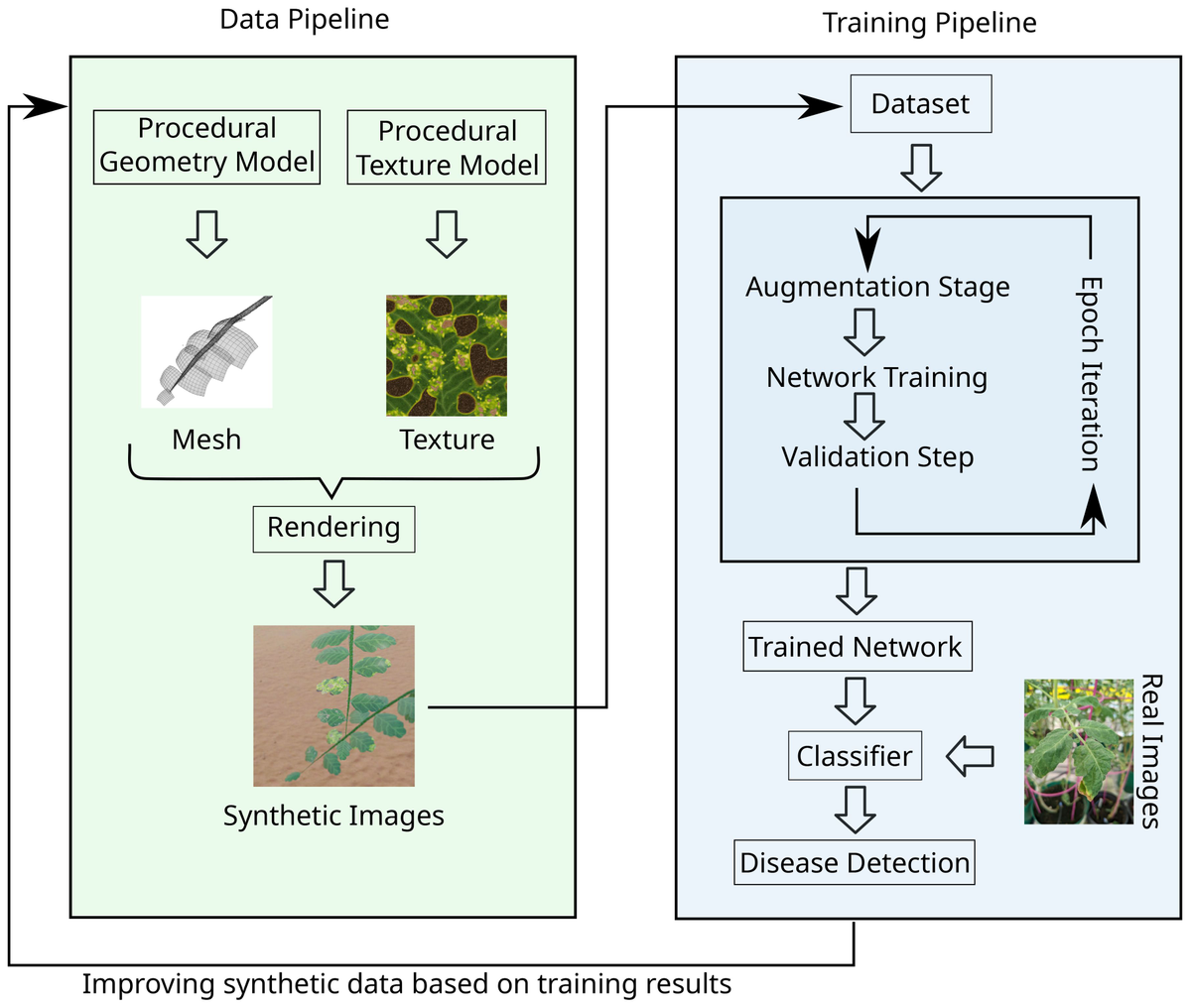
Synthetic data at scale: a development model to efficiently leverage machine learning in agriculture
The rise of artificial intelligence (AI) and in particular modern machine learning (ML) algorithms during the last decade has been met with great interest in the agricultural industry. While undisputedly powerful, their main drawback remains the need for sufficient and diverse training data. The collection of real datasets and their annotation are the main cost drivers of ML developments, and while promising results on synthetically generated training data have been shown, their generation is not without difficulties on their own. In this paper, we present a development model for the iterative, cost-efficient generation of synthetic training data. Its application is demonstrated by developing a low-cost early disease detector for tomato plants (Solanum lycopersicum) using synthetic training data. A neural classifier is trained by exclusively using synthetic images, whose generation process is iteratively refined to obtain optimal performance. In contrast to other approaches that rely on a human assessment of similarity between real and synthetic data, we instead introduce a structured, quantitative approach. Our evaluation shows superior generalization results when compared to using non-task-specific real training data and a higher cost efficiency of development compared to traditional synthetic training data.
NeuroRVQ: Multi-Scale Biosignal Tokenization for Generative Foundation Models
NeuroRVQ: Multi-Scale Biosignal Tokenization for Generative Foundation Models
In silico experiments of bone remodeling explore metabolic diseases and their drug treatment
In silico experiments of bone remodeling enable observation and prediction of physiological and pathological bone conditions. , Bone structure and function are maintained by well-regulated bone metabolism and remodeling. Although the underlying molecular and cellular mechanisms are now being understood, physiological and pathological states of bone are still difficult to predict due to the complexity of intercellular signaling. We have now developed a novel in silico experimental platform, V-Bone, to integratively explore bone remodeling by linking complex microscopic molecular/cellular interactions to macroscopic tissue/organ adaptations. Mechano-biochemical couplings modeled in V-Bone relate bone adaptation to mechanical loading and reproduce metabolic bone diseases such as osteoporosis and osteopetrosis. V-Bone also enables in silico perturbation on a specific signaling molecule to observe bone metabolic dynamics over time. We also demonstrate that this platform provides a powerful way to predict in silico therapeutic effects of drugs against metabolic bone diseases. We anticipate that these in silico experiments will substantially accelerate research into bone metabolism and remodeling.

Biohub releases a world model of protein biology
Open AI models used for a wide range of scientific applications, including accelerating the design of therapeutic molecules.
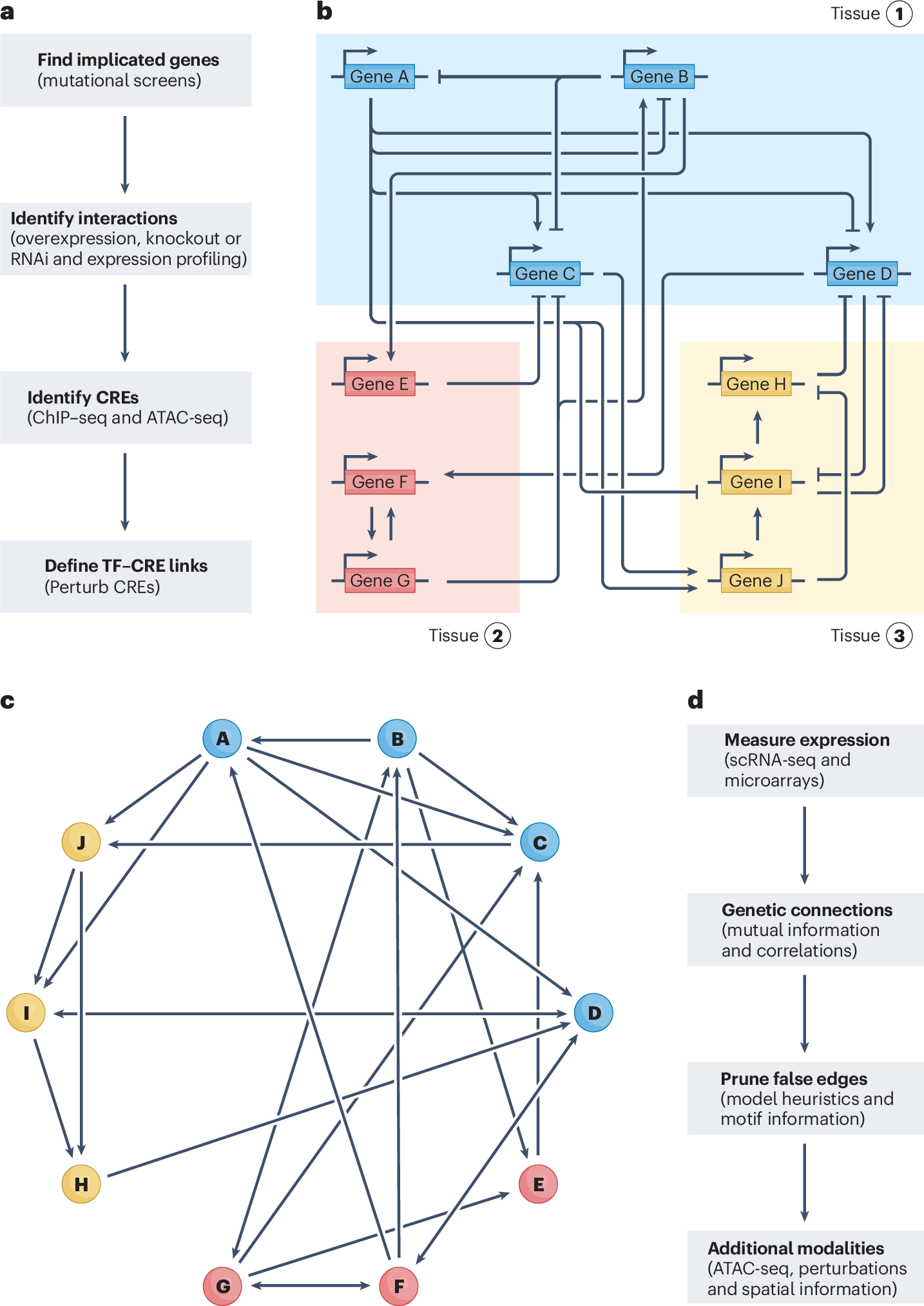
Gene regulatory networks: from correlative models to causal explanations
Gene regulatory networks (GRNs) explain how the genome controls cellular behaviour and tissue morphogenesis, serving to connect molecular mechanism to functional output. Single-cell technologies now provide descriptions of these networks with unprecedented detail, but this advance has also revealed gene regulatory systems that are too complex for our existing conceptual frameworks. GRNs, which should provide mechanistic explanations, are increasingly reduced to statistical correlations — ‘hairballs’ that fail to capture molecular causation. Here, we explore why this dilemma exists and propose a path forward. We argue that methods in ‘representation learning’ can be used to model GRNs, without needing to capture every molecular detail. For this framework, we advocate three linked principles: models must be inherently mechanistic, with structures grounded in cellular and evolutionary biology; molecular principles and constraints must be used to reduce the solution space for learning GRN models; and more sophisticated forms of experimental perturbation and synthetic biological engineering are needed to train models and test predictions. By reimagining GRNs through these principles, we can bridge the gap from data abundance to new conceptual understanding.
About the Network
About the network Our vision is for a thriving and resilient food production system across BC. Since 2017, the BC Agricultural Climate Action Research Network (ACARN) has been working to make climate research more accessible and useful for the agricultural sector. By connecting people across disciplines and regions, we help ensure that climate solutions are […]
Crop–livestock integration beyond the farm level: a review
AbstractParadoxically, the number of crop–livestock farms is declining across Europe, despite the fact that crop-livestock farms are theoretically optimal to improve the sustainability of agriculture. To solve this issue, crop–livestock integration may be organized beyond the farm level. For instance, local groups of farmers can negotiate land-use allocation patterns and exchange materials such as manure, grain, and straw. Development of such a collective agricultural system raises questions, rarely documented in the literature, about how to integrate crops and livestock among farms, and the consequences, impacts, and conditions of integrating them. Here, we review the different forms of crop–livestock integration beyond the farm level, their potential benefits, and the features of decision support systems (DSS) needed for the integration process. We identify three forms of crop–livestock integration beyond the farm level: local coexistence, complementarity, and synergy, each with increasingly stronger temporal, spatial, and organizational coordination among farms. We claim that the forms of integration implemented define the nature, area, and spatial configuration of crops, grasslands, and animals in farms and landscapes. In turn, these configurations influence the provision of ecosystem services. For instance, we show that the synergy form of integration promotes soil fertility, erosion control, and field-level biological regulation services through organizational coordination among farmers and spatiotemporal integration between crops, grasslands, and animals. We found that social benefits of the synergy form of integration include collective empowerment of farmers. We claim that design of the complementarity and synergy forms of crop–livestock integration can best be supported by collective participatory workshops involving farmers, agricultural consultants, and researchers. In these workshops, spatialized simulation modeling of crop–livestock integration among farms is the basis for achieving the upscaling process involved in integrating beyond the farm level. Facilitators of these workshops have to pay attention to the consequences on governance and equity issues within farmers groups.
https://www.thegardensaltspring.com/The Garden Salt Spring Island | cold-hardy citrus & avocado production in Canada | growing healthy soils & nutrient dense food | anaerobic digestion & Johnson-Su
The Garden is an innovative farm in Canada's Pacific Southwest. It focuses on developing resource-efficient systems for greenhouse and orchard production. It applies regenerative practices for on-farm nutrient cycling. The farm operates a small-scale anaerobic digester, has extensive rainwater catchment, and assesses progress with on-farm analysis of soil and plants using Soil Food Web microscopy, brix, and off-farm leaf sap analysis. Visit our blog, YouTube channel and workshop opportunities.