


The rise of artificial intelligence (AI) and in particular modern machine learning (ML) algorithms during the last decade has been met with great interest in the agricultural industry. While undisputedly powerful, their main drawback remains the need for sufficient and diverse training data. The collection of real datasets and their annotation are the main cost drivers of ML developments, and while promising results on synthetically generated training data have been shown, their generation is not without difficulties on their own. In this paper, we present a development model for the iterative, cost-efficient generation of synthetic training data. Its application is demonstrated by developing a low-cost early disease detector for tomato plants (Solanum lycopersicum) using synthetic training data. A neural classifier is trained by exclusively using synthetic images, whose generation process is iteratively refined to obtain optimal performance. In contrast to other approaches that rely on a human assessment of similarity between real and synthetic data, we instead introduce a structured, quantitative approach. Our evaluation shows superior generalization results when compared to using non-task-specific real training data and a higher cost efficiency of development compared to traditional synthetic training data.
Dataset Condensation with Gradient Matching
As the state-of-the-art machine learning methods in many fields rely on larger datasets, storing datasets and training models on them become significantly more expensive. This paper proposes a training set synthesis technique for data-efficient learning, called Dataset Condensation, that learns to condense large dataset into a small set of informative synthetic samples for training deep neural networks from scratch. We formulate this goal as a gradient matching problem between the gradients of deep neural network weights that are trained on the original and our synthetic data. We rigorously evaluate its performance in several computer vision benchmarks and demonstrate that it significantly outperforms the state-of-the-art methods. Finally we explore the use of our method in continual learning and neural architecture search and report promising gains when limited memory and computations are available.
Dataset Condensation with Distribution Matching
Computational cost to train state-of-the-art deep models in many learning problems is rapidly increasing due to more sophisticated models and larger datasets. A recent promising direction to reduce training time is dataset condensation that aims to replace the original large training set with a significantly smaller learned synthetic set while preserving its information. While training deep models on the small set of condensed images can be extremely fast, their synthesis remains computationally expensive due to the complex bi-level optimization and second-order derivative computation. In this work, we propose a simple yet effective dataset condensation technique that requires significantly lower training cost with comparable performance by matching feature distributions of the synthetic and original training images in sampled embedding spaces. Thanks to its efficiency, we apply our method to more realistic and larger datasets with sophisticated neural architectures and achieve a significant performance boost while using larger synthetic training set. We also show various practical benefits of our method in continual learning and neural architecture search.
GAN-Based Data Augmentation for Prediction Improvement Using Gene Expression Data in Cancer
Within the area of bioinformatics, Deep Learning (DL) models have shown exceptional results in applications in which histological images, scans and tomographies are used. However, when gene expression data is under analysis, the performance is often limited, further hampered by the complexity of these models that require several instances, in the order of thousands, to provide good results. Due to the difficulty and the costs involved in the collection of medical data, the application of Data Augmentation (DA) techniques to alleviate the lack of samples is a topic of great relevance. State-of-the-art models based on Conditional Generative Adversarial Networks (CGAN) and some introduced modifications are used in this work to investigate the effect of DA for prediction of the vital status of patients from RNA-Seq gene expression data. Experimental results on several real-world data sets demonstrate the effectiveness and efficiency of the proposed models. The application of DA methods significantly increase prediction accuracy, leading by 12% with respect to benchmark data sets and 3.15% with respect to data processed with feature selection. Results based on CGAN models outperform in most cases, alternative methods like the SMOTE or noise injection techniques.

Realistic in silico generation and augmentation of single cell RNA-seq data using Generative Adversarial Neural Networks
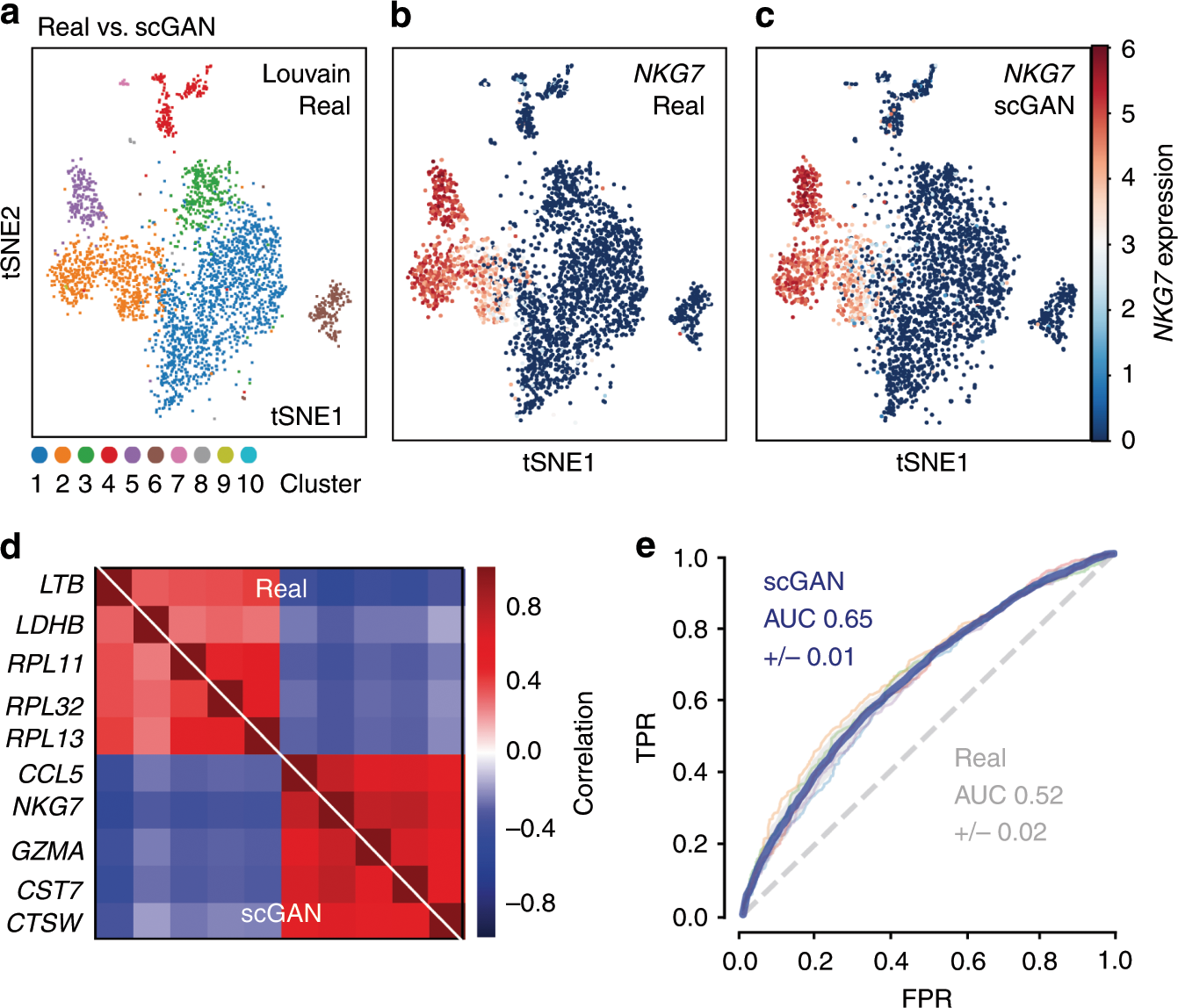
A fundamental problem in biomedical research is the low number of observations available, mostly due to a lack of available biosamples, prohibitive costs, or ethical reasons. Augmenting few real observations with generated in silico samples could lead to more robust analysis results and a higher reproducibility rate. Here we propose the use of conditional single cell Generative Adversarial Neural Networks (cscGANs) for the realistic generation of single cell RNA-seq data. cscGANs learn non-linear gene-gene dependencies from complex, multi cell type samples and use this information to generate realistic cells of defined types. Augmenting sparse cell populations with cscGAN generated cells improves downstream analyses such as the detection of marker genes, the robustness and reliability of classifiers, the assessment of novel analysis algorithms, and might reduce the number of animal experiments and costs in consequence. cscGANs outperform existing methods for single cell RNA-seq data generation in quality and hold great promise for the realistic generation and augmentation of other biomedical data types. *

Realistic in silico generation and augmentation of single-cell RNA-seq data using generative adversarial networks
A fundamental problem in biomedical research is the low number of observations available, mostly due to a lack of available biosamples, prohibitive costs, or ethical reasons. Augmenting few real observations with generated in silico samples could lead to more robust analysis results and a higher reproducibility rate. Here, we propose the use of conditional single-cell generative adversarial neural networks (cscGAN) for the realistic generation of single-cell RNA-seq data. cscGAN learns non-linear gene–gene dependencies from complex, multiple cell type samples and uses this information to generate realistic cells of defined types. Augmenting sparse cell populations with cscGAN generated cells improves downstream analyses such as the detection of marker genes, the robustness and reliability of classifiers, the assessment of novel analysis algorithms, and might reduce the number of animal experiments and costs in consequence. cscGAN outperforms existing methods for single-cell RNA-seq data generation in quality and hold great promise for the realistic generation and augmentation of other biomedical data types.
Dataset Distillation
Model distillation aims to distill the knowledge of a complex model into a simpler one. In this paper, we consider an alternative formulation called {\em dataset distillation}: we keep the model fixed and instead attempt to distill the knowledge from a large training dataset into a small one. The idea is to {\em synthesize} a small number of data points that do not need to come from the correct data distribution, but will, when given to the learning algorithm as training data, approximate the model trained on the original data. For example, we show that it is possible to compress $60,000$ MNIST training images into just $10$ synthetic {\em distilled images} (one per class) and achieve close to original performance with only a few steps of gradient descent, given a particular fixed network initialization. We evaluate our method in a wide range of initialization settings and with different learning objectives. Experiments on multiple datasets show the advantage of our approach compared to alternative methods in most settings.
Meta-Weight-Net: Learning an Explicit Mapping For Sample Weighting
Current deep neural networks(DNNs) can easily overfit to biased training data with corrupted labels or class imbalance. Sample re-weighting strategy is commonly used to alleviate this issue by designing a weighting function mapping from training loss to sample weight, and then iterating between weight recalculating and classifier updating. Current approaches, however, need manually pre-specify the weighting function as well as its additional hyper-parameters. It makes them fairly hard to be generally applied in practice due to the significant variation of proper weighting schemes relying on the investigated problem and training data. To address this issue, we propose a method capable of adaptively learning an explicit weighting function directly from data. The weighting function is an MLP with one hidden layer, constituting a universal approximator to almost any continuous functions, making the method able to fit a wide range of weighting function forms including those assumed in conventional research. Guided by a small amount of unbiased meta-data, the parameters of the weighting function can be finely updated simultaneously with the learning process of the classifiers. Synthetic and real experiments substantiate the capability of our method for achieving proper weighting functions in class imbalance and noisy label cases, fully complying with the common settings in traditional methods, and more complicated scenarios beyond conventional cases. This naturally leads to its better accuracy than other state-of-the-art methods.
Distilling Dataset into Neural Field
Utilizing a large-scale dataset is essential for training high-performance deep learning models, but it also comes with substantial computation and storage costs. To overcome these challenges, dataset distillation has emerged as a promising solution by compressing the large-scale dataset into a smaller synthetic dataset that retains the essential information needed for training. This paper proposes a novel parameterization framework for dataset distillation, coined Distilling Dataset into Neural Field (DDiF), which leverages the neural field to store the necessary information of the large-scale dataset. Due to the unique nature of the neural field, which takes coordinates as input and output quantity, DDiF effectively preserves the information and easily generates various shapes of data. We theoretically confirm that DDiF exhibits greater expressiveness than some previous literature when the utilized budget for a single synthetic instance is the same. Through extensive experiments, we demonstrate that DDiF achieves superior performance on several benchmark datasets, extending beyond the image domain to include video, audio, and 3D voxel. We release the code at \url{https://github.com/aailab-kaist/DDiF}.
OpenDataVal: a Unified Benchmark for Data Valuation
Assessing the quality and impact of individual data points is critical for improving model performance and mitigating undesirable biases within the training dataset. Several data valuation algorithms have been proposed to quantify data quality, however, there lacks a systemic and standardized benchmarking system for data valuation. In this paper, we introduce OpenDataVal, an easy-to-use and unified benchmark framework that empowers researchers and practitioners to apply and compare various data valuation algorithms. OpenDataVal provides an integrated environment that includes (i) a diverse collection of image, natural language, and tabular datasets, (ii) implementations of eleven different state-of-the-art data valuation algorithms, and (iii) a prediction model API that can import any models in scikit-learn. Furthermore, we propose four downstream machine learning tasks for evaluating the quality of data values. We perform benchmarking analysis using OpenDataVal, quantifying and comparing the efficacy of state-of-the-art data valuation approaches. We find that no single algorithm performs uniformly best across all tasks, and an appropriate algorithm should be employed for a user's downstream task. OpenDataVal is publicly available at https://opendataval.github.io with comprehensive documentation. Furthermore, we provide a leaderboard where researchers can evaluate the effectiveness of their own data valuation algorithms.
Self-Consuming Generative Models Go MAD
Seismic advances in generative AI algorithms for imagery, text, and other data types has led to the temptation to use synthetic data to train next-generation models. Repeating this process creates an autophagous (self-consuming) loop whose properties are poorly understood. We conduct a thorough analytical and empirical analysis using state-of-the-art generative image models of three families of autophagous loops that differ in how fixed or fresh real training data is available through the generations of training and in whether the samples from previous generation models have been biased to trade off data quality versus diversity. Our primary conclusion across all scenarios is that without enough fresh real data in each generation of an autophagous loop, future generative models are doomed to have their quality (precision) or diversity (recall) progressively decrease. We term this condition Model Autophagy Disorder (MAD), making analogy to mad cow disease.

Distributionally Robust Data Valuation
Data valuation quantifies the contribution of each data point to the performance of a machine learning model. Existing works typically define the value of data by its improvement of the validation performance of the trained model. However, this approach can be impractical to apply in collaborative machine learning and data marketplace since it is difficult for the parties/buyers to agree on a common validation dataset or determine the exact validation distribution a priori. To address this, we propose a distributionally robust data valuation approach to perform data valuation without known/fixed validation distributions. Our approach defines the value of data by its improvement of the distributionally robust generalization error (DRGE), thus providing a worst-case performance guarantee without a known/fixed validation distribution. However, since computing DRGE directly is infeasible, we propose using model deviation as a proxy for the marginal improvement of DRGE (for kernel regression and neural networks) to compute data values. Furthermore, we identify a notion of uniqueness where low uniqueness characterizes low-value data. We empirically demonstrate that our approach outperforms existing data valuation approaches in data selection and data removal tasks on real-world datasets (e.g., housing price prediction, diabetes hospitalization prediction).
Datamodels: Predicting Predictions from Training Data
We present a conceptual framework, datamodeling, for analyzing the behavior of a model class in terms of the training data. For any fixed "target" example $x$, training set $S$, and learning algorithm, a datamodel is a parameterized function $2^S \to \mathbb{R}$ that for any subset of $S' \subset S$ -- using only information about which examples of $S$ are contained in $S'$ -- predicts the outcome of training a model on $S'$ and evaluating on $x$. Despite the potential complexity of the underlying process being approximated (e.g., end-to-end training and evaluation of deep neural networks), we show that even simple linear datamodels can successfully predict model outputs. We then demonstrate that datamodels give rise to a variety of applications, such as: accurately predicting the effect of dataset counterfactuals; identifying brittle predictions; finding semantically similar examples; quantifying train-test leakage; and embedding data into a well-behaved and feature-rich representation space. Data for this paper (including pre-computed datamodels as well as raw predictions from four million trained deep neural networks) is available at https://github.com/MadryLab/datamodels-data .
Data Shapley: Equitable Valuation of Data for Machine Learning
As data becomes the fuel driving technological and economic growth, a fundamental challenge is how to quantify the value of data in algorithmic predictions and decisions. For example, in healthcare and consumer markets, it has been suggested that individuals should be compensated for the data that they generate, but it is not clear what is an equitable valuation for individual data. In this work, we develop a principled framework to address data valuation in the context of supervised machine learning. Given a learning algorithm trained on $n$ data points to produce a predictor, we propose data Shapley as a metric to quantify the value of each training datum to the predictor performance. Data Shapley uniquely satisfies several natural properties of equitable data valuation. We develop Monte Carlo and gradient-based methods to efficiently estimate data Shapley values in practical settings where complex learning algorithms, including neural networks, are trained on large datasets. In addition to being equitable, extensive experiments across biomedical, image and synthetic data demonstrate that data Shapley has several other benefits: 1) it is more powerful than the popular leave-one-out or leverage score in providing insight on what data is more valuable for a given learning task; 2) low Shapley value data effectively capture outliers and corruptions; 3) high Shapley value data inform what type of new data to acquire to improve the predictor.
BadNets: Identifying Vulnerabilities in the Machine Learning Model Supply Chain
Deep learning-based techniques have achieved state-of-the-art performance on a wide variety of recognition and classification tasks. However, these networks are typically computationally expensive to train, requiring weeks of computation on many GPUs; as a result, many users outsource the training procedure to the cloud or rely on pre-trained models that are then fine-tuned for a specific task. In this paper we show that outsourced training introduces new security risks: an adversary can create a maliciously trained network (a backdoored neural network, or a \emph{BadNet}) that has state-of-the-art performance on the user's training and validation samples, but behaves badly on specific attacker-chosen inputs. We first explore the properties of BadNets in a toy example, by creating a backdoored handwritten digit classifier. Next, we demonstrate backdoors in a more realistic scenario by creating a U.S. street sign classifier that identifies stop signs as speed limits when a special sticker is added to the stop sign; we then show in addition that the backdoor in our US street sign detector can persist even if the network is later retrained for another task and cause a drop in accuracy of {25}\% on average when the backdoor trigger is present. These results demonstrate that backdoors in neural networks are both powerful and---because the behavior of neural networks is difficult to explicate---stealthy. This work provides motivation for further research into techniques for verifying and inspecting neural networks, just as we have developed tools for verifying and debugging software.
Learning to Reweight Examples for Robust Deep Learning
Deep neural networks have been shown to be very powerful modeling tools for many supervised learning tasks involving complex input patterns. However, they can also easily overfit to training set biases and label noises. In addition to various regularizers, example reweighting algorithms are popular solutions to these problems, but they require careful tuning of additional hyperparameters, such as example mining schedules and regularization hyperparameters. In contrast to past reweighting methods, which typically consist of functions of the cost value of each example, in this work we propose a novel meta-learning algorithm that learns to assign weights to training examples based on their gradient directions. To determine the example weights, our method performs a meta gradient descent step on the current mini-batch example weights (which are initialized from zero) to minimize the loss on a clean unbiased validation set. Our proposed method can be easily implemented on any type of deep network, does not require any additional hyperparameter tuning, and achieves impressive performance on class imbalance and corrupted label problems where only a small amount of clean validation data is available.
mixup: Beyond Empirical Risk Minimization
Large deep neural networks are powerful, but exhibit undesirable behaviors such as memorization and sensitivity to adversarial examples. In this work, we propose mixup, a simple learning principle to alleviate these issues. In essence, mixup trains a neural network on convex combinations of pairs of examples and their labels. By doing so, mixup regularizes the neural network to favor simple linear behavior in-between training examples. Our experiments on the ImageNet-2012, CIFAR-10, CIFAR-100, Google commands and UCI datasets show that mixup improves the generalization of state-of-the-art neural network architectures. We also find that mixup reduces the memorization of corrupt labels, increases the robustness to adversarial examples, and stabilizes the training of generative adversarial networks.