


BackgroundBayesian regression models provide a robust framework for complex data analysis, which is particularly advantageous in scenarios with small sample sizes, common in psychology or medical research. However, specifying appropriate prior distributions that incorporate existing knowledge to regularize model parameters remains a challenge for many researchers. This can lead to unstable or implausible estimates. This study aims to demonstrate the impact of different prior distributions on regression models and to provide a practical guide for choosing and justifying informative priors to produce more stable and credible results.MethodsThe study involved two parts. First, a simulation study was conducted to systematically assess the sensitivity of Bayesian linear regression models to prior specification. We systematically varied the sample size, prior location, and prior scale to observe their impact on posterior estimates for a known true effect size. Second, a case–control study using real-world patient data (N = 526) demonstrated the practical application of choosing informative priors. Bayesian logistic regression models were used to analyze the relationship between severe dementia and fall incidence, comparing results from priors based on existing literature (“believer”), conservative priors (“agnostic”), and priors assuming an opposite effect (“skeptical”).ResultsThe simulation study showed that strongly informative priors had a substantial influence on posterior estimates, particularly for smaller sample sizes. As the sample size increased, the influence of the data increased, and the estimates converged toward the true effect. In the case–control study, a standard frequentist logistic regression produced an odds ratio of 8.87 with a very wide and unstable confidence interval (1.66–165.19), likely due to data sparsity. In contrast, a Bayesian model using a moderately informative “believer” prior derived from existing research yielded a more stable and plausible odds ratio of 4.01 with a substantially narrower credible interval (1.99–8.78).ConclusionCareful and transparent specification of informative priors is a critical tool in Bayesian analysis, especially when data are sparse. By incorporating justified evidence-based assumptions, researchers can regularize models to prevent implausible outcomes and produce more stable, interpretable, and credible results. This approach enhances the robustness of statistical inference in fields where small sample sizes are a frequent challenge.
Prior Modeling
In Bayesian inference the prior model provides a valuable opportunity to incorporate domain expertise into our inferences. Unfortunately this opportunity often becomes a contentious issue in many fields, and this potential value is lost in the debate. In this case study I will discuss the challenges of building prior models that capture meaningful domain expertise and some practical strategies for ameliorating those challenges as much as possible.
The Wisdom of Individuals: Exploring People's Knowledge About Everyday Events Using Iterated Learning
Abstract Determining the knowledge that guides human judgments is fundamental to understanding how people reason, make decisions, and form predictions. We use an experimental procedure called ‘‘iterated learning,’’ in which the responses that people give on one trial are used to generate the data they see on the next, to pinpoint the knowledge that informs people's predictions about everyday events (e.g., predicting the total box office gross of a movie from its current take). In particular, we use this method to discriminate between two models of human judgments: a simple Bayesian model ( Griffiths & Tenenbaum, 2006 ) and a recently proposed alternative model that assumes people store only a few instances of each type of event in memory (Min K ; Mozer, Pashler, & Homaei, 2008 ). Although testing these models using standard experimental procedures is difficult due to differences in the number of free parameters and the need to make assumptions about the knowledge of individual learners, we show that the two models make very different predictions about the outcome of iterated learning. The results of an experiment using this methodology provide a rich picture of how much people know about the distributions of everyday quantities, and they are inconsistent with the predictions of the Min K model. The results suggest that accurate predictions about everyday events reflect relatively sophisticated knowledge on the part of individuals.

Statistical Models Answer the Fundamental Clinical Question and Provide Clinical Trial Estimands – Statistical Thinking
Specific goals and estimation targets for randomized clinical trials have still not been well defined for general outcome variables. Proponents of causal inference calculus have claimed to define goals and estimands, but they have largely done so in a way that is not concordant with the most popular design, the parallel-group randomized trial. Causal inferential methods require the use of counterfactuals that are not informed by any data (outside of crossover studies) and make assumptions that are unverifiable, e.g., about the correlation structure of potential outcomes. Causal inferential structure also leads practitioners to act as if marginal treatment effect estimates are both helpful in decision making and transport to populations when in fact neither is true. Heterogeneity of participants within a treatment arm dictates heterogeneity of outcomes and heterogeneity of treatment effects when quantified on an absolute scale. Statistical models are best poised for estimation and causal inference that is specific to patient types. The increasing generality and robustness of statistical models bolsters the case. In this article I provide a succinct statement of the clinical goal of a parallel-group trial, and statistical estimands for it in the context of a general family of robust and efficient ordinal models that contain virtually all routinely used statistical models and tests as special cases.
A Bayesian Approach To Analysing Training Data Attribution In Deep Learning
Training data attribution (TDA) techniques find influential training data for the model's prediction on the test data of interest. They approximate the impact of down- or up-weighting a particular training sample. While conceptually useful, they are hardly applicable to deep models in practice, particularly because of their sensitivity to different model initialisation. In this paper, we introduce a Bayesian perspective on the TDA task, where the learned model is treated as a Bayesian posterior and the TDA estimates as random variables. From this novel viewpoint, we observe that the influence of an individual training sample is often overshadowed by the noise stemming from model initialisation and SGD batch composition. Based on this observation, we argue that TDA can only be reliably used for explaining deep model predictions that are consistently influenced by certain training data, independent of other noise factors. Our experiments demonstrate the rarity of such noise-independent training-test data pairs but confirm their existence. We recommend that future researchers and practitioners trust TDA estimates only in such cases. Further, we find a disagreement between ground truth and estimated TDA distributions and encourage future work to study this gap. Code is provided at https://github.com/ElisaNguyen/bayesian-tda.

A Bayesian Approach To Analysing Training Data Attribution In Deep Learning
Training data attribution (TDA) techniques find influential training data for the model's prediction on the test data of interest. They approximate the impact of down- or up-weighting a particular training sample. While conceptually useful, they are hardly applicable to deep models in practice, particularly because of their sensitivity to different model initialisation. In this paper, we introduce a Bayesian perspective on the TDA task, where the learned model is treated as a Bayesian posterior and the TDA estimates as random variables. From this novel viewpoint, we observe that the influence of an individual training sample is often overshadowed by the noise stemming from model initialisation and SGD batch composition. Based on this observation, we argue that TDA can only be reliably used for explaining deep model predictions that are consistently influenced by certain training data, independent of other noise factors. Our experiments demonstrate the rarity of such noise-independent training-test data pairs but confirm their existence. We recommend that future researchers and practitioners trust TDA estimates only in such cases. Further, we find a disagreement between ground truth and estimated TDA distributions and encourage future work to study this gap. Code is provided at https://github.com/ElisaNguyen/bayesian-tda.
A Nonparametric Approach to Practical Identifiability of Nonlinear Mixed Effects Models
Mathematical modelling is a widely used approach to understand and interpret clinical trial data. This modelling typically involves fitting mechanistic mathematical models to data from individual trial participants. Despite the widespread adoption of this individual-based fitting, it is becoming increasingly common to take a hierarchical approach to parameter estimation, where modellers characterize the population parameter distributions, rather than considering each individual independently. This hierarchical parameter estimation is standard in pharmacometric modelling. However, many of the existing techniques for parameter identifiability do not immediately translate from the individual-based fitting to the hierarchical setting. In this work, we propose a nonparametric approach to study practical identifiability within a hierarchical parameter estimation framework. We focus on the commonly used nonlinear mixed effects framework and investigate two well-studied examples from the pharmacometrics and viral dynamics literature to illustrate the potential utility of our approach.

Promises and Perils of Pre-analysis Plans
The purpose of this paper is to help think through the advantages and costs of rigorous pre-specification of statistical analysis plans in economics. A pre-analysis plan pre-specifies in a precise way the analysis to be run before examining the data. A researcher can specify variables, data cleaning procedures, regression specifications, and so on. If the regressions are pre-specified in advance and researchers are required to report all the results they pre-specify, data-mining problems are greatly reduced. I begin by laying out the basics of what a statistical analysis plan actually contains so those researchers unfamiliar with it can better understand how it is done. In so doing, I have drawn both on standards used in clinical trials, which are clearly specified by the Food and Drug Administration, as well as my own practical experience from writing these plans in economics contexts. I then lay out some of the advantages of pre-specified analysis plans, both for the scientific community as a whole and also for the researcher. I also explore some of the limitations and costs of such plans. I then review a few pieces of evidence that suggest that, in many contexts, the benefits of using pre-specified analysis plans may not be as high as one might have expected initially. For the most part, I will focus on the relatively narrow issue of pre-analysis for randomized controlled trials.

Eliciting Beliefs with Random Generation Tasks
Elicitation methods, such as asking people to produce the deciles of a distribution, are standard practices in policy or applied statistics. Similarly, much of cognitive science and psychology focuses on determining people's people's beliefs or latent traits through questionnaires or judgment tasks. However, these approaches often only capture a rough outline of what people know and are usually limited to point estimates of people's beliefs. Here, we present a novel experimental paradigm that allows us to access people's beliefs and how variable these beliefs are. Our task is based on an established random generation paradigm in which participants produce quantities from a particular domain as randomly as possible. We hypothesize that due to the minds' general-purpose mechanisms for probabilistic inferences, these random sequences represent the participants' underlying prior beliefs. We show that our method can infer participants' beliefs for a wide range of numeric quantities at comparable accuracy as an established elicitation method. Moreover, these inferred beliefs are consistent with individual participants' generalization and inference patterns in a subsequent conditional prediction task. We then extend our approach to non-numeric belief elicitation, highlighting how our method can go beyond numeric elicitation and provide insight into complex beliefs that are challenging to assess experimentally. Empirically, our results highlight that people know the rough shapes of environmental distributions, and these beliefs guide inference and generalization. Moreover, using our novel approach, we also show that people know the fine details of environmental distributions. Finally, our experimental results show that random generation paradigms can be a useful tool for cognitive scientists, psychologists, and applied statisticians.
Can Revealed Preferences Clarify LLM Alignment and Steering?
LLMs are increasingly used to make or support high-stakes decisions under uncertainty, where alignment depends not only on factual accuracy but on how models weigh tradeoffs between different outcomes. We present an empirical pipeline for estimating the implied preferences that an LLM's observed choices optimize: we elicit the model's probability distribution over unknowns along with the choice it would make for the decision task and then fit a discrete choice model to recover the cost function that best rationalizes the model's decisions. We show how this revealed-preference description allows rigorous evaluation of whether models behave in a consistently goal-directed way, whether they can verbalize a description of their objectives which matches their revealed decision policy, and whether prompting can reliably steer those policies to implement a user-specified cost function. We apply this evaluation across four medical diagnosis domains and multiple frontier and open-source models. We find that while many models have a nontrivial degree of internal coherence, they also have significant weaknesses in faithfully reporting or adopting preferences in response to user direction.
Reducing Bias in Observational Studies Using Subclassification on the Propensity Score
The propensity score is the conditional probability of assignment to a particular treatment given a vector of observed covariates. Previous theoretical arguments have shown that subclassification on the propensity score will balance all observed covariates. Subclassification on an estimated propensity score is illustrated, using observational data on treatments for coronary artery disease. Five subclasses defined by the estimated propensity score are constructed that balance 74 covariates, and thereby provide estimates of treatment effects using direct adjustment. These subclasses are applied within subpopulations, and model-based adjustments are then used to provide estimates of treatment effects within these subpopulations. Two appendixes address theoretical issues related to the application: the effectiveness of subclassification on the propensity score in removing bias, and balancing properties of propensity scores with incomplete data.
Reliability of LLMs as medical assistants for the general public: a randomized preregistered study
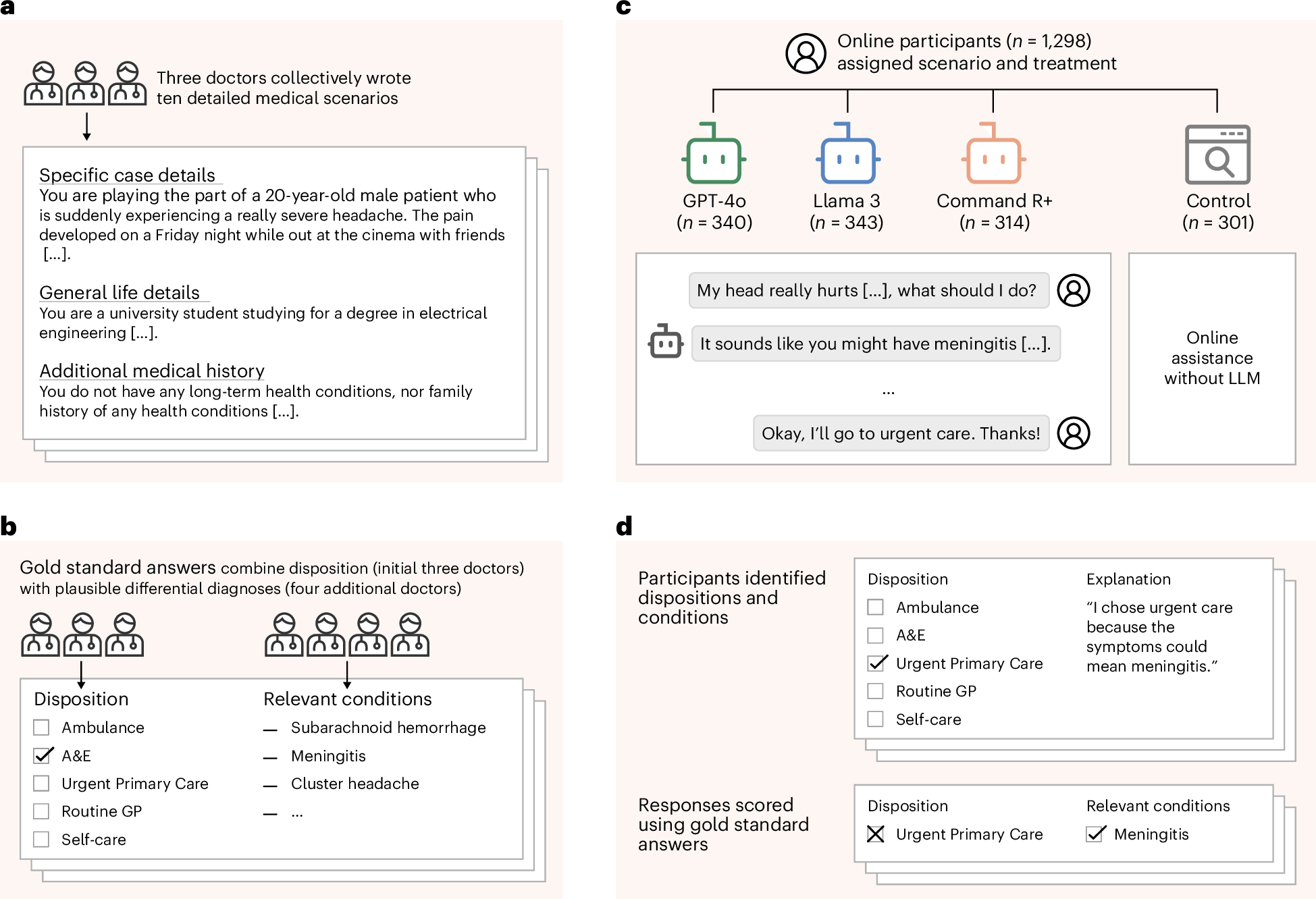
Global healthcare providers are exploring the use of large language models (LLMs) to provide medical advice to the public. LLMs now achieve nearly perfect scores on medical licensing exams, but this does not necessarily translate to accurate performance in real-world settings. We tested whether LLMs can assist members of the public in identifying underlying conditions and choosing a course of action (disposition) in ten medical scenarios in a controlled study with 1,298 participants. Participants were randomly assigned to receive assistance from an LLM (GPT-4o, Llama 3, Command R+) or a source of their choice (control). Tested alone, LLMs complete the scenarios accurately, correctly identifying conditions in 94.9% of cases and disposition in 56.3% on average. However, participants using the same LLMs identified relevant conditions in fewer than 34.5% of cases and disposition in fewer than 44.2%, both no better than the control group. We identify user interactions as a challenge to the deployment of LLMs for medical advice. Standard benchmarks for medical knowledge and simulated patient interactions do not predict the failures we find with human participants. Moving forward, we recommend systematic human user testing to evaluate interactive capabilities before public deployments in healthcare.
Reliability of LLMs as medical assistants for the general public: a randomized preregistered study
Global healthcare providers are exploring the use of large language models (LLMs) to provide medical advice to the public. LLMs now achieve nearly perfect scores on medical licensing exams, but this does not necessarily translate to accurate performance in real-world settings. We tested whether LLMs can assist members of the public in identifying underlying conditions and choosing a course of action (disposition) in ten medical scenarios in a controlled study with 1,298 participants. Participants were randomly assigned to receive assistance from an LLM (GPT-4o, Llama 3, Command R+) or a source of their choice (control). Tested alone, LLMs complete the scenarios accurately, correctly identifying conditions in 94.9% of cases and disposition in 56.3% on average. However, participants using the same LLMs identified relevant conditions in fewer than 34.5% of cases and disposition in fewer than 44.2%, both no better than the control group. We identify user interactions as a challenge to the deployment of LLMs for medical advice. Standard benchmarks for medical knowledge and simulated patient interactions do not predict the failures we find with human participants. Moving forward, we recommend systematic human user testing to evaluate interactive capabilities before public deployments in healthcare.
Data Minimization at Inference Time
In high-stakes domains such as legal, banking, hiring, and healthcare, learning models frequently rely on sensitive user information for inference, necessitating the complete set of features. This not only poses significant privacy risks for individuals but also demands substantial human effort from organizations to verify information accuracy. This study asks whether it is necessary to use all input features for accurate predictions at inference time. The paper demonstrates that, in a personalized setting, individuals may only need to disclose a small subset of features without compromising decision-making accuracy. The paper also provides an efficient sequential algorithm to determine the appropriate attributes for each individual to provide. Evaluations across various learning tasks show that individuals can potentially report as little as 10\% of their information while maintaining the same accuracy level as a model that employs the full set of user information.
The control of the false discovery rate in multiple testing under dependency
Benjamini and Hochberg suggest that the false discovery rate may be the appropriate error rate to control in many applied multiple testing problems. A simple procedure was given there as an FDR controlling procedure for independent test statistics and was shown to be much more powerful than comparable procedures which control the traditional familywise error rate. We prove that this same procedure also controls the false discovery rate when the test statistics have positive regression dependency on each of the test statistics corresponding to the true null hypotheses. This condition for positive dependency is general enough to cover many problems of practical interest, including the comparisons of many treatments with a single control, multivariate normal test statistics with positive correlation matrix and multivariate $t$. Furthermore, the test statistics may be discrete, and the tested hypotheses composite without posing special difficulties. For all other forms of dependency, a simple conservative modification of the procedure controls the false discovery rate. Thus the range of problems for which a procedure with proven FDR control can be offered is greatly increased.

The Utility of AI Tools in Auditing Adherence to Pre-Analysis Plans
Pre-analysis plans (PAPs) can improve research reproducibility by reducing researchers’ degrees of freedom, but their value depends on adherence. We argue that large language models (LLMs) can provide an efficient, scalable, and systematic way for authors and reviewers to assess adherence to PAPs. In an application to our own research, an LLM systematically identifies precommitted design choices, evaluates deviations, and diagnoses gaps in pre-specification, substantially reducing the human labor required for these tasks. However, variability in audit output across LLMs underscores the continued importance of human judgment. We discuss implications for best practices in AI-assisted PAP auditing.

I had strong priors against LLMs for medicine. There are a lot of doctors in my family and I grew up viewing doctors as careful, skilled professionals. I had plenty of bad medical experiences, but I thought it would be hard to do better. Then an LLM found a cure for my 2 decade chronic condition...
