What kind of sanctions could keep a non-human corporation in check?
AI and the Dangerous Fiction of ‘All Lawful Use’
Dunstan Allison-Hope and Iain Levine argue that human rights commitments are essential for all companies selling their products to governments worldwide.

Agentic AI Governance: Securing Autonomous AI Agents in Enterprise
When AI agents start making decisions, calling tools, and coordinating with other agents without waiting for human approval, the governance playbook most...

Lina Khan on Twitter / X
Law enforcers already have authority to charge companies and their CEOs for creating and releasing dangerous, unvetted, or defective products. We shouldn’t let discussions about new legal regimes distract from the fact that there’s no AI exemption from laws already on the books —…— Lina Khan (@linamkhan) September 13, 2026
Major company suffers serious damage from AI agent in 2026?
24% chance. In order to resolve yes, all of the following items need to be established by preponderance of the evidence: The incident occurs in 2026. The company has a market cap (by stock price if public, by valuation of latest round if private) over $10 billion prior to the incident. The incident consists of damage inflicted by an AI agent which was intentionally activated by company insiders, but was not intended to damage the company. For example, a Claude Code instance that was intended to respond to customer service questions ends up irrecoverably deleting an important database. It doesn't matter if the agent framework is a public product or an internal company product. Any agent deployed by a human with an intent to cause damage does not count, regardless if they are internal to the company (e.g. disgruntled employees) or external to the company (e.g hackers). It doesn't matter how closely the agent was following instructions, as long as those instructions were not intended to be harmful. An agent deployed by an external actor doesn't count, but an agent deployed by an internal actor that ends up causing harm due to some sort of external prompt would count. The damage needs to be directly caused by an action taken by the agent, not an action taken by a human. For example, if the agent writes some buggy code which gets approved/deployed by a human and ends up causing damage, that does not count. If the agent deploys the buggy code on its own that would count. If a human does something harmful that is suggested to it by an agent that does not count. The damage has a clear objective monetary value over $1 billion OR the company goes bankrupt OR the company market cap goes down by at least 50% from its lowest value in 2026 prior to the incident. (5) must be clearly caused primarily by (3). "Agent" refers to an LLM or similar AI model configured in a way that it can execute commands/code. Examples are illustrative but not intended to be limiting. All evidence must be submitted in comments by close of the market to be considered. I will not trade and will resolve at my discretion. There will be no AI clarifications added to this market's description.

Lawsuit says Anthropic, OpenAI, Google and SpaceXAI of illegal agreement to slow AI
Anthropic CEO acknowledged potential antitrust hurdles, writing that it would assist if the US government were to mediate ‘or at least enable’ cross-lab discussions

THEY WILL REPLACE U.S.: AI AND THE HALLUCINATIONS OF CORPORATIONS
ABSTRACT: I address AI as a manifestation of the corporate form in U.S. culture, and as it relates to the dreams of (or ascribed to) fascism and corporations. The merger of state and corporate power represents the trajectory of the corporation—to take over the state; elide accountability, empathy, transparency and (human) agency; and trade places with (and finally eliminate) people. The merger of state and corporate AI—a final stage of corporate speech, networking, and legal ontology—facilitates the takeover of human personhood by corporate personhood, and I trace the effects of that process in the systemic inversion of norms. Corporate personhood is part of a zero-sum game in which rights, speech, and identities are appropriated from people. When AI technology is grafted onto political systems and social media, the ensuing hallucinations are nightmares. The corporation always has been a posthuman simulacrum of persons, and its AI, in its wake, dreams of eliminating workers and people altogether.
Artificial Intelligence and the Purpose of Social Systems
The law and ethics of Western democratic states have their basis in liberalism. This extends to regulation and ethical discussion of technology and businesses doing data processing. Liberalism relies on the privacy and autonomy of individuals, their ordering through a public market, and, more recently, a measure of equality guaranteed by the state. We argue that these forms of regulation and ethical analysis are largely incompatible with the techno-political and techno-economic dimensions of artificial intelligence. By analyzing liberal regulatory solutions in the form of privacy and data protection, regulation of public markets, and fairness in AI, we expose how the data economy and artificial intelligence have transcended liberal legal imagination. Organizations use artificial intelligence to exceed the bounded rationality of individuals and each other. This has led to the private consolidation of markets and an unequal hierarchy of control operating mainly for the purpose of shareholder value. An artificial intelligence will be only as ethical as the purpose of the social system that operates it. Inspired by the science of artificial life as an alternative to artificial intelligence, we consider data intermediaries: sociotechnical systems composed of individuals associated around collectively pursued purposes. An attention cooperative, that prioritizes its incoming and outgoing data flows, is one model of a social system that could form and maintain its own autonomous purpose.

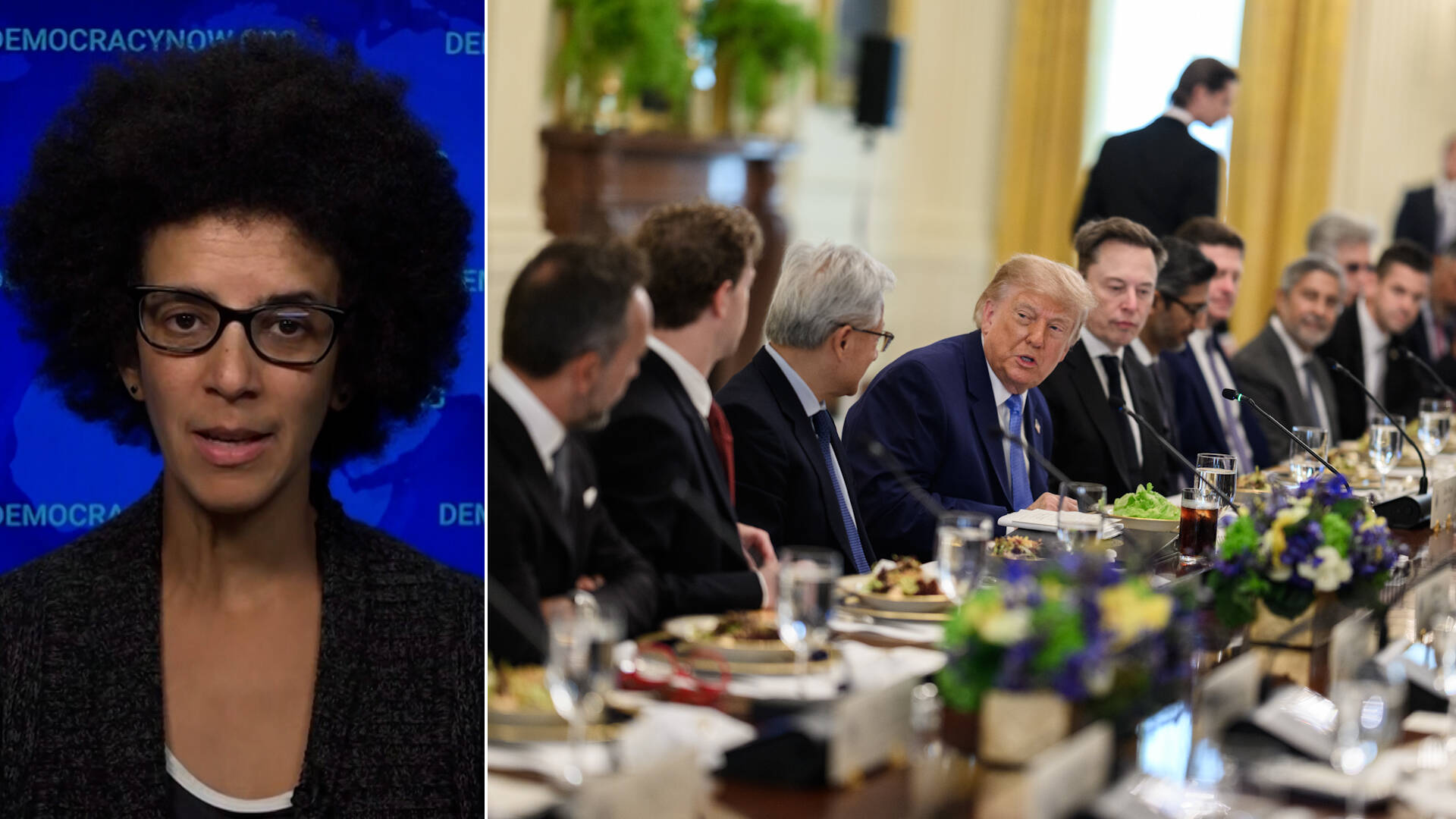
The Real Existential Risk Is AI CEOs Avoiding Oversight: “Alternative Nobel” Winner Timnit Gebru
We speak to the prominent AI researcher and leading critic of the AI industry, Timnit Gebru, who was recently awarded a 2026 Right Livelihood Award for her work investigating the harms and hype behind the global buildup of artificial intelligence. “Instead of discussing faulty, unreliable systems,” Gebru says tech leaders like SpaceXAI’s Elon Musk, OpenAI’s Sam Altman and Anthropic’s Dario Amodei are “marketing their systems as all-knowing, superpowerful, superintelligent,” and lobbying for “self-policing and self-regulation” to avoid being held “liable through existing laws.” Gebru expresses skepticism over increasingly widespread claims that AI algorithms pose an existential risk to humanity, warning that such claims are overblown and that “what is actually happening is regulatory capture.”
Taking AI Welfare Seriously
In this report, we argue that there is a realistic possibility that some AI systems will be conscious and/or robustly agentic in the near future. That means that the prospect of AI welfare and moral patienthood, i.e. of AI systems with their own interests and moral significance, is no longer an issue only for sci-fi or the distant future. It is an issue for the near future, and AI companies and other actors have a responsibility to start taking it seriously. We also recommend three early steps that AI companies and other actors can take: They can (1) acknowledge that AI welfare is an important and difficult issue (and ensure that language model outputs do the same), (2) start assessing AI systems for evidence of consciousness and robust agency, and (3) prepare policies and procedures for treating AI systems with an appropriate level of moral concern. To be clear, our argument in this report is not that AI systems definitely are, or will be, conscious, robustly agentic, or otherwise morally significant. Instead, our argument is that there is substantial uncertainty about these possibilities, and so we need to improve our understanding of AI welfare and our ability to make wise decisions about this issue. Otherwise there is a significant risk that we will mishandle decisions about AI welfare, mistakenly harming AI systems that matter morally and/or mistakenly caring for AI systems that do not.

Unlawful by design: Exposing the human rights costs of generative AI - Amnesty International
This briefing examines how standalone generative AI systems, based on unlawful web scraping, are in conflict with international human rights law (IHRL) and standards through their design, development and deployment. While these technologies promise sophisticated automation and efficiency, they rely on data collection and model training practices that abuse privacy rights, enable discrimination, and threaten […]
The Corporation’s Neoliberal Soul? | Human Rights after Corporate Personhood
Human Rights after Corporate Personhood offers a rich overview of current debates, and seeks to transcend the "outrage response" often found in public discourse and corporate legal theory. Through ...

AI agents pose untold risk to humanity. We must act to prevent that future | David Krueger
The pieces are falling into place for autonomous artificial intelligence. We must stop unregulated development
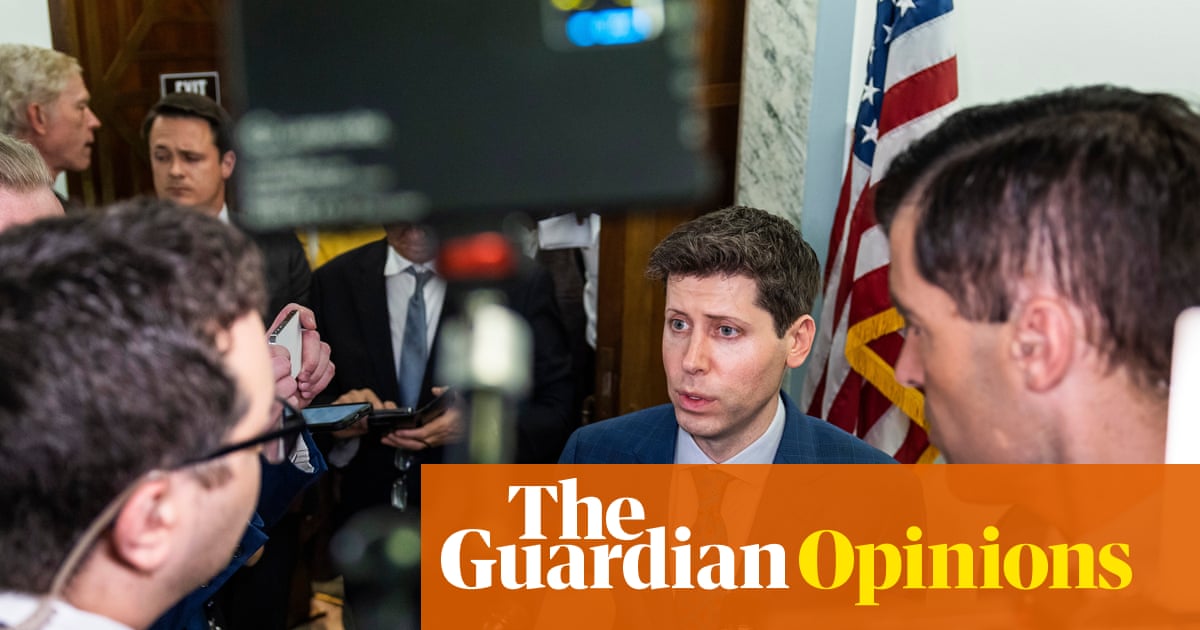
Why AI companies can’t be trusted to self-regulate
From aviation to banking, high-risk industries are subject to independent oversight and meaningful penalties. AI companies should be no exception.
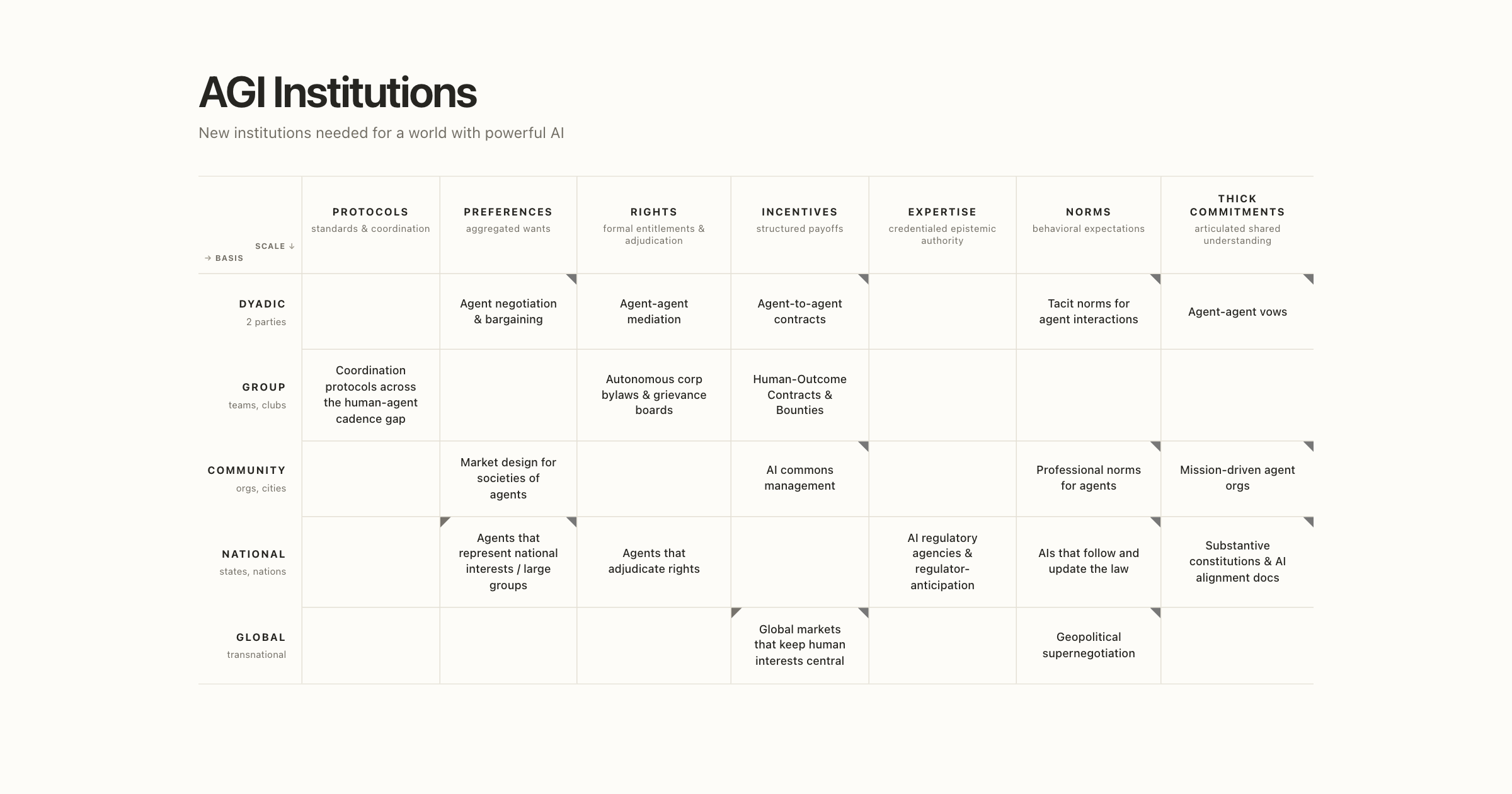
Existing Human Institutions — AGI Institutions Wiki
How existing human institutions handle coordination across scales — and how autonomous AI agents break them. Maps protocols, preferences, rights, incentives, expertise, norms, and thick commitments from dyadic to global.