


A revenue-based charge would protect the livelihoods of copyright holders and bring legal certainty
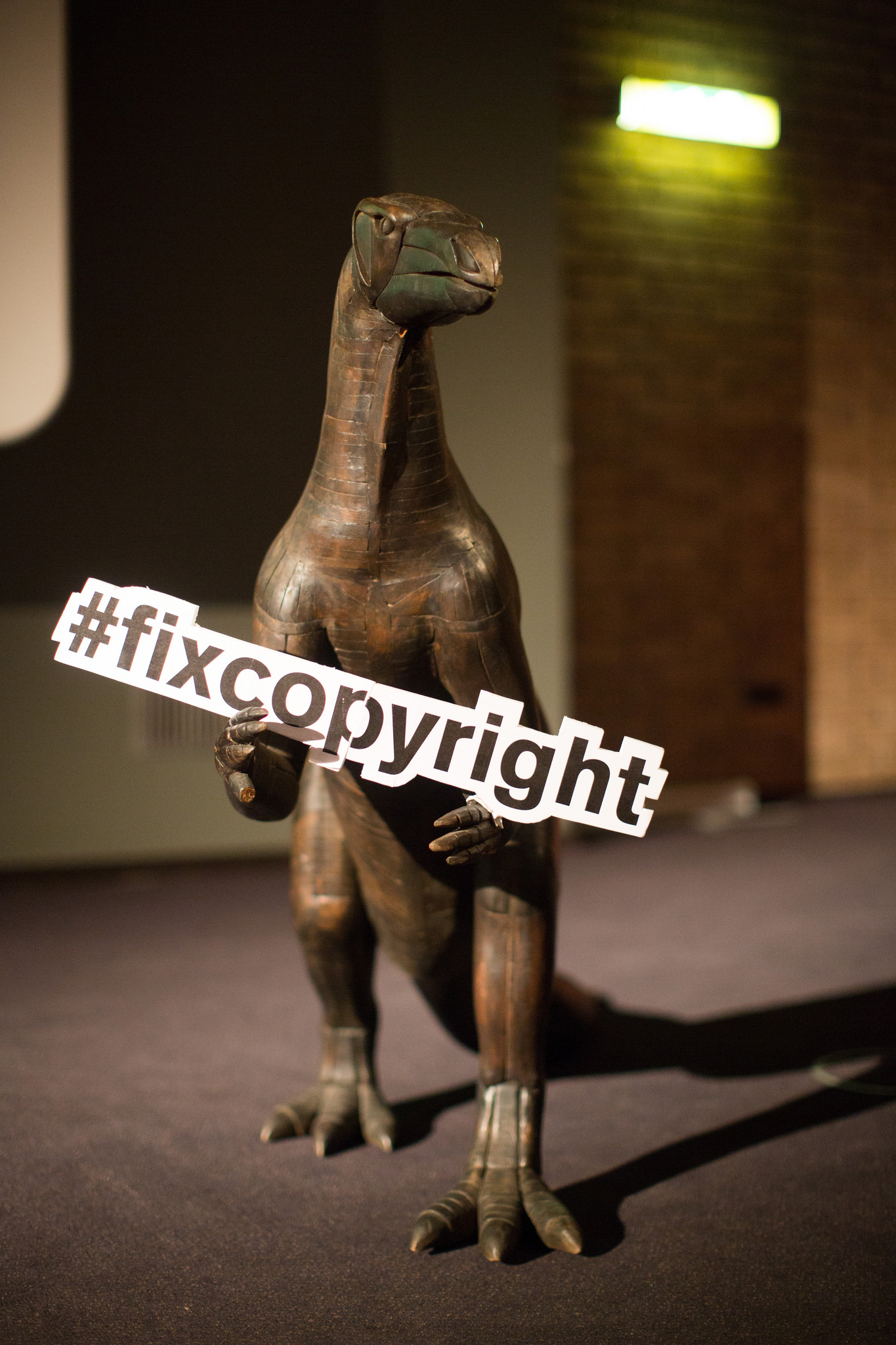
Head of copyright committee wants to deny EU creators the right to share - Creative Commons
Over the last few years the European Union has been working on revising its rules on copyright. But the latest proposal from the head of the copyright committee would deny creators the right to refuse remuneration — the right to share a work without getting paid — which could undermine the use of CC licenses…
Firms like Meta and A16z admit having to pay billions for training data would ruin their generative-AI plans as they fight new copyright rules
Meta, Google, Microsoft, and Andreessen Horowitz are trying to keep AI developers from having to pay for copyrighted material used in AI training.
Pluralistic: Copyright won't solve creators' Generative AI problem (09 Feb 2023)
The media spectacle of generative AI (in which AI companies' breathless claims of their software's sorcerous powers are endlessly repeated) has understandably alarmed many creative workers, a group that's already traumatized by extractive abuse by media and tech companies.
Lina Khan on Twitter / X
Law enforcers already have authority to charge companies and their CEOs for creating and releasing dangerous, unvetted, or defective products. We shouldn’t let discussions about new legal regimes distract from the fact that there’s no AI exemption from laws already on the books —…— Lina Khan (@linamkhan) September 13, 2026
Who Pays for the Commons?
Three and a half years after the emergence of generative AI as a new technology paradigm, there is broad agreement that AI companies have extracted enorm...

Music Publishers Sue AI Company Anthropic for Copyright Infringement
Universal Music Publishing Group, Concord, and ABKCO claim that the large language model Claud was trained on copyrighted works

Introducing pay per crawl: Enabling content owners to charge AI crawlers for access
Pay per crawl is a new feature to allow content creators to charge AI crawlers for access to their content.
Help Fix Copyright: Send a Rebellious Selfie to European Parliament (Really!) | The Mozilla Blog
The EU’s proposed copyright reform keeps in place retrograde laws that make many normal online creative acts illegal. The same restrictive laws will stif
Permissive-Washing in the Open AI Supply Chain: A Large-Scale Audit of License Integrity
Permissive licenses like MIT, Apache-2.0, and BSD-3-Clause dominate open-source AI, signaling that artifacts like models, datasets, and code can be freely used, modified, and redistributed. However, these licenses carry mandatory requirements: include the full license text, provide a copyright notice, and preserve upstream attribution, that remain unverified at scale. Failure to meet these conditions can place reuse outside the scope of the license, effectively leaving AI artifacts under default copyright for those uses and exposing downstream users to litigation. We call this phenomenon ``permissive washing'': labeling AI artifacts as free to use, while omitting the legal documentation required to make that label actionable. To assess how widespread permissive washing is in the AI supply chain, we empirically audit 124,278 dataset $\rightarrow$ model $\rightarrow$ application supply chains, spanning 3,338 datasets, 6,664 models, and 28,516 applications across Hugging Face and GitHub. We find that an astonishing 96.5\% of datasets and 95.8\% of models lack the required license text, only 2.3\% of datasets and 3.2\% of models satisfy both license text and copyright requirements, and even when upstream artifacts provide complete licensing evidence, attribution rarely propagates downstream: only 27.59\% of models preserve compliant dataset notices and only 5.75\% of applications preserve compliant model notices (with just 6.38\% preserving any linked upstream notice). Practitioners cannot assume permissive labels confer the rights they claim: license files and notices, not metadata, are the source of legal truth. To support future research, we release our full audit dataset and reproducible pipeline.

AI News Audit: AI, Canadian Journalism, and Paths for Policy Action — Centre for Media, Technology and Democracy
March 16, 2026 - AI companies built their products using Canadian journalism without permission and without compensation, and are now delivering that journalism to consumers as their own product. Existing copyright and media policy frameworks were not designed to address this. In February and Marc

EU copyright reform: the facts – Open Policy & Advocacy
Ahead of the crucial EU copyright vote on 12 Sept., we set the facts straight and explain exactly what the new rules will mean for the internet in Europe.
Anthropic sued by authors over alleged misuse of copyrighted works for AI training
The complaint alleges that Anthropic used pirated versions of books by hundreds of thousands of authors to develop its AI models without proper authorization or compensation.

RSL: Really Simple Licensing
The open content licensing standard for the AI-first Internet
An Elegant Solution to AI Slop: Tax It, and Use the Resulting Billions of Dollars to Fund Cultural Institutions, Artists, and Researchers
A technologist proposes slapping a "slop tax" on companies that use or create generative AI content.

Microsoft CEO of AI Says It’s Fine to Steal Anything on the Open Web
Microsoft AI CEO Mustafa Suleyman has some thoughts about fair use — and according to him, just about anything online is fair for him to use!
Data Streaming for AI: From Extractive Training to Sovereign Infrastructure DWeb Camp 2026
AI systems are consuming the world's content without compensating its creators. This session explores data streaming as a new paradigm — where content flows to AI in real time, with built-in rights management, usage tracking, and fair compensation — and asks what it would take to make this infrastructure decentralized, sovereign, and governed by the communities it serves.