

The React.js documentation framework.
React
React is the library for web and native user interfaces. Build user interfaces out of individual pieces called components written in JavaScript. React is designed to let you seamlessly combine components written by independent people, teams, and organizations.

Next.js by Vercel - The React Framework
Production grade React applications that scale. The world's leading companies use Next.js by Vercel to build static and dynamic websites and web applications.
JavaScript concepts to master before learning React - LogRocket Blog
Before you dive into learning React, it makes good sense to master the common JavaScript patterns you'll see in virtually every React app.
Text.js | The Console Framework
Build full-stack React apps that render inside console.log.
React Server Components: the Good, the Bad, and the Ugly
Evaluating Next.js's implementation of React's new server features.
next.js/packages/next/README.md at canary · vercel/next.js
The React Framework. Contribute to vercel/next.js development by creating an account on GitHub.
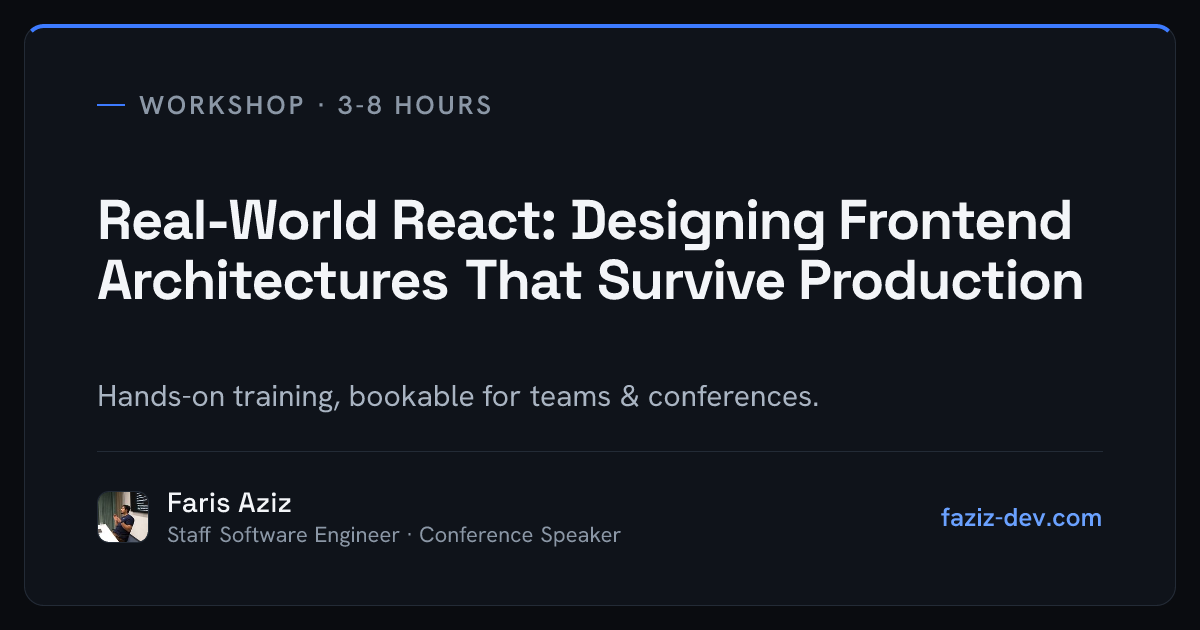
Real-World React: Designing Frontend Architectures That Survive Production | Workshops | Faris Aziz
Most React workshops focus on building features. This one focuses on keeping them alive. In production, React applications fail in ways that local environments never show: partial outages, slow dependencies, silent errors, broken rollouts, and performance regressions that only appear under real traffic. This workshop is a practical, architecture-first walkthrough of how experienced teams design React systems that stay resilient, observable, and scalable long after the first release. We will explore how component architecture, reconciliation in practice, and runtime failure patterns shape performance and operability far more than memoization tricks or framework features. Using React and Next.js as shared reference points, we will work through concrete patterns for failure recovery, error containment, safe rollouts, and post-deployment confidence. This is a hands-on, experience-driven workshop based on real production constraints, tradeoffs, and lessons learned from operating large React applications at scale. Attendees will leave with a mental model for building frontend systems that can fail safely, recover quickly, and ship continuously without fear. Most of the workshop is framework and library-agnostic, but we'll use React and Next.js as our common ground for communication and examples. This is not an exhaustive masterclass; it's a conversation starter and experience share to jumpstart your journey toward battle-tested software architecture.
Josh W. Comeau
Friendly tutorials for developers. Focus on React, CSS, Animation, and more!

Ant Design - The world's second most popular React UI framework
An enterprise-class UI design language and React UI library with a set of high-quality React components, one of best React UI library for enterprises

React 16.x Roadmap – React Blog
This blog site has been archived. Go to react.dev/blog to see the recent posts. You might have heard about features like “Hooks”, “Suspense”, and “Concurrent Rendering” in the previous blog posts and talks. In this post, we’ll look at how they fit together and the expected timeline for their availability in a stable release of React. An Update from August, 2019 You can find an update to this roadmap in the React 16.9 release blog post. tl;dr We plan to split the rollout of new React features…

10 Years Of SolidJS: Saying No To React | Ryan Carniato | PodRocket
Payload: The Next.js Headless CMS and App Framework
Built with TypeScript and React, Payload is an open-source headless CMS and application framework. Build anything.

Critical Security Vulnerability in React Server Components – React
The library for web and native user interfaces