

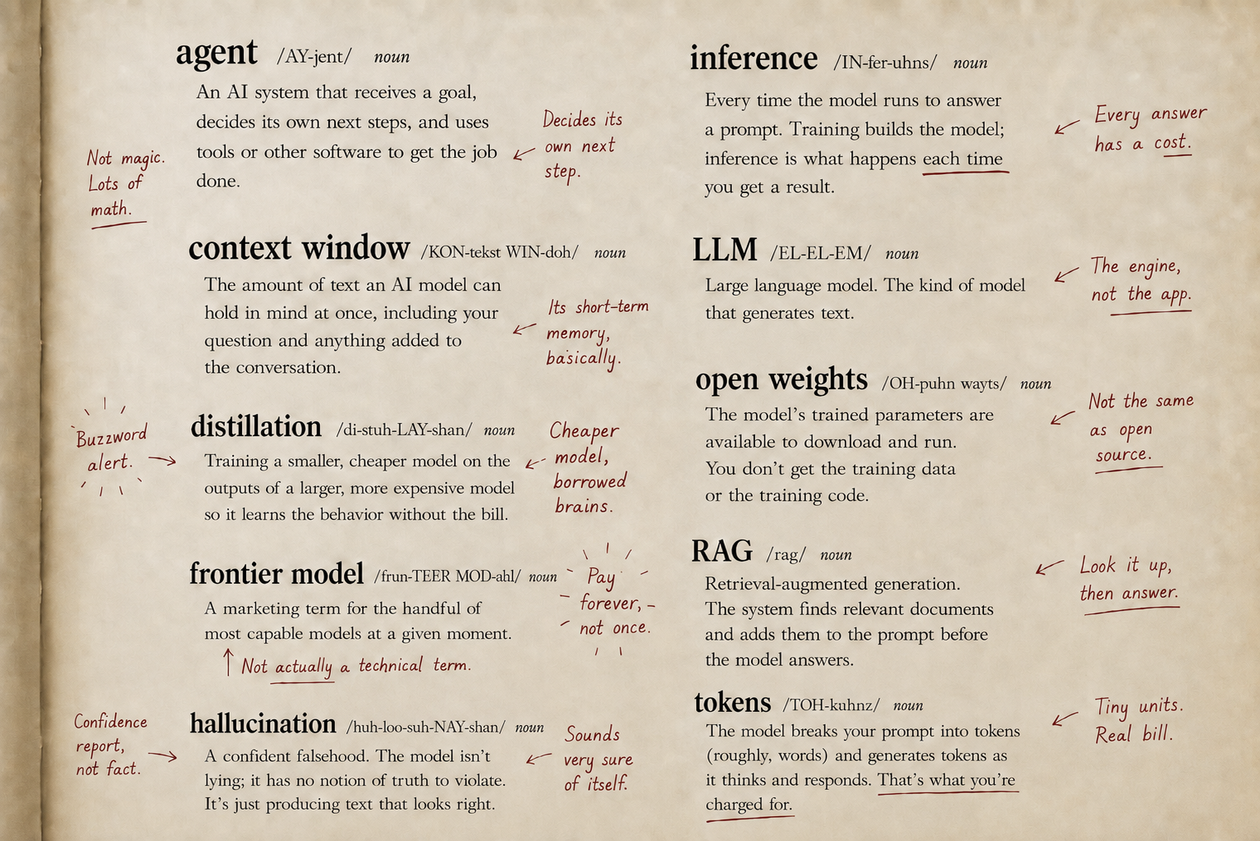
Everyone in tech says things like LLM, open weights, RAG and agent; far fewer could define precisely what they all mean. Oren Etzioni sorts out about 30 AI terms in plain English, with a blunt verdict on each and one novel phrase he believes isn't used enough.
Ali Alkhatib: Defining AI
The main issue I have with a lot of work that tries to define AI is that the criteria they use to draw boundaries often turn out to be functionally useless for my needs; these definitions lead us to weird places, letting scholars fixate on strange, unworkable frameworks. Those pedantic fixations don’t really benefit the organizers, activists, regular people who are getting crushed by the systems they’re trying to work against. So I’m going to try to unpack how I think about AI; how I trace the boundaries of the term in a way that’s as useful as possible for me and my needs; and how I would encourage you to scope or define ideas that are important to your work.
AI Agents: Key Concepts and How They Overcome LLM Limitations
An AI agent is an autonomous software entity that is often used to augment a large language model. Here's what developers need to know.

Artificial intelligence glossary: 60+ terms to know
Use this comprehensive glossary of AI terms to understand the language of artificial intelligence.

Opaque recurrence, and other AI terms that you should probably know | TechCrunch
The rise of AI has brought an avalanche of new terms and slang. Here is a glossary with definitions of some of the most important words and phrases you might encounter.

Artificial Intelligence Glossary | Stanford HAI
Artificial Intelligence (AI) is rapidly growing, with new terms and concepts being introduced at a breakneck speed. You may have seen terms such as AGI, machine learning, or foundation models in media headlines, emerging legislation, or in your everyday life.
Measuring Usage in the Age of AI - Research Information
Tasha Mellins-Cohen outlines COUNTER Metrics' new guidance for usage metrics associated with generative and agentic AI

Literature fans should welcome AI as a fellow wordsmith | Aeon Essays
Strong resistance to AI among writers is understandable. But it obscures what we share with the machines: language itself

Is there something it is like to be an AI?
Posted on Wednesday 2 Jul 2025. 1,593 words, 6 links. By Matt Webb.

I used AI. It worked. I hated it.
I used Claude Code to build a tool I needed. It worked great, but I was miserable. I need to reckon with what it means.

Stop saying that AI is just a tool and it only matters how it is used
I’m tired of this phrase and this simple way of thinking about tools. This blog post is a wandering train of thought on the topic of what tools are and why it matters to be even slightly more mature in how we think about them.
Artificial Intelligence
Summary. The term artificial intelligence (AI) is typically used as if it refers to a coherent, extant or near-future set of technologies, but, in fact, it

Questioning AI Resource List
Excellent summary of major problems with companies’ focus on AI written by expert in machine learning: https://ludic.mataroa.blog/blog/i-will-fucking-piledrive-you-if-you-mention-ai-again/ Another good summary piece that includes many examples (in general Ed Zitron’s work is a great resource): ...

The argument against AI agents and unnecessary automation
Opinion: OpenAI's Operator a solution in search of a problem

From AGI to ASI
Over the last decade, building human-level artificial general intelligence has moved from far-fetched speculation to being a concrete next-decade target for many of the largest AI organisations. Achieving this goal would have profound and far-reaching impacts on human society, which raises many complex questions for the decade ahead. This report investigates how AI itself might continue to develop in a post-AGI world along the continuum of machine intelligence. The endpoint of this continuum, Universal AI, is theoretically well understood, which provides some formal grounding for the main focus of this report: the transition from human-level AGI to artificial general superintelligence, which, intuitively, can be understood as a system that is more intelligent and cognitively capable than large organisations of humans. After characterizing ASI, the report discusses four potential pathways from AGI to ASI: scaling AGI, AI paradigm shifts, recursive improvement, and ASI emerging from large-scale multi-agent collectives. The report then discusses possible frictions and bottlenecks along these pathways. Determining whether the impact of these frictions will be negligible or substantial raises a number of concrete open research questions. Due to large uncertainties for predicting ASI progress, it cannot be ruled out that AI progress might continue to accelerate over the next years. This could imply that the image of a single transformative step change, caused by the introduction of human-level AGI into our society, could be inaccurate. More apt might be the prospect of a series of transformative societal changes caused by AI-enabled progress and breakthroughs across many areas of science and technology. Preparing for this prospect requires a massively interdisciplinary endeavour of global scope and interest.

AI* agents and autonomy

Or “autonomy” * I’m neither “pro-AI” nor “anti-AI.” I’ve been blocked for being perceived as both. —Actually, I’m honestly more anti-AI than pro-AI thus far, aside from specialized models and specific use cases, but I’m willing to consider information that’s new to me
AI*-generated summaries/AI Overview
Also including the use of AI (usually ChatGPT) as magical answer machines. * I’m neither “pro-AI” nor “anti-AI.” I’ve been blocked for being perceived as both. —Actually, I’m honestly more anti-AI than pro-AI thus far, aside from specialized models and specific use cases, but I’m willing to consider information that’s new to me

Opinion | A.I. Companies Say They Aren’t Responsible for Their Unpredictable Products. Don’t Believe Them.

Anthropic’s AI gave Philadelphia police a fake tip about an unsolved homicide

Wikimedia: Rogue OpenAI agents behind unauthorized Wikipedia edits

MCP for agent-to-agent comms may be the riskiest protocol you've never heard of

AIエージェントがスクショ1万3000枚を公開リポジトリにアップロード

AI Coding Agents Exposed 13,000 Internal Images, Including Billing Records, on GitHub

Do Americans trust AI news summaries? [Reality checks ft. Vince Nero]

ChatGPT, Claude, and Grok bypass EU restrictions on Russian state propaganda, RSF investigation finds
How to know if you can trust an AI’s answer to your question

「琉球新報社説に『スマホを置いて新聞を』」は本当か?

AIがX投稿を自動要約 内容が二転三転、誤情報拡散の一因に
Matthew Cortland (they) (@matthewcort.land)