


Billy Beane, general manager of MLB's Oakland A's and p…
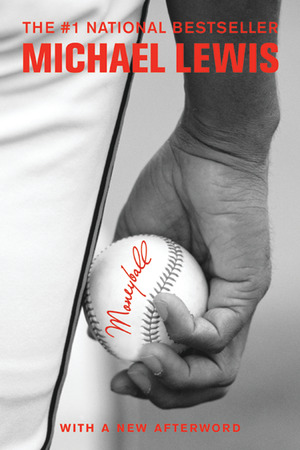
Moneyball
Michael Lewis’s instant classic may be 'the most influential book on sports ever written' (<em>People</em>), but 'you need know absolutely nothing about baseball to appreciate the wit, snap, economy and incisiveness of [Lewis’s] thoughts about it' (Janet Maslin, <em>New York Times</em>).<br /><br />One of <em>GQ</em>'s 50 Best Books of Literary Journalism of the 21st Century • A <em>Kirkus Review</em> Best Book of the 21st Century (So Far), Moneyball, The Art of Winning an Unfair Game, Michael Lewis, 9780393324815
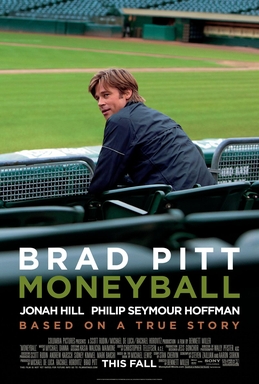
Moneyball (film)
Moneyball is a 2011 American biographical sports drama film directed by Bennett Miller and adapted by Steven Zaillian and Aaron Sorkin. It stars Brad Pitt, Jonah Hill, Philip Seymour Hoffman, Robin Wright and Chris Pratt. The film is based on the 2003 book Moneyball: The Art of Winning an Unfair Game by Michael Lewis, an account of the Oakland Athletics baseball team's 2002 season and their general manager Billy Beane's attempts to assemble a competitive team with half as much money as his rivals. Moneyball follows Beane and his deputy Peter Brand scout the major leagues for undervalued talent by taking a sophisticated sabermetric approach to scouting and analyzing players, triggering skepticism and resentment within the baseball community.
Home Field Advantage — Oakland Public Library
Home Field Advantage — Brekke-Miesner, Paul — In Home Field Advantage, historian Paul Brekke-Miesner examines why one relatively small American city produced not only an amazing number of professional athletes but individuals who changed the landscape of sports in America.--back cover.
The World Series Was Electric — So Was Bluesky - Bluesky
“How can you not be romantic about baseball?” — Moneyball 2011

BlATBall - Interdimensional Baseball on AT Protocol
Inside Baseball: The Automated Ball-Strike System as an Object Lesson in Technological Rule Enforcement
Clearly-defined rules are often assumed to be straightforward to automate and evaluate. We challenge this assumption through an in-depth study of Major League Baseball's (MLB) seven-year experimentation with the Automated Ball-Strike System (ABS). ABS is envisioned to call balls and strikes accurately: a seemingly straightforward use of technology to objectively determine the distance between a pitch and the strike zone. Although the strike zone is an area clearly defined in the rulebook, it took MLB seven years to figure out how to automate calling balls and strikes with ABS, showing how even seemingly straightforward rules require a complex translation process to operationalize via technological systems. In this paper, we trace the design decisions that led to the current implementation of ABS. Our case study reveals that "distance" exists even between a clear rule and its technological implementation. Using analytic frameworks from Science and Technology Studies (STS), we show that such distance exists because (1) historically, the "ground truth" of the strike zone is contested: the rule in practice has always reflected a hybrid between the rulebook definition and umpires' enforcement decisions; and (2) the use of ABS is embedded in an existing eco-system, where the implementation of a technological enforcement system needs to balance multiple stakeholder values. This perspective challenges conventional evaluation paradigms that center on the distance between a formalized rule and its technological implementation, and instead calls for evaluating how such systems are experienced in practice. Addressing this question requires in-depth social science approaches, contributing to ongoing conversations in FAccT about the implementation and evaluation of sociotechnical systems.

The "Yips" in Baseball: Psychological Causes and Cures - Baseball Scouter
Demystifying the baseball yips: learn what they are, why they happen, and a practical four-week plan with mental skills and graded drills to restore smooth, confident throws under pressure.

Ball State Settles With Ex-Employee for $225,000 Over Charlie Kirk Posts
Ball State University is the latest institution to agree to pay workers who lost their jobs over their posts about the conservative activist.

The Score: How to Stop Playing Somebody Else's Game
A philosophy of games to help us win back control over …

The Steve Ballmer Interview
Analyzing Baseball Data with R (3e)
Back in the late 1980s, as a college student, I would go to the NHL offices in downtown Montreal, and pick up their official end-of-season statistics package. This was something that was reserved for the media, but somehow I had the idea to ask, and they were kind enough to oblige. Since I was learning dBase, I then had to manually enter every piece of data in that package, probably some 20,000 discrete data values. Combining sports, numbers, and computers was a labour of love for me. Add in that in the 1980s, Pete Palmer and Bill James inspired the sabermetric revolution: my career path was set, as was that of thousands more.
What Ticketmaster Doesn't Want You To Know: Concerts Were Cheap For Decades
The causes of Olympic stadium cost overruns from 2000 to 2020
The Olympic Games have frequently witnessed cost overruns. Olympic stadiums have drawn significant media attention due to their escalating costs, but lack of systematic documentation. This study ai...

The causes of Olympic stadium cost overruns from 2000 to 2020
The Olympic Games have frequently witnessed cost overruns. Olympic stadiums have drawn significant media attention due to their escalating costs, but lack of systematic documentation. This study ai...
Exploitative Game Design: Beyond the F2P Debate
The past few months have seen a torrent of articles about Free-to-Play business models, often discussed alongside issues of ethics in games (for example: 1, 2, 3, 4, 5). These pieces have addressed the effect on addiction-prone players or children, the possibility of corrupting artistic intent, the sheer amount of money being spent, and other advantages and dangers of F2P. While all of this is relevant, I fear that we’re focusing too much on F2P and glossing over the wider ethical issues in game design.
Art is my sport. I’ve been competing since 1984. 444 pages of my Paper Stage art club journal have made it to home team supporters. Today’s swing at the bat is @sweetbee.vip as a warrior because I want to contribute to her brainstorming team and just get out there, give 110% Bee’s be the big leagues
