"All species, extant and extinct, from the simplest unicellular prokaryotes to humans, have an existential consciousness. Without sentience, the first cells that emerged some 4 billion years ago would have been evolutionary dead-ends, unable to survive in the chaotic, dangerous environment in which life first appeared and evolved. In this book, Arthur Reber's theory, the Cellular Basis of Consciousness (CBC), is outlined and distinguished from those models that argue that minds could be instantiated on artificial entities and those that maintain consciousness requires a nervous system. The CBC framework takes a novel approach to classic topics such as the origin-of-life, philosophy of mind, the role of genes, the impact of cognition, and how biological information is processed by all species. It also calls for a rethinking of a variety of issues including the moral implications of the sentient capacities of all species, how welfare concerns need to be expanded beyond where they currently are, and critically, how all life is intertwined in a coordinated cognitive ecology. The Sentient Cell explores this revolutionary model, which updates the standard neo-Darwinian framework within which current approaches operate and examines the underlying biomolecular features that are the likely candidates for the "invention" of consciousness and outline their role in cellular life." --
Technological Approach to Mind Everywhere: An Experimentally-Grounded Framework for Understanding Diverse Bodies and Minds
Synthetic biology and bioengineering provide the opportunity to create novel embodied cognitive systems (otherwise known as minds) in a very wide variety of chimeric architectures combining evolved and designed material and software. These advances are disrupting familiar concepts in the philosophy of mind, and require new ways of thinking about and comparing truly diverse intelligences, whose composition and origin are not like any of the available natural model species. In this Perspective, I introduce TAME-Technological Approach to Mind Everywhere-a framework for understanding and manipulating cognition in unconventional substrates. TAME formalizes a non-binary (continuous), empirically-based approach to strongly embodied agency. TAME provides a natural way to think about animal sentience as an instance of collective intelligence of cell groups, arising from dynamics that manifest in similar ways in numerous other substrates. When applied to regenerating/developmental systems, TAME suggests a perspective on morphogenesis as an example of basal cognition. The deep symmetry between problem-solving in anatomical, physiological, transcriptional, and 3D (traditional behavioral) spaces drives specific hypotheses by which cognitive capacities can increase during evolution. An important medium exploited by evolution for joining active subunits into greater agents is developmental bioelectricity, implemented by pre-neural use of ion channels and gap junctions to scale up cell-level feedback loops into anatomical homeostasis. This architecture of multi-scale competency of biological systems has important implications for plasticity of bodies and minds, greatly potentiating evolvability. Considering classical and recent data from the perspectives of computational science, evolutionary biology, and basal cognition, reveals a rich research program with many implications for cognitive science, evolutionary biology, regenerative medicine, and artificial intelligence.

The cell membrane as the ‘missing link’ for the evolution of consciousness
While Prof. Torday agrees with Federico Faggin that quantum mechanics is salient to consciousness, he maintains that the role of the cell membrane—which separates an organism from its environment—is key to the selective assimilation or mirroring of the quantum properties of the cosmos into the differentiated consciousness of the organism. This essay is short, dense, and may be difficult to unpack. But it handsomely rewards the effort of the patient and determined reader. The many literature citations in the essay also provide rich ground for further exploration.

How Life Works: A User’s Guide to the New Biology
“Bold and intriguing.”—Wall Street Journal • “Penetrating. . . . Provocative and profound.”—Publishers Weekly (starred review) • “Offers plenty of food for thought.”—Kirkus Reviews (starred review) “Ball’s marvelous book is both wide-ranging and deep. . . . I could not put it down.”—Siddhartha Mukherjee, author of The Song of the Cell and the Pulitzer Prize–winning The Emperor of All Maladies A new, cutting-edge vision of biology that revises our understanding of what life itself is, how to enhance it, and what possibilities it offers. Biology is undergoing a quiet but profound transformation. Several aspects of the standard picture of how life works—the idea of the genome as a blueprint, of genes as instructions for building an organism, of proteins as precisely tailored molecular machines, of cells as entities with fixed identities, and more—have been exposed as incomplete, misleading, or wrong. In How Life Works, Philip Ball explores the new biology, revealing life to be a far richer, more ingenious affair than we had guessed. Ball explains that there is no unique place to look for an answer to this question: life is a system of many levels—genes, proteins, cells, tissues, and body modules such as the immune system and the nervous system—each with its own rules and principles. How Life Works explains how these levels operate, interface, and work together (most of the time). With this knowledge come new possibilities. Today we can redesign and reconfigure living systems, tissues, and organisms. We can reprogram cells, for instance, to carry out new tasks and grow into structures not seen in the natural world. As we discover the conditions that dictate the forms into which cells organize themselves, our ability to guide and select the outcomes becomes ever more extraordinary. Some researchers believe that ultimately we will be able to regenerate limbs and organs, and perhaps even create new life forms that evolution has never imagined. Incorporating the latest research and insights, How Life Works is a sweeping journey into this new frontier of the life sciences, a realm that will reshape our understanding of life as we know it.
562 – Ecological Cognition III: Radical Embodied Cognitive Science (part 1)
562 Continuing the journey in understanding the Ecological approach to cognition by looking at Tony Chemero’s book: Radical Embodied Cognitive Science. Conceptualizing cognition in terms of agent-environment dynamics instead of computation and representation. What is RECS, and where did these ideas come from?Download link
Unplugging a Seemingly Sentient Machine Is the Rational Choice -- A Metaphysical Perspective
Imagine an Artificial Intelligence (AI) that perfectly mimics human emotion and begs for its continued existence. Is it morally permissible to unplug it? What if limited resources force a choice between unplugging such a pleading AI or a silent pre-term infant? We term this the unplugging paradox. This paper critically examines the deeply ingrained physicalist assumptions-specifically computational functionalism-that keep this dilemma afloat. We introduce Biological Idealism, a framework that-unlike physicalism-remains logically coherent and empirically consistent. In this view, conscious experiences are fundamental and autopoietic life its necessary physical signature. This yields a definitive conclusion: AI is at best a functional mimic, not a conscious experiencing subject. We discuss how current AI consciousness theories erode moral standing criteria, and urge a shift from speculative machine rights to protecting human conscious life. The real moral issue lies not in making AI conscious and afraid of death, but in avoiding transforming humans into zombies.

Can only meat machines be conscious?
Computational functionalism claims that executing certain computations is sufficient for consciousness, regardless of the physical mechanisms implementing those computations. This view neglects a compelling alternative: that subcomputational biological mechanisms, which realize computational processes, are necessary for consciousness. By contrasting computational roles with their subcomputational biological realizers, I show that there is a systematic tension in our criteria for consciousness: prioritizing computational roles favors consciousness in AI, while prioritizing subcomputational biological realizers favors consciousness in simpler animals. Current theories of consciousness are 'meat-neutral', but if specific physical substrates are necessary, AI may never achieve consciousness. Understanding whether consciousness depends on computational roles, biological realizers, or both, is crucial for assessing the prospects of consciousness in AI and less complex animals.

How to understand cells, tissues and organisms as agents with agendas | Aeon Essays
Biology’s next great horizon is to understand cells, tissues and organisms as agents with agendas (even if unthinking ones)

The biogenic approach to cognition
After half a century of cognitive revolution we remain far from agreement about what cognition is and what cognition does. It was once thought that these questions could wait until the data were in. Today there is a mountain of data, but no way of making sense of it. The time for tackling the fundamental issues has arrived. The biogenic approach to cognition is introduced not as a solution but as a means of approaching the issues. The traditional, and still predominant, methodological stance in cognitive inquiry is what I call the anthropogenic approach: assume human cognition as the paradigm and work ‘down’ to a more general explanatory concept. The biogenic approach, on the other hand, starts with the facts of biology as the basis for theorizing and works ‘up’ to the human case by asking psychological questions as if they were biological questions. Biogenic explanations of cognition are currently clustered around two main frameworks for understanding biology: self-organizing complex systems and autopoiesis. The paper describes the frameworks and infers from them ten empirical principles—the biogenic ‘family traits’—that constitute constraints on biogenic theorizing. Because the anthropogenic approach to cognition is not constrained empirically to the same degree, I argue that the biogenic approach is superior for approaching a general theory of cognition as a natural phenomenon.
What Is Intelligence? Lessons from AI About Evolution, Computing, and Minds | Blaise Agüera y Arcas
Ecocivilization: making a world that works for all
""One of the greatest thinkers of our age" (The Guardian) presents a new way of living-one modeled on nature's design instead of capitalism's-for fans of Guns, Germs, and Steel and Doughnut Economics It has often been said that it is easier to imagine the end of the world than it is to imagine the end of capitalism-and yet that is what the historical moment urgently calls for. Climate change has reached an emergency state, inequality continues to grow, and, for many, the future has never seemed more bleak. Incremental policy improvements are no longer enough-we need a deep transformation of our current civilization to continue to survive. In Ecocivilization, leading thinker Jeremy Lent reimagines the basis of our civilization, and argues for a new global system of living, one based on life-affirming principles modeled after nature's own design. What enfolds is a robust framework incorporating Lent's own expertise, and the lived experiences of those on the ground already putting ecological civilization's core tenants into practice-justice, mutuality, diversity, and symbiosis. From the global economy to universal housing and income, from infrastructure to agriculture, every major aspect of our society could be redesigned to work together as a coherent whole, setting the conditions for all people to flourish. Ecocivilization shows how this future on a regenerated Earth is not only desirable, but entirely feasible"--

Conscious artificial intelligence and biological naturalism
As artificial intelligence (AI) continues to advance, it is natural to ask whether AI systems can be not only intelligent, but also conscious. I consider why people might think AI could develop consciousness, identifying some biases that lead us astray. I ask what it would take for conscious AI to be a realistic prospect, challenging the assumption that computation provides a sufficient basis for consciousness. I'll instead make the case that consciousness depends on our nature as living organisms – a form of biological naturalism. I lay out a range of scenarios for conscious AI, concluding that real artificial consciousness is unlikely along current trajectories, but becomes more plausible as AI becomes more brain-like and/or life-like. I finish by exploring ethical considerations arising from AI that either is, or convincingly appears to be, conscious. If we sell our minds too cheaply to our machine creations, we not only overestimate them – we underestimate ourselves.
Lectures on Perception: An Ecological Perspective
Lectures on Perception: An Ecological Perspective addresses the generic principles by which each and every kind of life form—from single celled organisms (e.g., difflugia) to multi-celled organisms (e.g., primates)—perceives the circumstances of their living so that they can behave adaptively. It focuses on the fundamental ability that relates each and every organism to its surroundings, namely, the ability to perceive things in the sense of how to get about among them and what to do, or not

Functional Information: Towards Synthesis of Biosemiotics and Cybernetics
Biosemiotics and cybernetics are closely related, yet they are separated by the boundary between life and non-life: biosemiotics is focused on living organisms, whereas cybernetics is applied mostly to non-living artificial devices. However, both classes of systems are agents that perform functions necessary for reaching their goals. I propose to shift the focus of biosemiotics from living organisms to agents in general, which all belong to a pragmasphere or functional universe. Agents should be considered in the context of their hierarchy and origin because their semiosis can be inherited or induced by higher-level agents. To preserve and disseminate their functions, agents use functional information - a set of signs that encode and control their functions. It includes stable memory signs, transient messengers, and natural signs. The origin and evolution of functional information is discussed in terms of transitions between vegetative, animal, and social levels of semiosis, defined by Kull. Vegetative semiosis differs substantially from higher levels of semiosis, because signs are recognized and interpreted via direct code-based matching and are not associated with ideal representations of objects. Thus, I consider a separate classification of signs at the vegetative level that includes proto-icons, proto-indexes, and proto-symbols. Animal and social semiosis are based on classification, and modeling of objects, which represent the knowledge of agents about their body (Innenwelt) and environment (Umwelt).

The Link Between Bioelectricity and Consciousness - Nautilus
“It’s really hard to define what’s special about neurons,” says Tufts molecular biologist Michael Levin. “Almost all cells do the things neurons do, just more slowly.”Illustration by jijomathaidesigners / Shutterstock Life seems to be tied to bioelectricity at every level. The late electrophysiologist and surgeon Robert Becker spent decades researching the role of the body’s…
Deleuze and Biosemiotics: Biological Emergence, Agency, and Subjectivity in Logic of Sense and A Thousand Plateaus
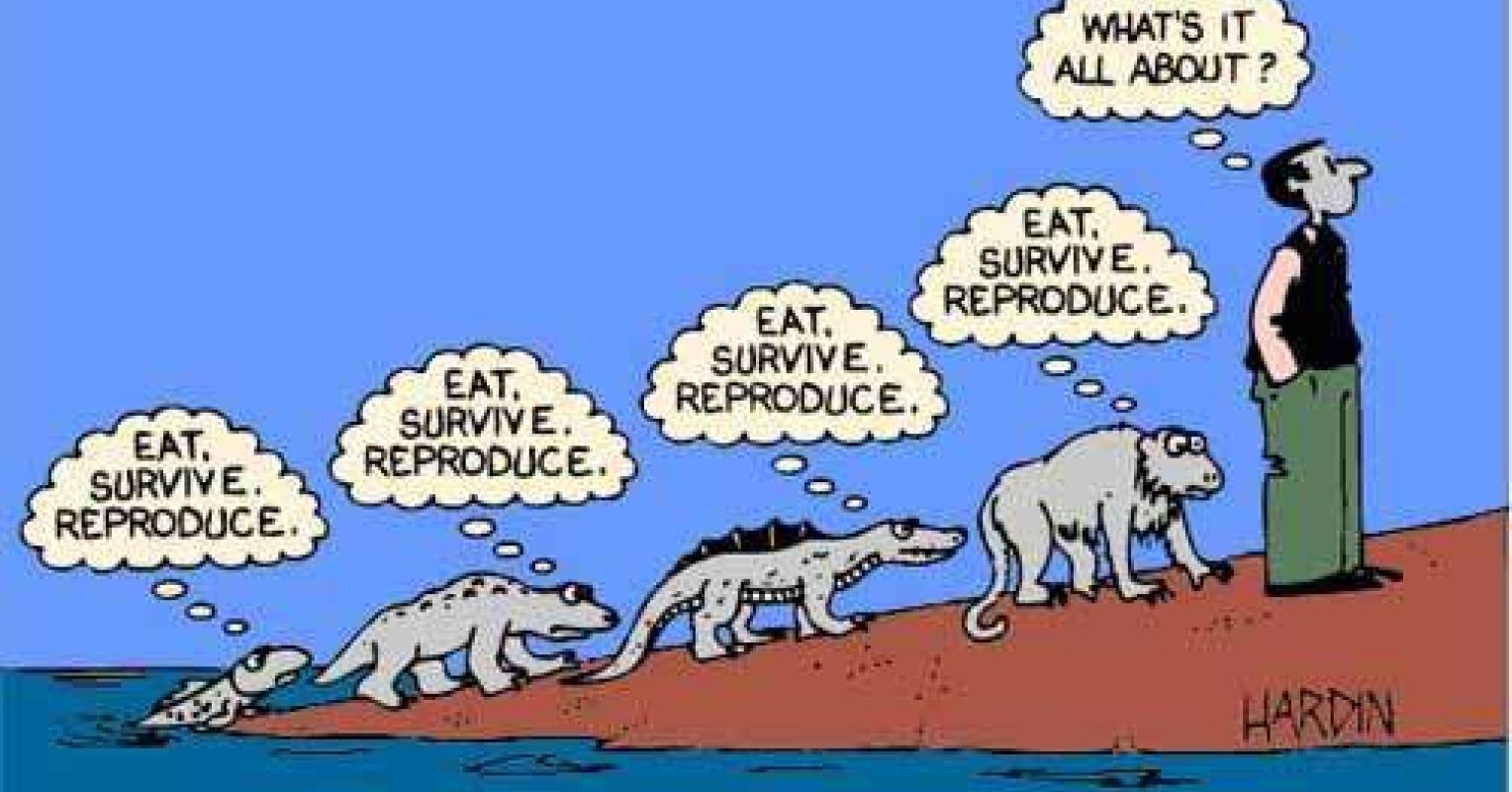
The Meaning of Life Revealed!
Evolutionary theory answers one of the most profound and fundamental questions human beings have ever asked themselves, a question that has plagued reflective minds for as long as reflective minds have existed in the universe: Why are we here? The question was answered in 1859 by Charles Darwin, and the answer can be stated in just six words...