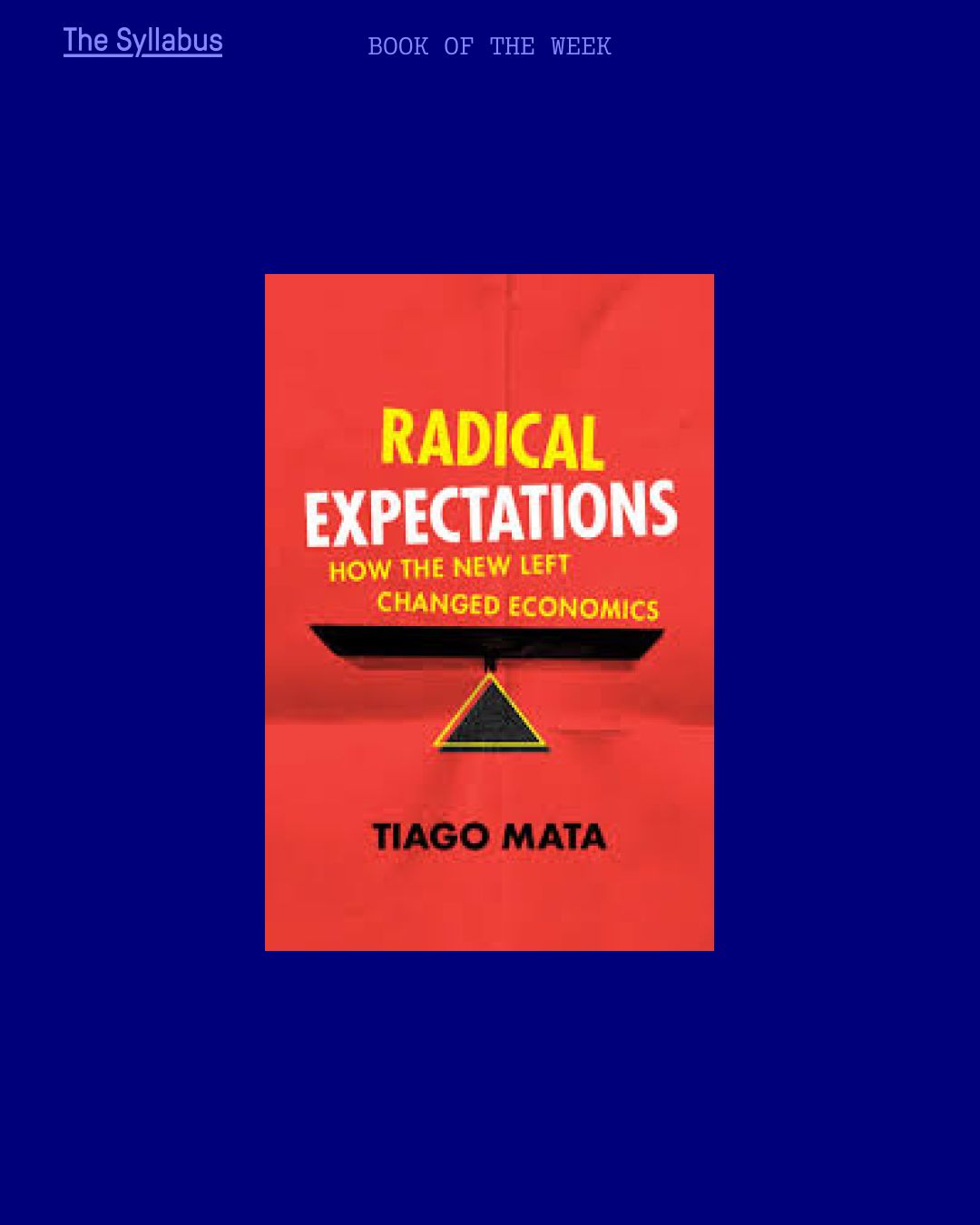
In the 1970s radical economists campaigned to reform their discipline and their universities. They became journalists and activists, moving beyond academia, to forge new models of public engagement and collaborative knowledge in economic life. Radical Expectations tells the story of how these economists set out to make economics more democratic. It traces their campaign to bring protest movements to the campuses, triggering the emergence of an alternative understanding of expertise directed at validating and empowering the perspectives and voices of women, Black Americans, labor activists, and the urban poor. It shows how a radical identity formed and how radicals helped reform disciplinary institutions. Furthermore, it argues that the radical economics' legacy was the development of a language and models of expert-lay collaboration that empowers direct action in economic affairs. The book is about the community of radical economists who championed the promise of change and what came of it
The Syllabus on Twitter / X
In the 1970s, radical economists left the university to work as activists. From the Union for Radical Political Economics to economic affairs bulletins, our book of the week investigates how the New Left changed economics.By Tiago Mata on @CambridgeUPhttps://t.co/aQQi9nqd0C pic.twitter.com/FM1A9nK5vN— The Syllabus (@syllabus_tweets) September 1, 2026
Radical markets: uprooting capitalism and democracy for a just society
Many blame today's economic inequality, stagnation, and political instability on the free market. The solution is to rein in the market, right? Radical Markets turns this thinking on its head. With a new foreword by Ethereum creator Vitalik Buterin and virtual reality pioneer Jaron Lanier as well as a new afterword by Eric Posner and Glen Weyl, this provocative book reveals bold new ways to organize markets for the good of everyone. It shows how the emancipatory force of genuinely open, free, and competitive markets can reawaken the dormant nineteenth-century spirit of liberal reform and lead to greater equality, prosperity, and cooperation. Only by radically expanding the scope of markets can we reduce inequality, restore robust economic growth, and resolve political conflicts. But to do that, we must replace our most sacred institutions with truly free and open competition Radical Markets shows how

Bookmarks Bookshop Home | Radical, Socialist and Progressive Books
Independent radical bookshop specialising in socialist, feminist, anti-racist and progressive books. Online orders and events.
Capitalism, Democracy, and Du Bois’s <em>Two</em> Proletariats
[epq-quote align="align-right"]"What can be more radical or liberating than freedom and justice for all?"[/epq-quote] As an ideal, liberal democracy has great appeal. What can be more radical or liberating than...
Radical Liberalism, Pragmatism, and Me - Aricie's thoughts
RadicalxChange
We are a community of activists, artists, entrepreneurs, and scholars committed to using mechanism design to inspire radical social change.

The revolution will not be funded: beyond the non-profit industrial complex
Introduction : the revolution will not be funded / Andrea Smith -- The political logic of the non-profit industrial complex / Dylan Rodríguez -- In the shadow of the shadow state / Ruth Wilson Gilmore -- From black awakening in capitalist America / Robert L. Allen -- Democratizing American philanthropy / Christine E. Ahn -- The filth on philanthropy : progressive philanthropy's agenda to misdirect social justice movements / Tiffany Lethabo King and Ewuare Osayande -- Between radical theory and community praxis : reflections on organizing and the non-profit industrial complex / Amara H. Pérez -- Native organizing before the non-profit industrial complex / Madonna Thunder Hawk -- Fundraising is not a dirty word : community-based economic strategies for the long haul / Stephanie Guilloud and William Cordery -- "We were never meant to survive" : fighting violence against women and the fourth world war / Ana Clarissa Rojas Durazo -- Social service or social change? / Paul Kivel -- Pursuing a radical anti-violence agenda inside/outside a non-profit structure / Alisa Bierria -- The NGOization of the Palestine liberation movement : interviews with Hatem Bazian, Noura Erekat, Atef Said, and Zeina Zaatari / Andrea Smith -- Radical social change : searching for a new foundation / Adjoa Florência Jones de Almeida -- Are the cops in our heads and hearts? / Paula X. Rojas -- Non-profits and the autonomous grassroots / Eric Tang -- On our own terms : ten years of radical community building with Sista II Sista / Nicole Burrowes ... [et al.]

The Road to Resegregation by Alex Schafran - Paper
Scholarship is a powerful tool for changing how people think, plan, and govern. By giving voice to bright minds and bold ideas, we seek to foster understanding and drive progressive change.

Technically Radical
Over 2024, we saw major tech investors and company owners overtly turn toward the right, overtly backing Donald Trump in his electoral campaign. This group of individuals, which commentators have taken to calling the “Tech Right”, are motivated by various concerns like the attempts by the Biden administration to regulate them and a general backlash against “wokeness”. Representative individuals and their respective justifications can be found in things like Marc Andreessen's essay The Techno-Optimist Manifesto or books like Balaji Srinivasan’s The Network State, and Alexander Karp and Nicholas Zamiska’s The Technological Republic.
Writings and rehearsals by Nathan Schneider
Welcome. I’m a professor of media studies at the University of Colorado Boulder, where I direct the Media Economies Design Lab and teach and learn from our students. I’ve written a book each on online democracy, cooperative enterprise, the Occupy movement, and God, and I’ve edited ones about solidarity economies, crypto, and co-ops. Reporting articles for both magazines and academic journals keeps my notebooks filled. Working with others to build a democratic economy keeps me accountable.
Capitalist Realism: Is There No Alternative?
It is easier to imagine the end of the world than the end of capitalism. After 1989, capitalism has successfully presented itself as the only realistic political-economic system - a situation that the bank crisis of 2008, far from ending, actually compounded. The book analyses the development and principal features of this capitalist realism as a lived ideological framework. Using examples from politics, film (Children Of Men, Jason Bourne, Supernanny), fiction (Le Guin and Kafka), work and education, it argues that capitalist realism colors all areas of contemporary experience, is anything but realistic and asks how capitalism and its inconsistencies can be challenged. It is a sharp analysis of the post-ideological malaise that suggests that the economics and politics of free market neo-liberalism are givens rather than constructions. New Edition includes:Forward by Zoe Fisher, Mark’s wife, talking about Mark as a personIntroduction by Alex Niven, his friend and colleague, talking about the political significance of the book thirteen years after it was writtenAfterword by Tariq Goddard, the original editor and publisher, describing the writing and editing of the book, its original reception, and Mark’s own view of it"A quick and entertaining read." Socialist Standard "A provocative and necessary read...for anyone wanting to talk seriously about the politics of education today. " Times Higher Educational Supplement
Their Side Is Organized; We Need to Be Organized, Too
Trump and his far-right acolytes wield their power to disinvest from public services, terrorize our neighborhoods with ICE agents, and ensure that opposition to genocide becomes a fireable, and deportable, offense. In the face of these grim and terrifying developments, it could scarcely be more urgent that we learn lessons from movements and organizing traditions that confronted repression, surveillance, and powerful opposition in the (recent and distant) past. We’ve put together a reading list of key books to help inform ongoing efforts to build and sustain durable organizations, and forge effective strategies, for both short term survival and long term social transformation. What fuels and sustains activism and organizing when it feels like our worlds are collapsing? Let This Radicalize You is a practical and imaginative resource for activists and organizers building power in an era of destabilization and catastrophe. “Anyone trying to rebuild an effective U.S. labor movement needs to read Class Struggle Unionism by Joe Burns. He lays out the fundamental principles that UE has tried to uphold for the last 85 years. For a union to be worthwhile to the working class, it needs to know which side it is on and it has to recognize that the fight itself is what allows workers to gain the knowledge and power they need.”—Carl Rosen From two co-founders of the largest tenants union in the country, this deeply reported account of the resurgent tenant movement centers poor and working-class people who are fighting back, staying put, and remaking the city in the process. A collection of essays from the Stop Cop City movement on the fight for police abolition and for a liveable planet for all, with gripping reporting from activists on the ground and rousing articles from renowned radical academics. In this remarkable collaborative work, leading scholar-activists Angela Y. Davis, Gina Dent, Erica R. Meiners, and Beth E. Richie surface the often unrecognized genealogies of queer, anti-capitalist, internationalist, grassroots, and women-of-color-led feminist movements, struggles, and organizations that have helped to define abolition and feminism in the twenty-first century. This guide, based on the collective experience of organizers and workers in non-unionized workplaces, is a critical tool to help you and your coworkers organize for justice at work. Drawing from over twenty years of activism on local and national levels, this striking book offers an organizer’s perspective on the intersections of immigrant rights, racial justice, and prison abolition. At a political moment when Liberatory Harm Reduction and mutual aid are more important than ever, this book serves as an inspiration and a catalyst for radical transformation of our world. Even the River Starts Small is a collection from the movement to stop construction of the Line 3 pipeline through northern Minnesota, featuring anonymous writing, art, and photos spanning nearly a decade, and including reflections on many of the diverse experiences that made up this grassroots resistance. “Tracing revolutionary uprisings from 1989 to 2019, this book is a map of resistance and resilience in the face of tremendous odds. The case studies, as well as the introductory essay, lead us through situations where the victory of capitalism over humanity was anything but assured. And yet the book is not a wistful history about what could have been. Rather, it is a strategic assessment of near-victories to prepare us for the fire next time.” —Tithi Bhattacharya As isolated individuals, debtors have little influence. But as a bloc, we can leverage our debts and devise new tactics to challenge the corporate creditor class and help win reparative, universal public goods. Individually, our debts overwhelm us. But together, our debts can make us powerful. What does the politics of solidarity look like in practice, and how can left-wing organizations grow—in numbers and power—while remaining accountable to the broader movements of which they are a part? An oral history and critical genealogy of “accountability,” the complex abolitionist concept that pushes us to ask: just what do we mean by “community?” Environmentalism from Below takes readers inside the popular struggles for environmental liberation in the Global South. These communities—among the most vulnerable to but also least responsible for the climate crisis—have long been at the forefront of the fight to protect imperiled worlds. This volume—the Socialist Register’s first-ever reader—grapples with the question of whether political organization is a necessary part of the struggle by the working-class to overthrow capitalism. In pieces published over the course of publication’s entire history contributors, from Ralph Miliband to Jean-Paul Satre, examine various aspects of this theme. The Socialist Challenge Today presents an essential historical, theoretical, and critical perspective for understanding the potential as well as the limits of three important recent phenomena: the Sanders electoral insurgency in the United States; the Syriza experience in Greece; and Corbyn's leadership of the Labour Party in the United Kingdom. This book surveys revolutionary socialist ideas and engages a gallery of contentious political thinkers, offering an indispensable assessment of the place of revolutionary collectives in this radical tradition. A trenchant history of community organizing and a must-read for the next generation of organizers seeking to learn from the successes, failures, and contradictions of the past. In an era of stark racial injustice, Aaron Dixon dedicated his life to revolution, founding the Seattle chapter of the Black Panther Party in 1968 at age nineteen. In My People Are Rising, he traces the course of his own radicalization, and that of a generation. SNCC: The New Abolitionists influenced a generation of activists struggling for civil rights and seeking to learn from the successes and failures of those who built the fantastically influential Student Nonviolent Coordinating Committee. Detroit: I Do Mind Dying tracks the extraordinary development of the Dodge Revolutionary Union Movement and the League of Revolutionary Black Workers as they became two of the landmark political organizations of the 1960s and 1970s. It is widely heralded as one the most important books on the Black liberation movement. A landmark account of a key radical feminist organization, offering lessons for today’s women’s liberation movement. Boston Female Liberation member Nancy Rosenstock expertly weaves together the reflections of her fellow-activists, describing how they became feminists, recounting the breadth of their organizing work, and linking their achievements and experience to contemporary struggles against sexism. In this rousing and insightful participant's account, Hal Draper recounts the now iconic events of the Berkeley Free Speech Movement. From the impromptu speak out atop a police car after the administration decided to clamp down on students “distributing communist literature,” to the inspiring Student Strike that shut down the entire campus, Draper's narrative captures the energy and dynamism of each twist and turn in the struggle, and offers invaluable analysis along the way. From the dawning of the industrial epoch, wage earners have organized themselves into unions, fought bitter strikes, and gone so far as to challenge the very premises of the system by creating institutions of democratic self-management aimed at controlling production without bosses. During the first two decades of the twentieth century the ideas of revolutionary syndicalism developed into a major influence within the trade union movement. Committed to destroying capitalism through direct industrial action and revolutionary trade union struggle, the movement raised fundamental questions for activists across the world. In this thorough, concise, and accessible introduction to Lenin’s theory and practice of revolutionary politics, Paul Le Blanc gives a vibrant sense of the historical context of the socialist movement (in Russia and abroad) from which Lenin’s ideas about revolutionary organization spring. What emerges from Le Blanc’s partisan yet measured account is an image of a collaborative, ever adaptive, and dynamically engaged network of revolutionary activists who formed the core of the Bolshevik party.

The Root – Black News, Opinions, Politics and Culture
The Revolution Has Come: Black Power, Gender, and the Black Panther Party in Oakland
"Tearing down myths and distortions on virtually every page, The Revolution Has Come is the first substantive account of the Black Panther Party’s Oakland chapter—the iconic gathering that birthed the party and held on to its very last breath. Robyn C. Spencer’s incisive attention to gender, state repression, black radical alliances, philosophical and ideological debates, and the organization’s long decline makes this one of the most original studies of the Panthers to appear in years." - Robin D. G. Kelley, author of Freedom Dreams: The Black Radical Imagination

Rutger Bregman - “Moral Ambition” | The Daily Show
The Triumph of Broken Promises — Harvard University Press
A powerful case that the economic shocks of the 1970s hastened both the end of the Cold War and the rise of neoliberalism by forcing governments to impose austerity on their own people.Why did the Cold War come to a peaceful end? And why did neoliberal economics sweep across the world in the late twentieth century? In this pathbreaking study, Fritz Bartel argues that the answer to these questions is one and the same. The Cold War began as a competition between capitalist and communist governments to expand their social contracts as they raced to deliver their people a better life. But the economic shocks of the 1970s made promises of better living untenable on both sides of the Iron Curtain. Energy and financial markets placed immense pressure on governments to discipline their social contracts. Rather than make promises, political leaders were forced to break them.In a sweeping narrative, The Triumph of Broken Promises tells the story of how the pressure to break promises spurred the end of the Cold War. In the West, neoliberalism provided Western leaders like Ronald Reagan and Margaret Thatcher with the political and ideological tools to shut down industries, impose austerity, and favor the interests of capital over labor. But in Eastern Europe, revolutionaries like Lech Walesa in Poland resisted any attempt at imposing market discipline. Mikhail Gorbachev tried in vain to reform the Soviet system, but the necessary changes ultimately presented too great a challenge.Faced with imposing economic discipline antithetical to communist ideals, Soviet-style governments found their legitimacy irreparably damaged. But in the West, politicians could promote austerity as an antidote to the excesses of ideological opponents, setting the stage for the rise of the neoliberal global economy.