


In the spring of 1957, when he was eighty-one years old…
50 Ideas That Changed My Life - David Perell
David shares 50 ideas that changed his life. Read here.

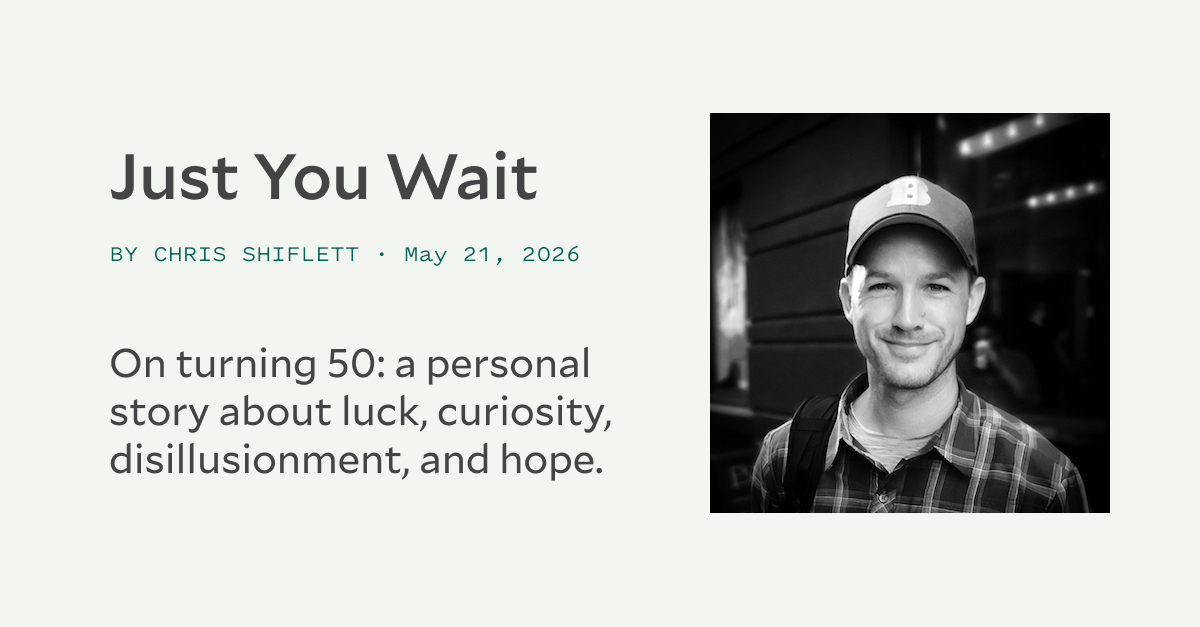
Just You Wait, by Chris Shiflett
On turning 50: a personal story about luck, curiosity, disillusionment, and hope.
Augmenting Long-term Memory
One day in the mid-1920s, a Moscow newspaper reporter named Solomon Shereshevsky entered the laboratory of the psychologist Alexander Luria. Shereshevsky's boss at the newspaper had noticed that Shereshevsky never needed to take any notes, but somehow still remembered all he was told, and had suggested he get his memory checked by an expert.
36 important life and work lessons a top tech executive learned before turning 30
The days are long but the decades are short.
I have forgotten how to read
For a long time Michael Harris convinced himself that a childhood spent immersed in old-fashioned books would insulate him from our new media climate, but he was wrong


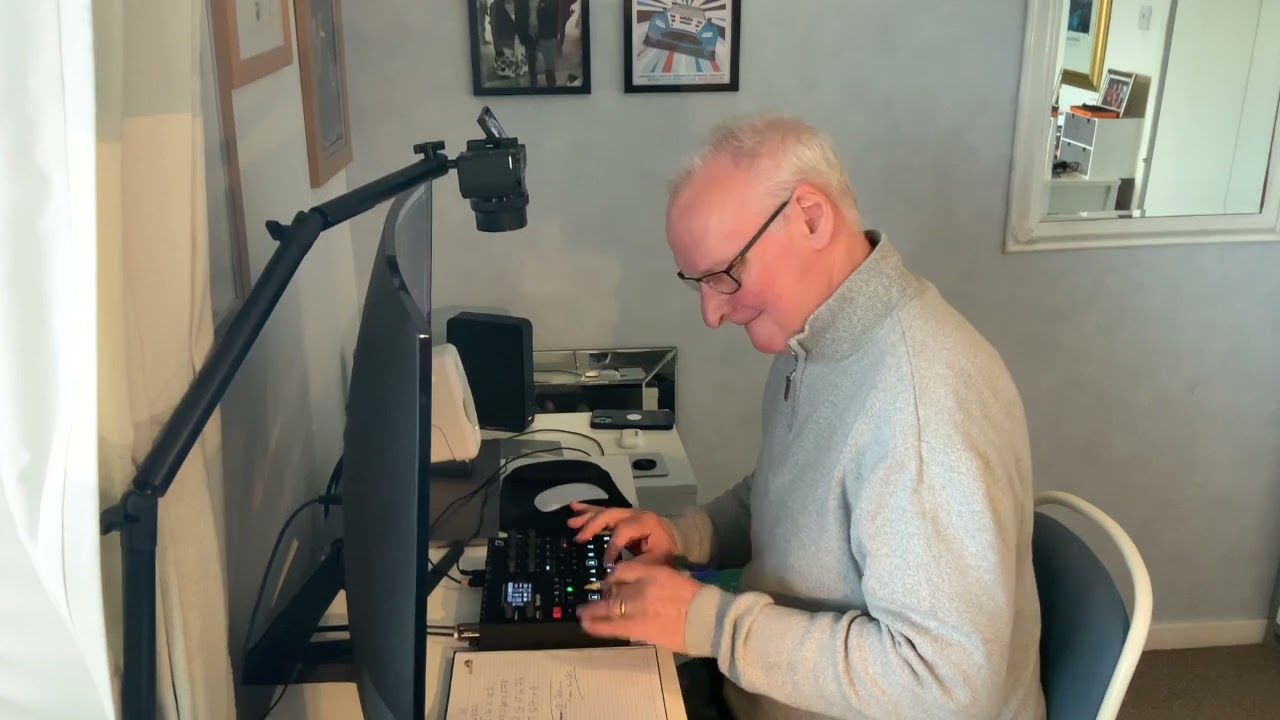
"Last night I got an email from someone who said 'I'm 46, is it okay to start producing music?' I said 'yes, start now!'": How a 67-year-old pensioner went viral performing industrial techno at home
What started as a post-retirement hobby has led The Last DJ to runaway success and his first gig in 40 years. Now he's on a mission to inspire others to do the same
Leonard Cohen Dead at 82
Leonard Cohen, the hugely influential singer and songwriter whose work spanned five decades, died at the age of 82.

Three important steps in my maturation process – Thomas Dullien / Halvar Flake
My father passed recently, and he was twice my age. I am approximately the same age that he was when I was born, and I am now “the old generation” - there’s no one left in the generation above me.
Tradition and the Individual Talent
Poems, readings, poetry news and the entire 110-year archive of POETRY magazine.

I Thought I Would Have Accomplished a Lot More Today and Also by the Time I Was Thirty-Five
When I think about all the time I frittered away today, it agitates me, and I jump on Wikipedia to look up famous nineteenth-century circuses.

The obsolescence of man, vol I , part 2: The world as phantom and as matrix: philosophical considerations on radio and television - Günther Anders
The first complete English translation of a remarkable 1956 essay about television from Vol. I of The Obsolescence of Man by Günther Anders, who—using phenomenological analyses, excerpts from his diaries and reflections on daily life—depicts a capitalist world that manufactures a warped “mass-man” by imposing nonparticipation, consumption of images, artificial “needs” (“drug addiction is the model for today’s needs”), separation, “conditioning”, an eternal present, commodified leisure and the dissolution of the individual in vapid mass produced roles, in a text that in many ways anticipates the theory of the “spectacle” of Guy Debord and the situationists.
Child Prodigy Discovers Butterflies Remember Caterpillar Life, And Pass Down Memories To Offspring
Jo Nagai conducted an experiment on butterflies that would surprise scientists around the world. Are memories passed down?

Does Silicon Valley dream of Philip K Dick?
[FREE TO READ] His 1960s science-fiction visions are a guide to our age of erratic billionaires, wild space fantasies and glitchy, invasive technology

Use it or lose it: How cognitive skills change with age
Cognitive skills are commonly assumed to begin deteriorating from the age of 30, which could pose a significant challenge for rapidly ageing populations. But this assumption relies largely on cross-sectional data that cannot distinguish between ageing patterns and cohort differences. Using German longitudinal data, this column finds that skills, on average, increase markedly into one’s 40s before decreasing slightly in literacy and more severely in numeracy. In addition, skills decline at older ages only for those with below-average skill usage, outlining a clear policy pathway for avoiding skill declines.

Roman Opałka
Opałka was born on 27 August 1931 in Abbeville-Saint-Lucien, France, to Polish parents. The family returned to Poland in 1946 and Opałka studied lithography at a graphics school before enrolling in the School of Art and Design in Łódź. He later earned a degree from the Academy of Fine Arts in Warsaw. He moved back to France in 1977.[1] Opałka lived in Teille, near Le Mans, and Venice.[2] He died at age 79 after falling ill while on holiday in Italy. He was admitted to a hospital near Rome and died there a few days later, on 6 August 2011.[1]
