

An investigation of the roots of the alliance between free-market neoliberals and social conservatives.Why was the discourse of family values so pivotal to the conservative and free-market revolution of the 1980s and why has it continued to exert such a profound influence on American political life? Why have free-market neoliberals so often made common cause with social conservatives on the question of family, despite their differences on all other issues? In this book, Melinda Cooper challenges the idea that neoliberalism privileges atomized individualism over familial solidarities, and contractual freedom over inherited status. Delving into the history of the American poor laws, she shows how the liberal ethos of personal responsibility was always undergirded by a wider imperative of family responsibility and how this investment in kinship obligations is recurrently facilitated the working relationship between free-market liberals and social conservatives. Neoliberalism, she argues, must be understood as an effort to revive and extend the poor law tradition in the contemporary idiom of household debt. As neoliberal policymakers imposed cuts to health, education, and welfare budgets, they simultaneously identified the family as a wholesale alternative to the twentieth-century welfare state. And as the responsibility for deficit spending shifted from the state to the household, the private debt obligations of family were defined as foundational to socioeconomic order. Despite their differences, neoliberals and social conservatives were in agreement that the bonds of family needed to be encouraged—and at the limit enforced—as a necessary counterpart to market freedom. In a series of case studies ranging from Bill Clinton's welfare reform to the AIDS epidemic and from same-sex marriage to the student loan crisis, Cooper explores the key policy contributions made by neoliberal economists and legal theorists. Only by restoring the question of family to its central place in the neoliberal project, she argues, can we make sense of the defining political alliance of our times, that between free-market economics and social conservatism.
Neoliberal Fascism as the Endpoint of Casino Capitalism
This article explores neoliberal fascism as a distinctive political formation within the current historical moment. In doing so, it first analyzes neoliberalism as a project that has since the 1970s destroyed all the commanding institutions of democracy while consolidating power in the hands of a financial elite. In addition, it analyzes neoliberalism as a movement, that produces and legitimates massive economic inequality and suffering, privatizes public goods, dismantles essential government agencies, and individualizes all social problems. Under such circumstances, neoliberalism creates the conditions for right wing extremists to mobilize the anger of white disenfranchised working class populations by both appealing to the economic injustices they experience while simultaneously blaming and directing their frustrations towards non-white minority groups such as immigrants, blacks, and Muslims. It is precisely this merging of the social, political, and economic hardships produced by neoliberal capitalism and its appropriation of the discourse of white supremacy to divert attention from its worst excesses and failures that a neoliberal fascism is produced. Â More specifically, I argue that in the face of 40 years of neoliberalism with its production of massive inequality, a frontal attack on the welfare state, and the erosion of civic institutions and culture, there has been a resurgence of fascist discourses and a populist fascist political movement. Neoliberal fascism represents the conjoining of the most extreme elements of casino capitalism with the discourses of racial cleansing, and white nationalism. The article concludes by examining how atomization, fear, and anxiety have become the breeding grounds of fascism and what it means to revive education as a central tenet of politics so as to address the task of not simply resisting oppressive economic structures, but also what it means to engage in the massive challenge of changing individual and collective consciousness as a precondition for collective struggle and the building of new social movements. Author Biography Henry Giroux, McMaster University Chair for Scholarship in the Public Interest The Paulo Freire Distinguished Scholar in Critical Pedagogy
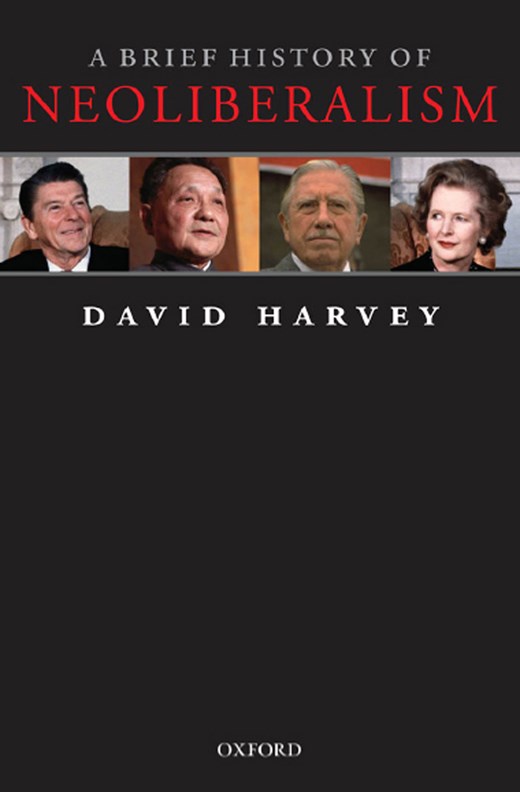
A Brief History of Neoliberalism
Abstract. Neoliberalism--the doctrine that market exchange is an ethic in itself, capable of acting as a guide for all human action--has become dominant in
Re-enchanting the world : feminism and the politics of the commons
xviii, 227 pages ; 23 cm; "Silvia Federici is one of the most important contemporary theorists of capitalism and feminist movements. In this collection of her work spanning over twenty years, she provides a detailed history and critique of the politics of the commons from a feminist perspective. In her clear and combative voice, Federici provides readers with an analysis of some of the key issues and debates in contemporary thinking on this subject. Drawing on rich historical research, she maps the connections between the previous forms of enclosure that occurred with the birth of capitalism and the destruction of the commons and the "new enclosures" at the heart of the present phase of global capitalist accumulation. Considering the commons from a feminist perspective, this collection centers on women and reproductive work as crucial to both our economic survival and the construction of a world free from the hierarchies and divisions capital has planted in the body of the world proletariat. Federici is clear that the commons should not be understood as happy islands in a sea of exploitative relations but rather autonomous spaces from which to challenge the existing capitalist organization of life and labor"--; Foreward by Peter Linebaugh; Includes bibliographical references (pages198-216) and index; On primitive accumulation, globalization, and reproduction -- Introduction to the new enclosures -- The debt crisis, Africa, and the new enclosures -- China: breaking the iron rice bowl -- From commoning to debt: financialization, microcredit, and the changing architecture of capital accumulation -- Beneath the United States, the Commons -- Commons against and beyond Capitalism -- The University: a knowledge common? -- Feminism and the politics of the commons in an era of primitive accumulation -- Women's struggles for land in Africa and the reconstruction of the commons -- Women's struggles for land and the common good in Latin America -- Marxism, feminism, and the commons -- From crisis to commons: reproductive work, affective labor and technology, and the transformation of everyday life -- Re-enchanting the world: technology, the body, and the construction of the commons

Social Reproduction Theory: Remapping Class, Recentering Oppression
This groundbreaking collection explores the profound power of Social Reproduction Theory to deepen our understanding of everyday life under capitalism. While many Marxists tend to focus on the productive economy, this book focuses on issues such as child care, health care, education, family life and the roles of gender, race and sexuality, all of which are central to understanding the relationship between economic exploitation and social oppression. In this book, leading writers such as Lise Vogel, Nancy Fraser, David McNally and Susan Ferguson reveal the ways in which daily and generational reproductive labour, found in households, schools, hospitals and prisons, also sustains the drive for accumulation. Presenting a more sophisticated alternative to intersectionality, these essays provide ideas which have important strategic implications for anti-capitalists, anti-racists and feminists attempting to find a path through the seemingly ever more complex world we live in.

What "Parents' Rights" REALLY Means
Freedom Now | Polity: Vol 52, No 3
Left-wing politics is resurgent. Self-proclaimed socialists are unexpectedly popular. Proposals like universal health care are a commonplace of Democratic campaigns. But there is not yet a clear, unifying idea behind this political shift. We propose that that idea is freedom. While the left once understood freedom as emancipation from the economy, the right spent the twentieth century neutralizing and appropriating the idea of freedom by reinventing the economy as the true site of freedom. To reclaim freedom as a value of the left, we have to begin with the daily experience of most people: the unfreedom of the workplace. The authoritarian organization of work is not just an offense against freedom; it also helps us understand how freedom requires emancipation both from the economy and within the economy, and why that emancipation requires mass struggle.

Neoliberalism | The Paper Pilot
The Paper Pilot's digital garden of thoughts on philosophy, politics, and sociology
Lo and behold, the bourgeois gaslighting machine! - Lemmy
This thread is an exemplary case of how “we” (that is, liberal-minded minions uncritically parroting the talking points of the bourgeoisie) inhibit any social and class consciousness from sprouting in the proletarian mind. The original post, titled “Nothing worth having in life comes easily”, goes as such: >Yes it does. Yes it fucking does. For SOME people. >Some people were born into rich families. Money is worth having, and money came easily to them. >[…] >Some people are born white. Not being discriminated against must be nice. >I could go on. You get the fucking point. >Why do people on Reddit keep repeating this blatantly false platitude? There are countless of examples of people in this world who didn’t have to work for shit, yet many things came easily to them. As you might expect, the comments went on the offense to discredit OP’s sentiments, in different manners. The first category of comments involves invoking “life” as some natural order of things which is beyond human control, ergo it must be accepted. >I get what you mean life is unfair sometimes. >Life sucks and then we die. >Life is 100% unfair. Full stop. Get used to it. This defeatist attitude just dissuades any doubts in one’s mind regarding the viability of the current system. The second category includes comments that deny any exteriority to OP’s sentiments and focus on their own personal ailments: >Some people get so fixated on being victims of society that they seem to give away their own power to change their lives. >This post is somewhat delusional. Highly suggest to not compare your insides to other people’s outsides or you’ll always come away with a distorted perception. There are so many false assumptions in here I don’t know where to start but if you wanna pity yourself and put others on pedestals - knock yourself out. >Being mad and jealous, letting negative emotions permeate through every facet of your mind will make it better. Keep going. They’re basically saying: “the world is fine, the problem is you; and you should feel bad for feeling otherwise.” The third category involves comments that dilute the importance of wealth and socioeconomic status: >Every privilege you mentioned comes with its own set of problems. >It might not seem like it, but everybody has the same amount of issues as everyone else. >Dating, money, and privilege aren’t the meaning of life. An obvious case of blatantly gaslighting people struggling to survive when they realize the unfairness of capitalism. And an honourable mentions goes to those talking down white supremacy and systemic racism! >Agreed except for the white comment. Every race gets discriminated against, just in different ways. >Oh good more hatred of White people this will surely solve this loser’s personal problems. >Oh, if you are born white don’t worry, there will be plenty of people who will discriminate against you. One of the major political parties sanctions it. It’s socially acceptable. There’s plenty of people like you. You get the point. >Well white people get discriminated against and this is all very victim mentality based. There are many other arguments, but you get the point. They all share the same motive: the annihilation of any hint of social consciousness. It is tragic because, more often than not, it is the oppressed who are gaslighting themselves and not the bourgeois and capitalists. The latter outsource even the labor of propagating their foul logic and arguments to the proletariat.
npj on Twitter / X
Schumpeter in a nut shell:— Capitalism forces “rationalization” and the rationalist worldview, which just ends in an almost nihilistic skepticism that corrodes everything traditional that it touches: in particular “family life” and the aristocracy.— The traditional… pic.twitter.com/hThnUJ6jNE— npj (@TiltingatM3) May 28, 2026

The Alternative to Capitalism Nobody Talks About | Eleanor Finley & Camila Vergara
The Inner Life of Liberalism - Aaron Ross Powell’s Blog
The practices that make your life better are the same ones that sustain a free society. It's time liberalism took that seriously.
Capitalist Realism: Is There No Alternative?
It is easier to imagine the end of the world than the end of capitalism. After 1989, capitalism has successfully presented itself as the only realistic political-economic system - a situation that the bank crisis of 2008, far from ending, actually compounded. The book analyses the development and principal features of this capitalist realism as a lived ideological framework. Using examples from politics, film (Children Of Men, Jason Bourne, Supernanny), fiction (Le Guin and Kafka), work and education, it argues that capitalist realism colors all areas of contemporary experience, is anything but realistic and asks how capitalism and its inconsistencies can be challenged. It is a sharp analysis of the post-ideological malaise that suggests that the economics and politics of free market neo-liberalism are givens rather than constructions. New Edition includes:Forward by Zoe Fisher, Mark’s wife, talking about Mark as a personIntroduction by Alex Niven, his friend and colleague, talking about the political significance of the book thirteen years after it was writtenAfterword by Tariq Goddard, the original editor and publisher, describing the writing and editing of the book, its original reception, and Mark’s own view of it"A quick and entertaining read." Socialist Standard "A provocative and necessary read...for anyone wanting to talk seriously about the politics of education today. " Times Higher Educational Supplement

Why The Rich Think The Poor Are Lazy
Time and the Neo-Monarchist Turn
One of the classical arguments against democracy concerns its supposed short-termism. Early-modern political thought contrasted the pitfalls of elected authority, whose timebound character was seen to invite inconstancy, instability and plunder, with the merits of indefinite rule on the model of kingship. Such reasoning has seen two revivals in recent years, first in a neo-liberal form as an argument for technocracy (see independent central banking), second in a neo-reactionary form as an argument for an all-powerful executive or ‘monarch’ (see the contemporary international far Right). This article looks at the structure of these political arguments and the work they do. Having reconstructed their historical background, it charts how the neo-monarchist turn marks a radicalisation in democracy-scepticism, guided by a patrimonial logic of authority as property ownership. The article goes on to examine the political-economic factors to which this responds, as well as the contradictions to which neo-monarchism is prone. As the article concludes, temporal arguments for authoritarian politics may be dubious in substance but merit careful observation in a context of widespread disaffection with existing institutions.
