

The Sunday Times and #1 New York Times Bestseller‘The Technological Republic is far too important to ignore’ Times Literary SupplementSilicon Valley’s brightest minds once collaborated with governments to advance technologies, securing the West’s dominance on the global stage. But that relationship has corroded – with perilous repercussions for us all.Lifting the veil on tech giant Palantir and its broader political project, visionary co-founder and CEO Alexander C. Karp and his long-time deputy Nicholas W. Zamiska offer a searing critique of our collective culture of complacency. To regain geopolitical power and preserve our freedoms, we must tackle the world’s most pressing challenges – including the artificial intelligence arms race – together and head-on. Now is the time for the West to wake up.‘Bold and ambitious ... Essential reading’ Eric Schmidt‘Fascinating’ Financial Times‘A stirring manifesto’ Niall Ferguson‘Provocative and insightful’ Jamie Dimon
Palantir's social media manifesto is a blueprint for technofascism
The surveillance firm’s viral X post calls for hard power, conscription and the end of pluralism. AI expert and academic Mark Coeckelbergh on what happens when technology becomes the gateway to authoritarianism
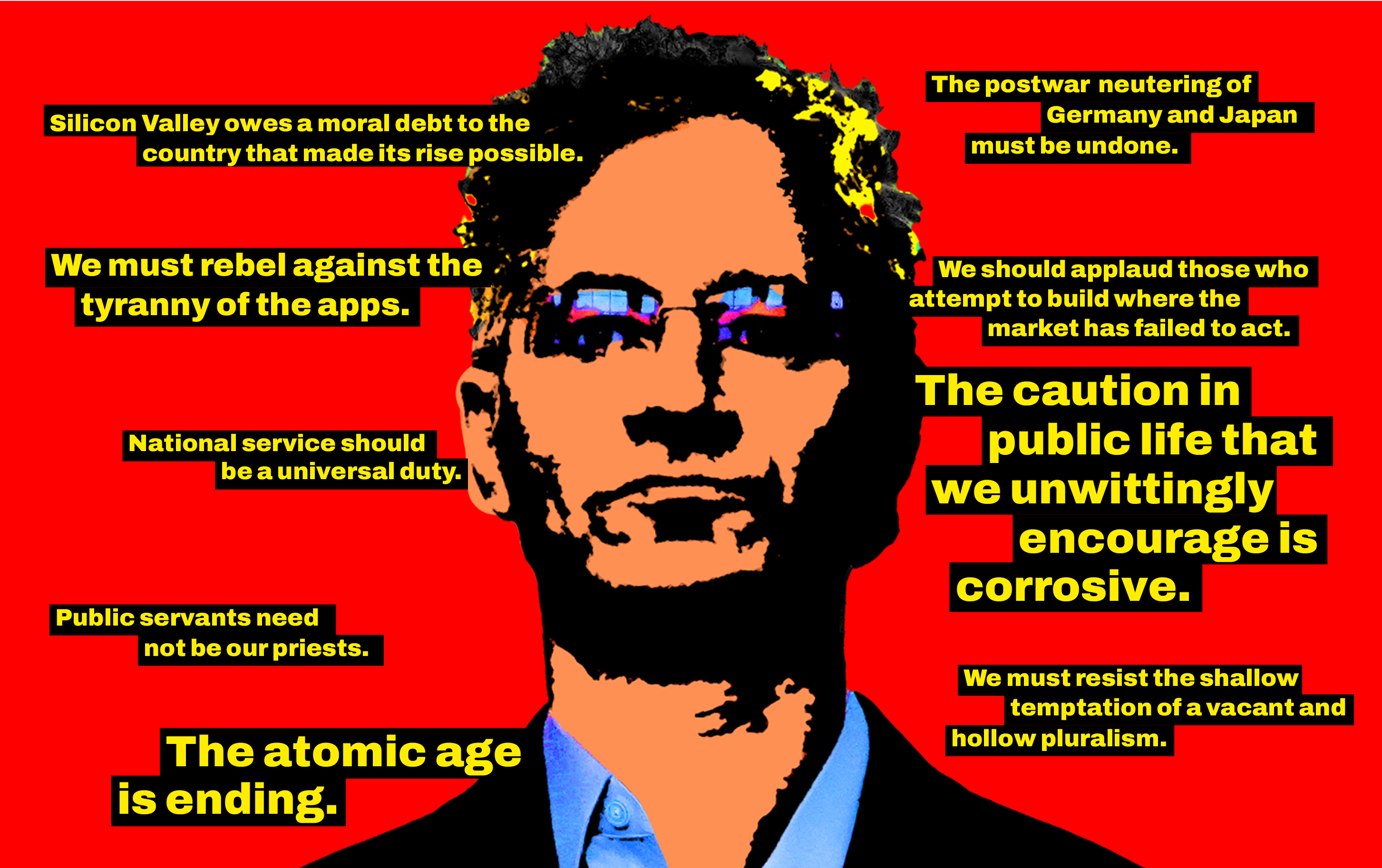
Palantir posted a manifesto that reads like the ramblings of a comic book villain
Palantir shared 22 points excerpted from CEO Alex Karp and Nicholas W. Zamiska's 2025 book, The Technological Republic, and they're troubling.

A Thesis on the History of the 21st Century: Technocracy, AI, and the End of the World
Reviewing a trio of books by a sextet of ruling-class ideologues, Mathias Fuelling finds an ambient anxiety hanging over a perceived crisis in American capitalism, with visions of bolstering a Silicon Valley-led technocracy fueled by AI investment reflecting American fears over the dawn of a "Chinese Century."

The Philosophy Behind Palantir: Moira Weigel and Anthony Burton w/ Alexis Papazoglou
The Philosopher in the Valley
An acclaimed New York Times Magazine writer brings us into the world of the controversial technology firm Palantir and its very colorful and outspo...
A Real Political Economy of Technology - The Ideas Letter
Two technological futures are competing for political and material priority: generative AI and the green transition. Benanav argues that while AI is marketed as a world-reordering breakthrough, its productivity gains…

Technological parables and iconic illustrations: American technocracy and the rhetoric of the technological fix
This paper traces the role of American technocrats in popularizing the notion later dubbed the ‘technological fix’. Channeled by their long-term ‘chief’, Howard Scott, their claim was that technolo...

Hype, financial narratives, and self-fulfilling prophecies in surveillance capitalism
The rise of platforms has transformed our understanding of contemporary capitalism, with the critical literature describing how these firms leverage unprecedented digital powers to extract monopoly rents – perhaps even heralding a new form of Feudalism. This paper draws on the literature on financial narratives to examine the role that such stories play within the form of capitalism that they describe, and what this suggests for the role of “hype” in contemporary capitalism. The same stories that for critical scholars appear as menacing threats of “technofeudalism” or “surveillance capitalism” for investors appear as optimistic stories of promising future returns. By driving financial investments, narratives afford platforms very real social and political powers, enabling them to function as a form of self-fulfilling prophecies. The paper argues for a cultural inflection to the political economy of Big Tech – viewing capitalism as neither mechanistic nor rational, but as an expression of a complex interplay between narrative, technology, and economic power. This suggests the need for a critical hype studies, geared at deconstructing the narratives undergirding the technological waves of capitalist pursuits, and examining the broader role of hype in coordinating and directing flows of capital within contemporary financialized capitalism.


Technological Metamodernism (Sep 2024)
Technological Metamodernism A four-week course with Stephen Reid and special guests Telegram group: https://t.me/+4CC9lfZMBN04ZTdk Substack post announcing the open-sourcing of the notes: https://stephenreid.substack.com/p/technological-metamodernism-course This work is licensed under Cre...

The scent of Musk: Power, charisma and paranoia in Silicon Valley
Technopoly: The Surrender of Culture to Technology
A witty, often terrifying that chronicles our transform…

‘If we don’t fight back, we don’t have a future’: the journalist taking on the ‘tech fascists’ of Silicon Valley
As Elon Musk, Peter Thiel and their peers have grown richer and more influential, Gil Durán argues they have all but abandoned democracy – and found the perfect government to enable them
Palantir put out a 22-point summary of their CEO's book The Technological Republic. It's pitched as a defence of the West, but if you read it through the VDA framework, verification, deliberation, accountability, what it's actually doing looks rather different. twitter-thread.com/t/2045574398573453312
Palantir put out a 22-point summary of their CEO's book The Technological Republic. It's pitched as a defence of the West, but if you read it through the VDA framework, verification, deliberation, accountability, what it's actually doing looks rather different. twitter-thread.com/t/2045574398573453312
Gil Duran, author of The Nerd Reich, pulls it together: "the real 'innovation' we are seeing is the tech bros using wealth to seize government - in order to break government."

David Fenton
Crypto companies are the largest donors in American politics. Very few Americans use crypto at all. Journalist @gilduran.com calls it a gun to the head of American democracy. If a politician goes against them, tens of millions of dollars land on their head.

