


We consulted on further measures to prepare children for the future in an age of rapid technological change. This includes potential age restrictions on social media and other services such as gaming sites and AI chatbots, restrictions on addictive design features and risky functionalities, and better support for parents and families.
Ensuring a safer online experience for U.S. kids and teens
An overview of our approach to age assurance and our commitment to online safety for young users and families.

The Illusion of Protection: Why Canada’s Growing Push to Ban Social Media for Kids Won’t Work - Michael Geist
The momentum behind a social media ban for Canadian minors has been building for months. The federal Liberals voted at their April policy convention to back a minimum age of 16 for social media accounts and AI chatbots, the government’s expert panel on online safety is studying the issue, protesters have now rallied on Parliament Hill calling for it, and on Saturday night, Manitoba Premier Wab Kinew told a Winnipeg fundraiser that his government will be the first in Canada to ban social media and AI chatbots for kids. Kinew did not specify which kids, when it would happen, or how it would be enforced, none of which appeared to matter to the audience. The political appeal of a ban is obvious, since concerns about social media’s effects on young users are widely shared. Yet the policy itself is a terrible idea that will not work. This post examines at least six reasons why an outright age-based ban, particularly one that extends to AI chatbots, is the wrong response to a serious issue.
The CHATBOT Act Forces One Parenting Model On Every Family
Artificial intelligence is rapidly changing education, and the way people search for information. Parents, teenagers, teachers, and schools are struggling with tough questions about when AI should,

#cybersafety #ageverification #privacy #minors #ai | Parry Aftab
Internet Age-Verification Causing More Risks than It’s Worth This is not a new issue. Regulators and policymakers have raised it for the last 28 years as the way the keep kids safer online. They compare it to having to flash an ID to purchase regulated content or items (porn, cigarettes, alcohol, restricted medications, age-restricted movies, amusement rides, etc.) But verification online is very different and vastly riskier than flashing an ID in real life. For one, it’s collecting personally-identifiable information about our kids. For two, it puts that information in the too-often untrustworthy digital hands of tech companies. For three, while porn, alcohol and regulated drugs may be a clear-cut case for restricting access to adults, access to the Internet is very different. Yet, regulations begun in the UK and adopted globally have begun a weighted cybersafety approach that, in my humble opinion, prefers excluding young people from digital technology over teaching the cybersafety and digital life skills. That, in my 32 years of work in the fields of cybersafety and protection of minors online, was and remains a mistake. One of my best known quotes, repeated in Congressional and state legislative testimony and in the media is: “The greatest single risk our children face online is being denied access. We have solutions for everything else.” (my testimony before the FTC) Some proponents of age-verification have opted to denying them access unless they give up confirmable personally-identifiable info, such as selfies, feeding AI with PII, and govt or school credentials. I argue that this gives social networks, game providers and digital app operators a wealth of PII to be used for profiling, marketing and collecting far too much. With their privacy at stake, too often incompetent, malicious and greedy producers and mega-tech industry players, can’t and shouldn’t be trusted with the personal info of our most vulnerable - our kids. And AI will now be tasked with collecting everything it can find about our kids to be able to “age-verify.” (It’s ability to age-verify is less reliable with youth as their data-sets are more limited.) I served on a task force appointed by 49 state attorneys general, charged to research and weigh-in on this issue. We concluded that age-verification wasn’t feasible. While this task force was formed many years ago, with the exception of a fortified AI, not much as changed. Our children’s privacy remains, or should remain, paramount. We have robust filtering and blocking technologies. The adult industry has adopted an age-gated model. And parents can restrict access using device-specific tools. And, many well-intentioned age-verification laws were adopted too quickly for thoughtful discourse. Or by governments more prone to censorship/content restrictions. I fear in our quest to protect our kids we have thrown our babies out with the bath water. #cybersafety #ageverification #privacy #minors #AI

The Dangers of Age Verification Provisions
One proposed solution to ensuring safe youth online experiences is age verification provisions, which require platforms to confirm the ages

What Would Online Age Verification Mean for Speech, Privacy, and Youth Online Safety?
Does AI stop children from learning?
New data show the peril and promise of the technology

Online age-verification tools spread across U.S. for child safety, but adults are being surveilled
New age-verification laws and tools are designed for child safety on social media and the internet, but adults are in the crosshairs, say privacy experts.

Patrick - I'm worried about the web
I'm worried about the web. I don't want to live in a world where most users of internet-connected devices consume their information and accomplish their tasks via a chat bot interface.

Erlend Sogge Heggen (@erlend.sh)
1. solitude: single-player game loop 2. bottomlessness: infinite scroll 3. speed: instant delivery/gratification 4. teasing: generally satisfactory, never perfect; “maybe the next one is exactly what I want” ↘️ quoting NPR (@npr.org): Taken together, these four features can create a trancelike state that can keep us stuck on social media apps or video games for hours. Children are particularly vulnerable. n.pr/4mH6i6s
Children’s Rights and Online Age Assurance Systems
Abstract Age assurance is a way to prevent children accessing content, products or services that are potentially harmful to them, ranging from gambling services or alcohol or tobacco or, increasingly, certain products and services online. Now that children’s lives are mediated by digital technologies, policymakers are deliberating over the legal, technical and practical challenges. These have been little examined from the perspective of children’s rights. By combining legal and social research methods, this article examines the legal requirements for age assurance in Europe, assesses compliance by companies and reveals the consequences for family life. In law and practice, we show that age assurance is often ineffective in protecting children from online risk of harm. Further, as currently implemented it risks children’s other rights – to non-discrimination, privacy, to be heard, and their civil rights and freedoms, and remedy. We identify promising directions for the use of age assurance in child online protection, focusing on European policy, regulators and civil society actors.

Debate: Social media in children and young people – time for a ban? Weighing up the implications and limitations of age-based social media restrictions
Recent legislation in Australia banning social media accounts for children under 16, alongside similar proposals worldwide, has ignited debate about whether age-based restrictions are an effective way to protect young people's mental health. While the intent of such bans is to reduce exposure to harmful content, their feasibility and effectiveness remain unclear. Enforcement requires robust age verification, often relying on sensitive data such as government-issued identification or facial scans, which raises privacy concerns and can be circumvented through the use of VPNs. Moreover, social media use is diverse. Although it can intensify harms such as bullying, it also provides vital opportunities for connection and support, particularly for marginalised adolescents. Removing access to accounts may limit risks within platforms, but does not prevent exposure to harmful content elsewhere, nor does it guarantee increased offline engagement. Importantly, blanket bans fail to address unsafe design features embedded within social media or to equip adolescents with the skills needed to navigate online environments. More targeted, evidence-based regulation that promotes safer platform design and accountability may provide a more effective pathway to protecting young people's well-being.

Reality Roundtable #20 — Hacking Human Attachment: The Loneliness Crisis, Cognitive Atrophy, and Other Personal Dangers of AI - The Great Simplification
Mainstream conversations about artificial intelligence tend to center around the technology’s economic and large-scale impacts. Yet it’s at the individual level where we’re seeing AI’s most potent effects, and they may not be what you think. Even in the limited time that AI chatbots have been publicly available (like Claude, ChatGPT, Perplexity, etc.), studies show that our increasing reliance on them wears down our ability to think and communicate effectively, and even erodes our capacity to nurture healthy attachments to others. In essence, AI is atrophying the skills that sit at the core of what it means to be human. Can we as a society pause to consider the risks this technology poses to our well-being, or will we keep barreling forward with its development until it’s too late?

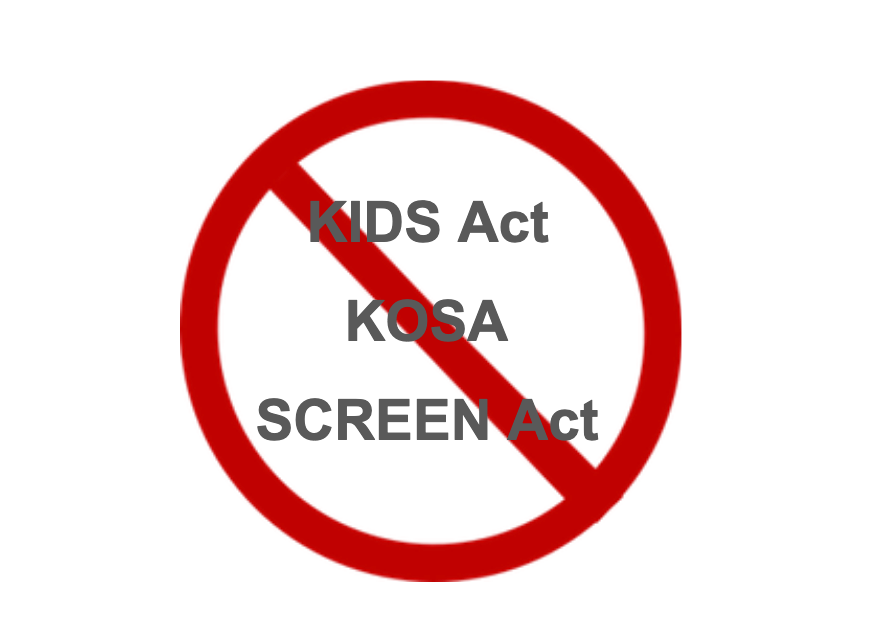
KOSA, the KIDS Act, AI, Bad Internet Bills, and a potential giveaway to big tech (UPDATED)
Just say no to bills that age restrict, censor, and surveil the internet!
Guide to age assurance
The internet offers children and young people many empowering opportunities for personal growth, learning, and social exchange. However, along with these great benefits can come certain risks, including children facing content or services that may be harmful to them. Age assurance is one solution that can be used to keep children safe from online risks.
Teen and Parent Perspectives on Approaches to Age Verification
Age verification (AV) is being rolled out by online services to comply with new laws in Europe and across states in the United States. Proposed legislation at the federal level in the U.S., such as the Kids Off Social Media Act and the Kids Online Safety Act, may also result in increased adoption of AV […]
