

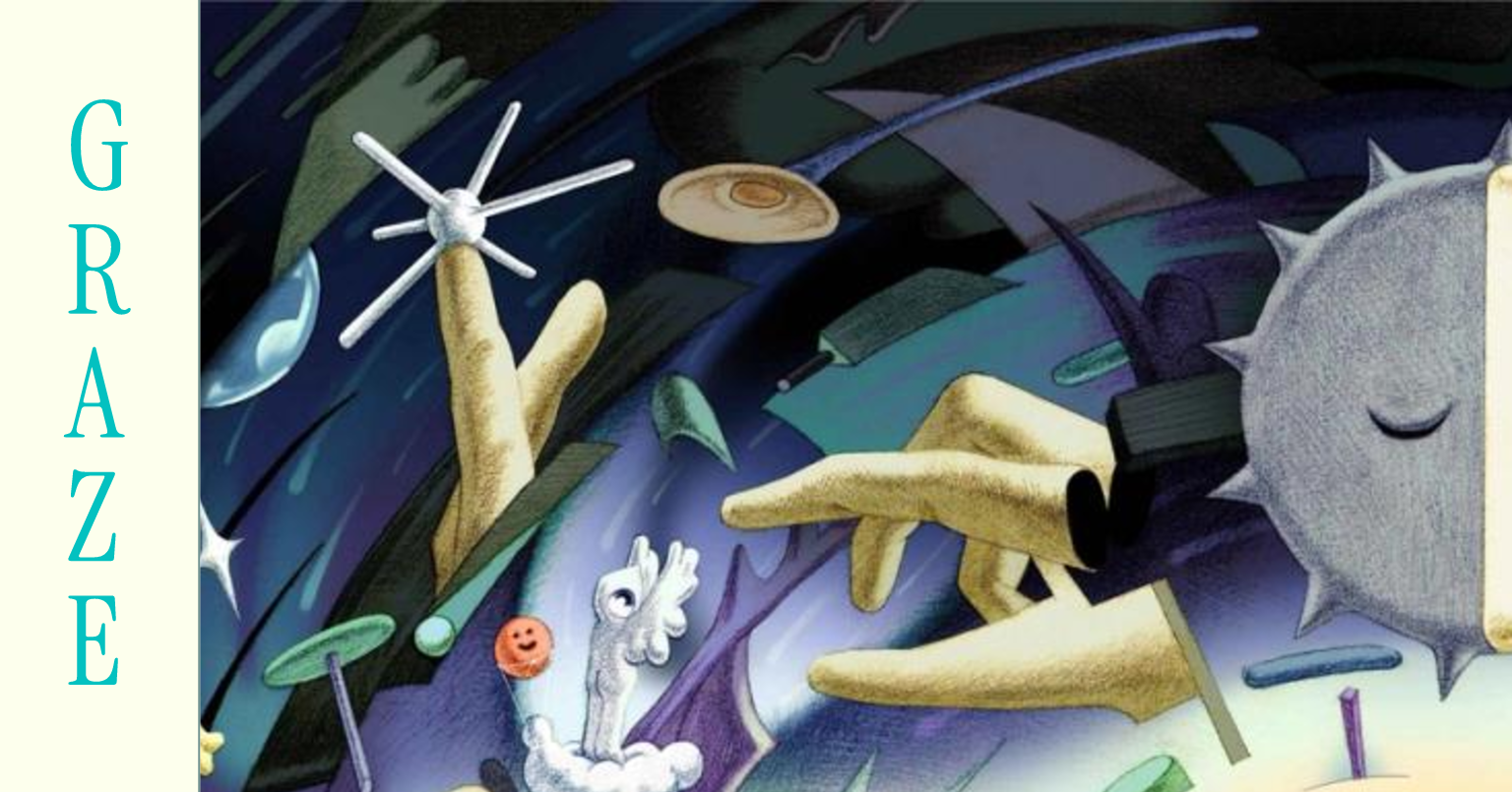
Our brand illustration shows three layers: the foundation being built, the valley we're stuck in, and the world waiting above. Here's what it all means.
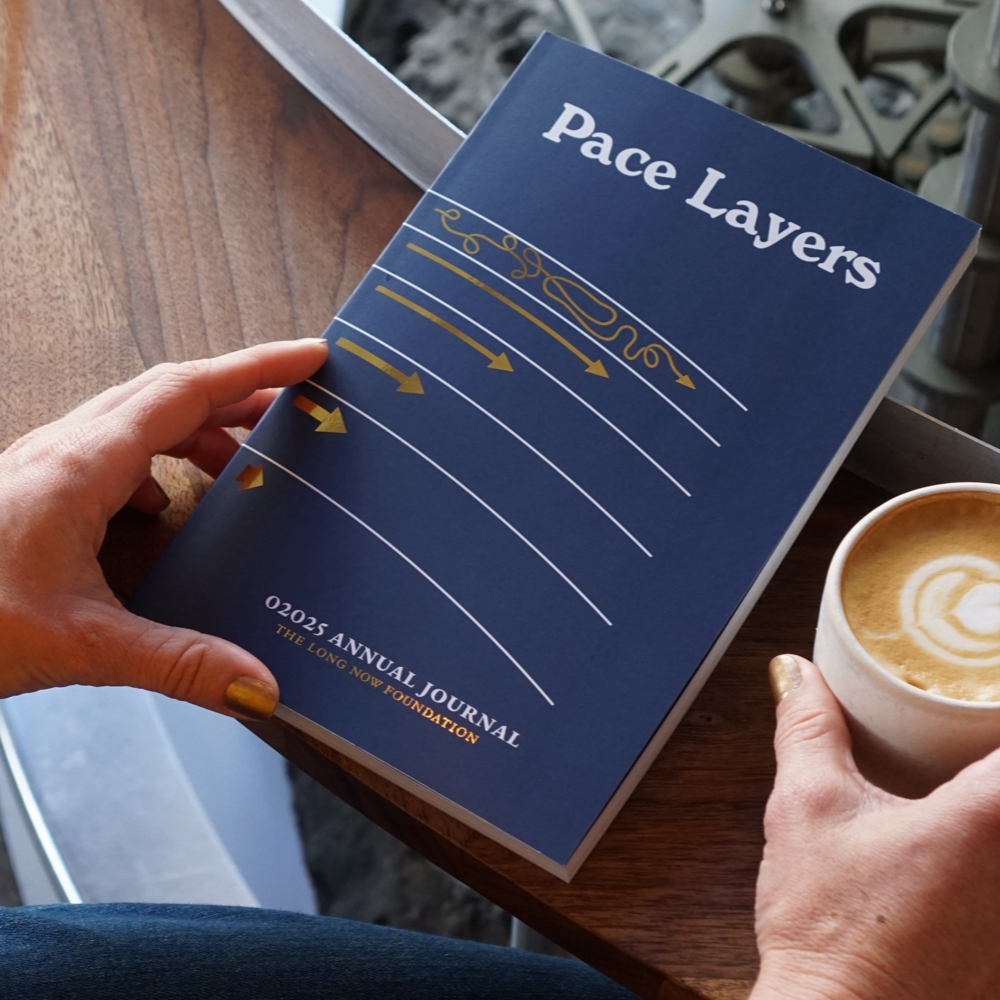
Pace Layers 02025 Annual Journal
Long Now’s annual print journal explores the ancient past and distant future of the present moment through essays, interviews, fiction, poetry, and visual art. The journal takes its name and shape from Long Now cofounder Stewart Brand’s pace layers framework — a tool for thinking about how civilizations work. [Learn more about Pace Layers](https://longnow.org/pacelayers/)
Silicon Valley, disruption, and the end of uncertainty
This paper reflects on the relationship between high-tech disruption narratives and uncertainty. My main argument is that an economic sociology of the future is incomplete without addressing the ‘d...

Dami Lee on Instagram: "What holds up a society? This art piece in Korea stopped me cold, and I haven’t stopped thinking about it since. 180,000 tiny figures. Arms raised. A glass floor you’re meant to walk on. The artist is Do Ho Suh, and the question he’s asking feels more urgent than ever right now: is it the collective that holds everything up, or the individual? Because both stories have produced extraordinary things. Korea’s GDP per capita in the 1960s was lower than Sudan’s. Sixty years later, it’s the twelfth largest economy in the world. Built on coordination, sacrifice, twelve-hour days, families who gave everything for the next generation. And then there’s the Western story. The entrepreneur. The innovator. The one who puts a car in space but somehow can’t build affordable housing or a high-speed rail. As the world order gets reshaped in real time, I keep coming back to this floor. Who’s actually holding it up? And does the person walking on it ever think to look down? Tell me what you think in the comments. #DoHoSuh #KoreaArt #ContemporaryArt #PublicArt #SeoulArt"
14K likes, 59 comments - damileearch on June 11, 2026: "What holds up a society? This art piece in Korea stopped me cold, and I haven’t stopped thinking about it since. 180,000 tiny figures. Arms raised. A glass floor you’re meant to walk on. The artist is Do Ho Suh, and the question he’s asking feels more urgent than ever right now: is it the collective that holds everything up, or the individual? Because both stories have produced extraordinary things. Korea’s GDP per capita in the 1960s was lower than Sudan’s. Sixty years later, it’s the twelfth largest economy in the world. Built on coordination, sacrifice, twelve-hour days, families who gave everything for the next generation. And then there’s the Western story. The entrepreneur. The innovator. The one who puts a car in space but somehow can’t build affordable housing or a high-speed rail. As the world order gets reshaped in real time, I keep coming back to this floor. Who’s actually holding it up? And does the person walking on it ever think to look down? Tell me what you think in the comments. #DoHoSuh #KoreaArt #ContemporaryArt #PublicArt #SeoulArt".

Game Design Perspective: Stardew Valley — Pixelated Playgrounds
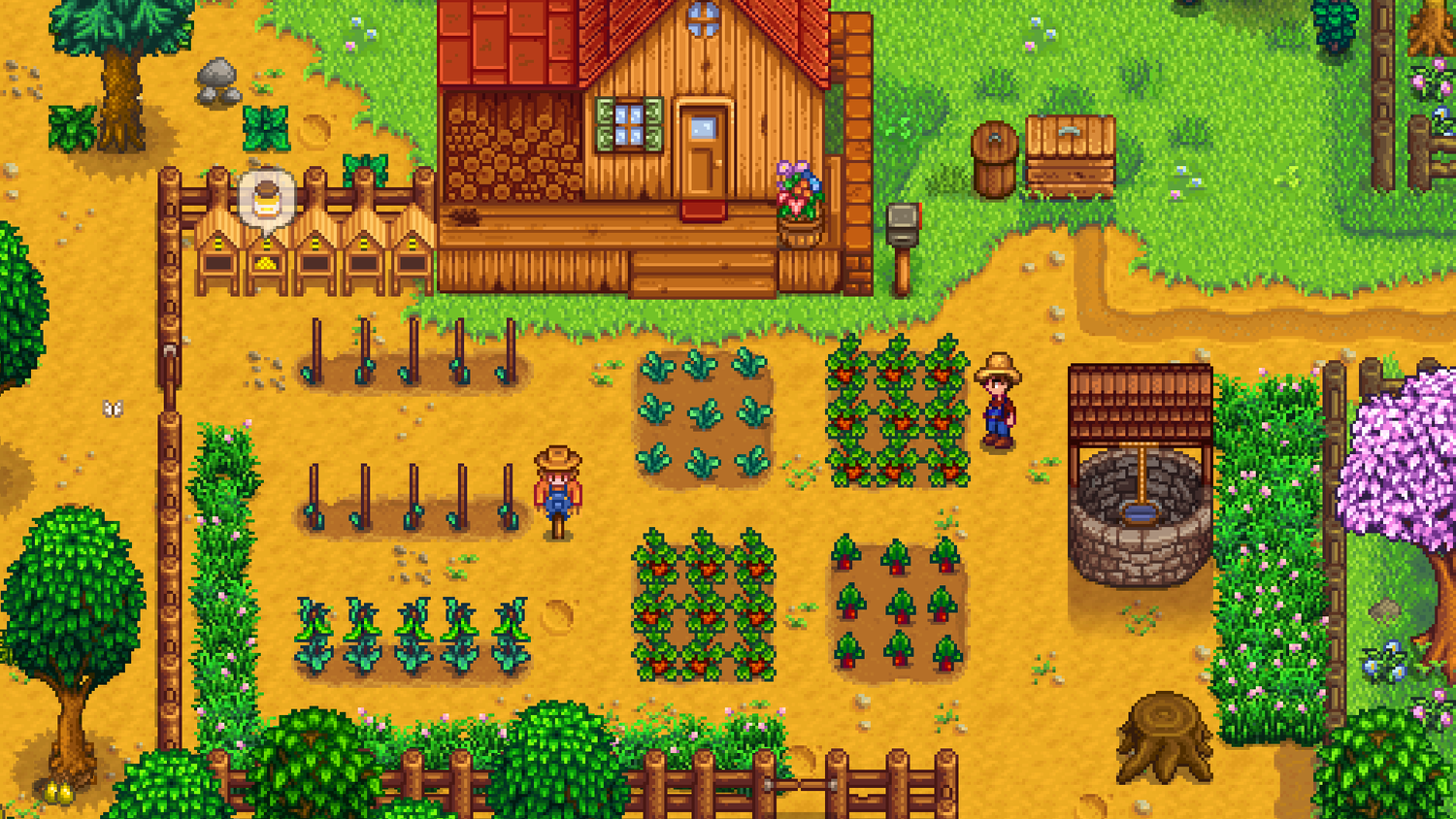
Recently, Juliana has gotten into Stardew Valley. Hard. Since I’m a huge fan myself, I'm doing a Game Design Perspective on the game to celebrate. I'll be looking at the game mechanics and how the interlocking layers make the game tick. In Stardew Valley, you play as a disillusioned city slicker wh
From global trends to local realities: A multi-scale scenario-building methodology for community infrastructure planning
This paper details a multi-scale scenario-building methodology designed to explore transport infrastructure futures in rapidly changing Circumpolar North communities, bridging global trends and national contexts with local realities. Focusing on Churchill, Canada, and Kirkenes, Norway, we employed a hybrid approach that combined top-down adaptation of existing global and regional socioeconomic scenarios with bottom-up, participatory ethnographic research to ensure local relevance and incorporate stakeholder knowledge. We developed coherent scenarios across global, regional (national), and local scales, allowing higher-level archetypes to manifest differently depending on locally specific features identified through fieldwork. This consecutive, nested process utilized morphological analysis and the Factor-Actor-Sector framework to maintain consistency while accommodating local specificities. The methodology centered not just on scenario creation but also on the function of scenarios as a tool for community dialogue, utilizing artistic visualizations in workshops to engage diverse stakeholders. This approach demonstrates a way to navigate the tension between global and national drivers versus local community needs, yielding distinct yet comparable local futures grounded in broader development pathways. It offers practical insights for deliberations and planning in uncertain environments, both built and unbuilt.
4-Layers, A Narrative Design Approach
Introduction This blog post will be about a new way to approach narrative design in games - the 4 Layers Approach. It is based on a GDC ...

Home - FLI Worldbuilding Contest
It is frequently practiced by creative writers and scriptwriters, providing the context and backdrop for stories that take place in future, fantasy or alternative realities. Worldbuilding is a tool that can help us explore possible futures for our own world. It helps us better understand what sorts of worlds we may find more or less desirable, and how we might get to there. World builds don’t always have to be grounded in reality, but for our worldbuilding contest we asked contestants to make their imagined worlds plausible and aspirational. To better understand the constraints and ground rules that were used for this contest, visit the Rules page prior to exploring the worlds.

Cameron's World
🌍 A web-collage of text and images excavated from the buried neighbourhoods of GeoCities.
How creatives and devs can all finally escape the control of the silicon valley of evil and make a trillion dollars · Multi-hyphenate
ft. ATprotocol (the remix)
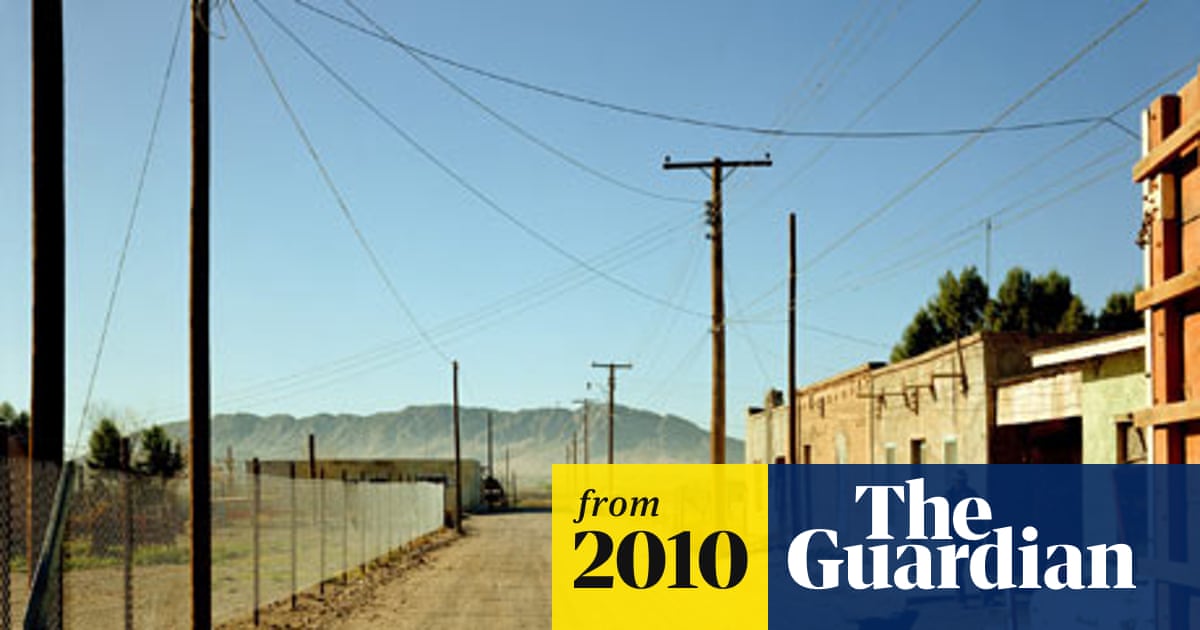
New Topographics: photographs that find beauty in the banal
William Jenkins's 1975 exhibition rewrote the rules of landscape photography. Does it have the same impact today?
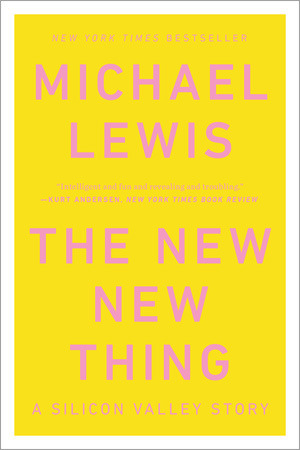
The New New Thing: A Silicon Valley Story
In the weird glow of the dying millennium, Michael Lewi…
"we're building rainforests, not skyscrapers" diverse ecosystems with lots of different life forms and symbiotic relationships and growth! @schlage.town got me feeling hopeful, talking about building an Atmospheric (sub) stack
This is the semi-finished result for the Adventureland module, inside the Indiana Jones temple I 3D printed. I never actually went and finished painting this; the module is still on my garage workbench, embarrassingly enough #SkyTok #3DPrinting #ModelRailroad #DisSky

Jay Stevens
Since Bluesky has a video feed now now I'm going to post this throwback to when I was working on the lava temple for my Adventureland model railroad module
Digital Placemaking

What does it mean to make a digital space into a place?
The Garden

Everything is connected. The master collection of all links collected across all collections, and a pretty decent snapshot of my brain

Gradients of intimacy and creating shelter: An interview with Erin Kissane

When the Internet Was a Place - Front Porch Republic

Law and Borders - the Rise of Law in Cyberspace
AI and the future of digital public squares
Ambient Co-presence

Spatial Communication in Level Design
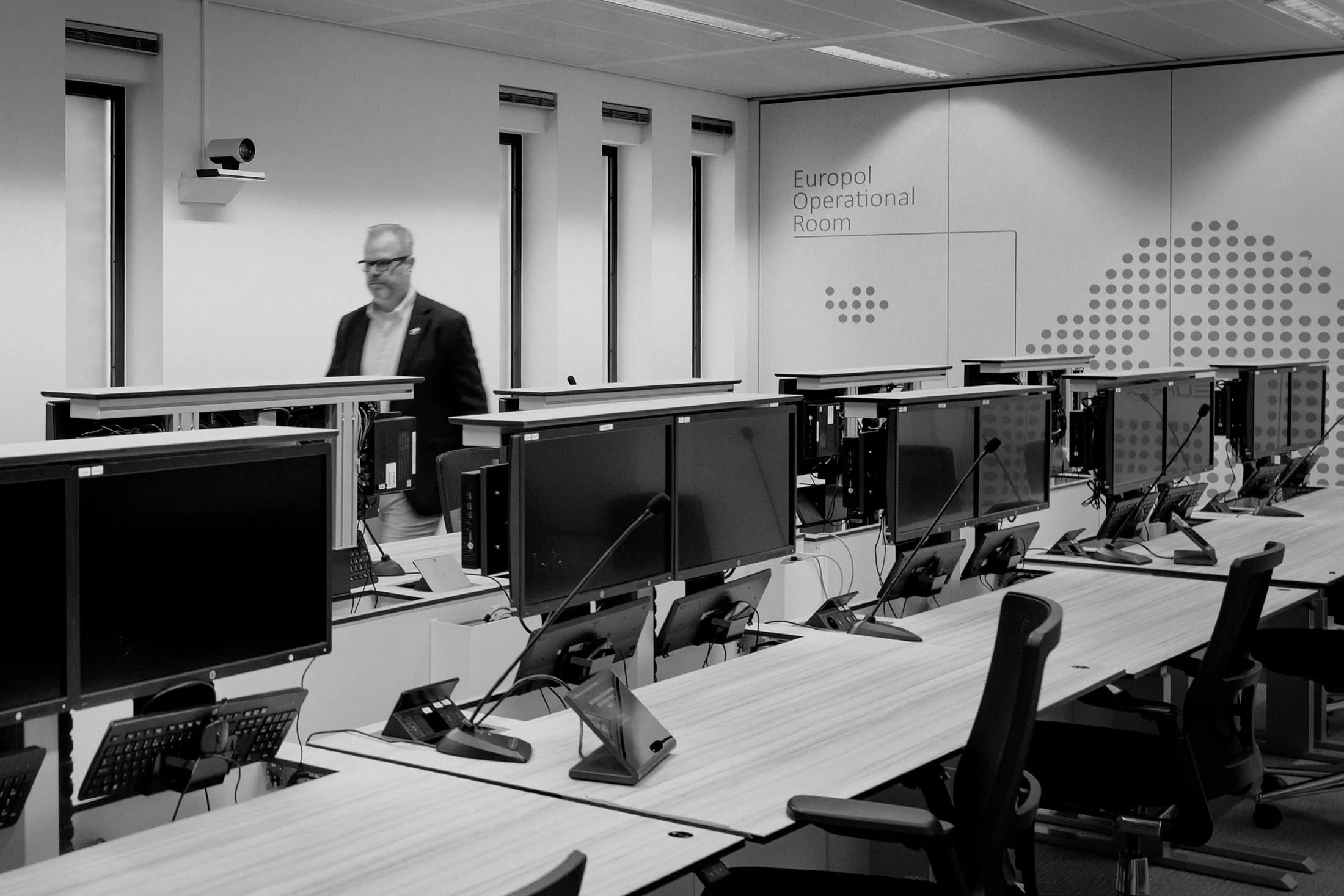
Child Predators Turn to Open-Source AI to Make Unlimited Illegal Images

A senator tried to ban gambling on prediction markets—now she's a Kalshi lobbyist

Mac Users Reclaim 12GB+ of Storage With Apple Intelligence Removal Tool

Revealed: Britain's contracts with Palantir hit £1bn

'We’re watching you’: MP Clive Lewis reveals Tom Watson has warned him over criticising Palantir

‘Doom Loop’: OpenAI and Microsoft Admits LLMs Are Destroying the Web and Built on Theft
