


When people talk about the value of paying attention and slowing down, they often make it sound prudish and monk-like. But we shouldn’t forget how interesting and overpoweringly pleasurable sustained attention can be.
How to reclaim your attention from the distraction economy | Psyche Videos
Could you watch this video on full screen, 1x speed, with no distractions? Here are five steps to rebuild your attention span

How We Pay Attention Changes the Very Shape of Our Brains
Imagine arriving at the airport just in time to catch a plane. Everything in your behavior betrays the heightened concentration of your attention. Your mind on alert, you look for the departures si…

The Great Attention Heist | Los Angeles Review of Books
A new book on how attention became a commodity.
:quality(75)/https%3A%2F%2Fassets.lareviewofbooks.org%2Fuploads%2F201712theattentionmerchants.jpg)
How to gain more from reading by taking it all in more slowly | Psyche Guides
There’s more to words than meets the eye. Deepen your appreciation of literature through the art of slow, attentive reading

Why Your Brain Needs More Downtime
Research on naps, meditation, nature walks and the habits of exceptional artists and athletes reveals how mental breaks increase productivity, replenish attention, solidify memories and encourage creativity

It's getting harder to focus every day
I’m feeling it right now. I had to set a timer for 15 minute on my computer and block all distractions to write this. If I didn’t force myself to focus I would easily get distracted by something after few minutes. Even when I’m doing things that I’ve been waiting to do it, I still feel the urge to do something else. I don’t know how and when this happened. During the last few years I was always studying, working, and doing open source. And actually got stuff done. Doing all of those at the same time requires paying attention to what I wanted to do and ignore the noise.
The lost art of concentration: being distracted in a digital world
We check our phones every 12 minutes, often just after waking up. Always-on behaviour is harmful to long-term mental health, and we need to learn to the hit the pause button

The wandering mind: A gift we squander - Darius Foroux
Most people treat a wandering mind like a defect. They see it as a leak in their productivity bucket. We’ve been conditioned to believe that if we aren’t staring at a screen or checking off a to-do list, we are failing. But Daniel Goleman, the […]

The Attention Economy and the Collapse of Cognitive Autonomy
Check out the first in a series on social media from Denny Center Student Fellow Rai Hasen Masoud (F'27) to learn more about the attention economy and it's impacts on our democracy.
The attention market—and what is wrong with it
Attention is described as a “scarce commodity” that is traded in “a marketplace.” This, it is further claimed, contributes to a “widespread sense of attentional crisis.” But is there really an attention market, and if so, what, if anything, is wrong with it? We defend the claim that there are markets in attention. We provide an account of such attention markets and use that account to address what is morally wrong with them. Our account draws on knowledge of how attention works and what roles it plays in the mind. The attention market trades in an ability to influence our attention – somewhat (though not exactly) like the labor market trades in an ability to influence how we use our capacity for work. Specifically, the commodity it trades in is attentional landscaping potential, viz. the ability to systematically influence patterns of attention by changes to the sensory environment individuals are exposed to. Attention markets thus, we argue, commodify influence over a human capacity that plays a central role in shaping individual experience, agency, and belief formation. This feature of attention markets makes them ethically problematic. As markets in access to external influence, attention markets pose a special threat to individual autonomy and escape the classical liberal defense of free markets. Those who value autonomy should worry about the attention markets that exist today.

Accelerating dynamics of collective attention
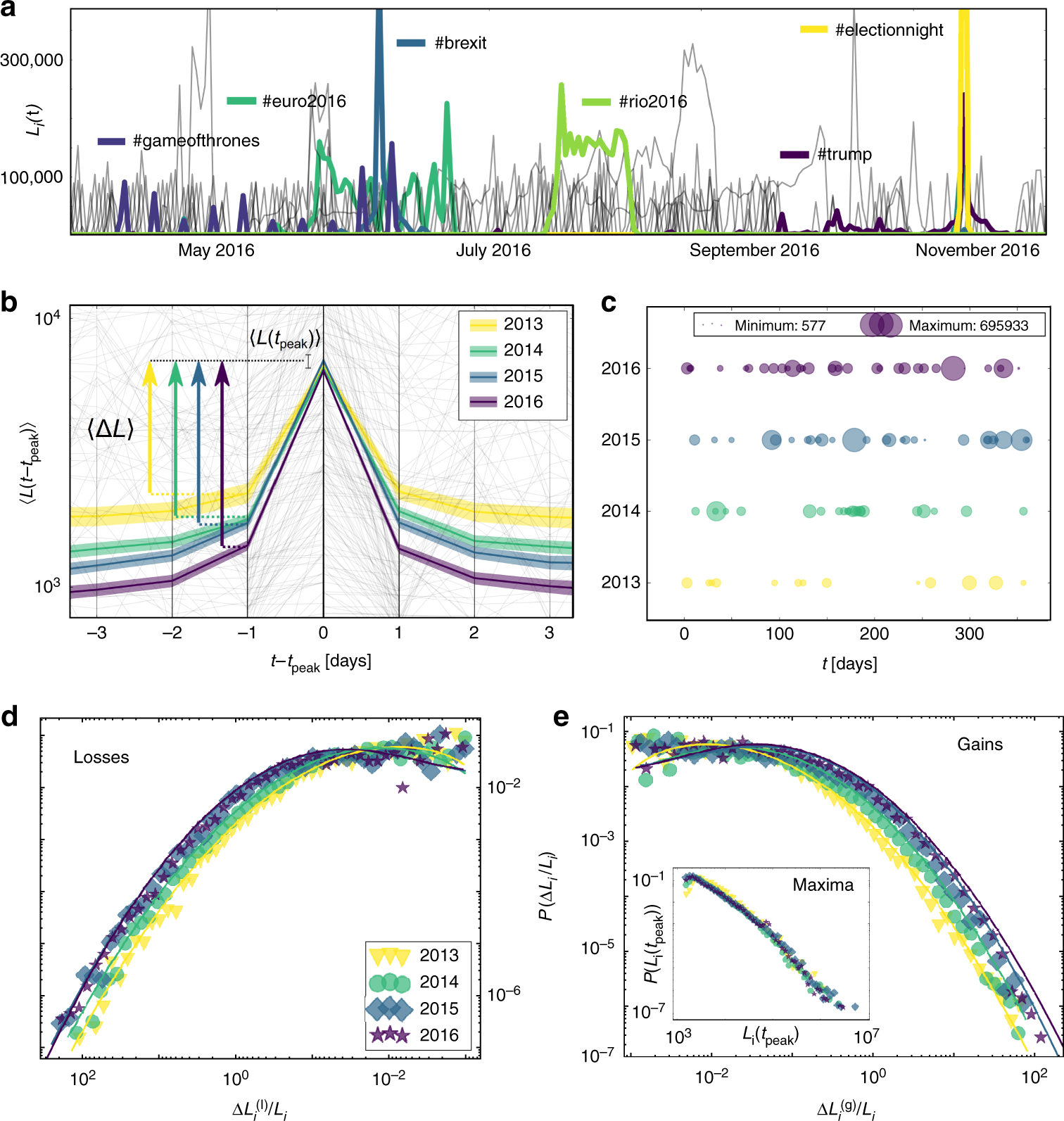
With news pushed to smart phones in real time and social media reactions spreading across the globe in seconds, the public discussion can appear accelerated and temporally fragmented. In longitudinal datasets across various domains, covering multiple decades, we find increasing gradients and shortened periods in the trajectories of how cultural items receive collective attention. Is this the inevitable conclusion of the way information is disseminated and consumed? Our findings support this hypothesis. Using a simple mathematical model of topics competing for finite collective attention, we are able to explain the empirical data remarkably well. Our modeling suggests that the accelerating ups and downs of popular content are driven by increasing production and consumption of content, resulting in a more rapid exhaustion of limited attention resources. In the interplay with competition for novelty, this causes growing turnover rates and individual topics receiving shorter intervals of collective attention.
Attention and the Relevance Problem
ABSTRACT The relevance problem is the problem of how cognitive systems can be sensitive to what is relevant despite relevance being holistic, open‐ended, and context‐sensitive. The problem has typically been applied to higher‐order cognitive processes. In this paper, I argue that there is a hitherto unrecognized relevance problem for perceptual attention. This problem becomes apparent when considering the functions of attention: attention must not only support ongoing task performance but also remain sensitive to opportunities for task switching, latent learning, and context checking. Existing treatments of the relevance problem have largely focused on its task‐relative form: given a task, what is relevant? I argue that attention faces a more general problem that includes sensitivity to factors relevant to other interests and to cues indicating that another activity may be worth pursuing. For such features of the environment to stand out as salient, salience cannot be determined solely by bottom‐up factors and a limited set of occurrent top‐down factors, such as current goals and intentions. Rather, it must reflect the wider (if not the entire) range of an agent's latent interests in a context‐sensitive way. This motivational unencapsulation of attention poses a challenge for both contemporary accounts of attention and suggests that passive attention is much more intelligent than commonly thought.

Attention and the Relevance Problem
ABSTRACT The relevance problem is the problem of how cognitive systems can be sensitive to what is relevant despite relevance being holistic, open‐ended, and context‐sensitive. The problem has typically been applied to higher‐order cognitive processes. In this paper, I argue that there is a hitherto unrecognized relevance problem for perceptual attention. This problem becomes apparent when considering the functions of attention: attention must not only support ongoing task performance but also remain sensitive to opportunities for task switching, latent learning, and context checking. Existing treatments of the relevance problem have largely focused on its task‐relative form: given a task, what is relevant? I argue that attention faces a more general problem that includes sensitivity to factors relevant to other interests and to cues indicating that another activity may be worth pursuing. For such features of the environment to stand out as salient, salience cannot be determined solely by bottom‐up factors and a limited set of occurrent top‐down factors, such as current goals and intentions. Rather, it must reflect the wider (if not the entire) range of an agent's latent interests in a context‐sensitive way. This motivational unencapsulation of attention poses a challenge for both contemporary accounts of attention and suggests that passive attention is much more intelligent than commonly thought.
Does each click of attention cost a bit of ourselves? | Aeon Essays
It costs nothing to click, respond and retweet. But what price do we pay in our relationships and our peace of mind?

Rethinking the cognitive foundations of the attention economy
The attention economy is the economic system in which human attention is the scarce resource. This literature takes a particular passage in Herbert Simon’s seminal Chapter Designing Organization fo...

Capturing our Attention by @neillevy.bsky.social "we possess sophisticated capacities of epistemic vigilance, which work reasonably well to distinguish reliable from unreliable information, but ... we do not have parallel defences against attentional capture" > tandfonline.com/doi/full/10.1080/00048402.202…
