

Been quiet around here! I’ve been putting almost all of my writing time into Logic for Programmers and my whole brain is book-shaped. Trust me, you do not want to read my 2000-word rant on Sphinx post-build LaTeX customization. But I spent the past week in a historical rabbit hole and had to share what I found. It started with Algebraic [Data] Types are not Scary, Actually. The post covers AlgDTs1 in more detail, but a quick overview is:
Category Theory for Programmers: The Preface
Table of Contents Part One Category: The Essence of Composition Types and Functions Categories Great and Small Kleisli Categories Products and Coproducts Simple Algebraic Data Types Functors Functo…
Algebraic data integration
In this paper, we develop an algebraic approach to data integration by combining techniques from functional programming, category theory, and database theory. In our formalism, database schemas and instances are algebraic (multi-sorted equational) theories of a certain form. Schemas denote categories, and instances denote their initial (term) algebras. The instances on a schema S form a category, S–Inst, and a morphism of schemas F : S → T induces three adjoint data migration functors: ΣF : S–Inst → T–Inst, defined by substitution along F, which has a right adjoint ΔF : T–Inst → S–Inst, which in turn has a right adjoint ΠF : S–Inst → T–Inst. We present a query language based on for/where/return syntax where each query denotes a sequence of data migration functors; a pushout-based design pattern for performing data integration using our formalism; and describe the implementation of our formalism in a tool we call AQL (Algebraic Query Language).
Categories of Containers
We introduce the notion of containers as a mathematical formalisation of the idea that many important datatypes consist of templates where data is stored. We show that containers have good closure properties under a variety of constructions including the formation of initial algebras and final coalgebras. We also show that containers include strictly positive types and shapely types but that there are containers which do not correspond to either of these. Further, we derive a representation result classifying the nature of polymorphic functions between containers. We finish this paper with an application to the theory of shapely types and refer to a forthcoming paper which applies this theory to differentiable types.

Show me the data - Design Notes
Categorical Data Structures for Technical Computing
Many mathematical objects can be represented as functors from finitely-presented categories $\mathsf{C}$ to $\mathsf{Set}$. For instance, graphs are functors to $\mathsf{Set}$ from the category with two parallel arrows. Such functors are known informally as $\mathsf{C}$-sets. In this paper, we describe and implement an extension of $\mathsf{C}$-sets having data attributes with fixed types, such as graphs with labeled vertices or real-valued edge weights. We call such structures "acsets," short for "attributed $\mathsf{C}$-sets." Derived from previous work on algebraic databases, acsets are a joint generalization of graphs and data frames. They also encompass more elaborate graph-like objects such as wiring diagrams and Petri nets with rate constants. We develop the mathematical theory of acsets and then describe a generic implementation in the Julia programming language, which uses advanced language features to achieve performance comparable with specialized data structures.

What is data oriented design?
I was reading this article, and this guy goes on talking about how everyone can greatly benefit from mixing in data oriented design with OOP. He doesn't show any code samples, however. I googled t...

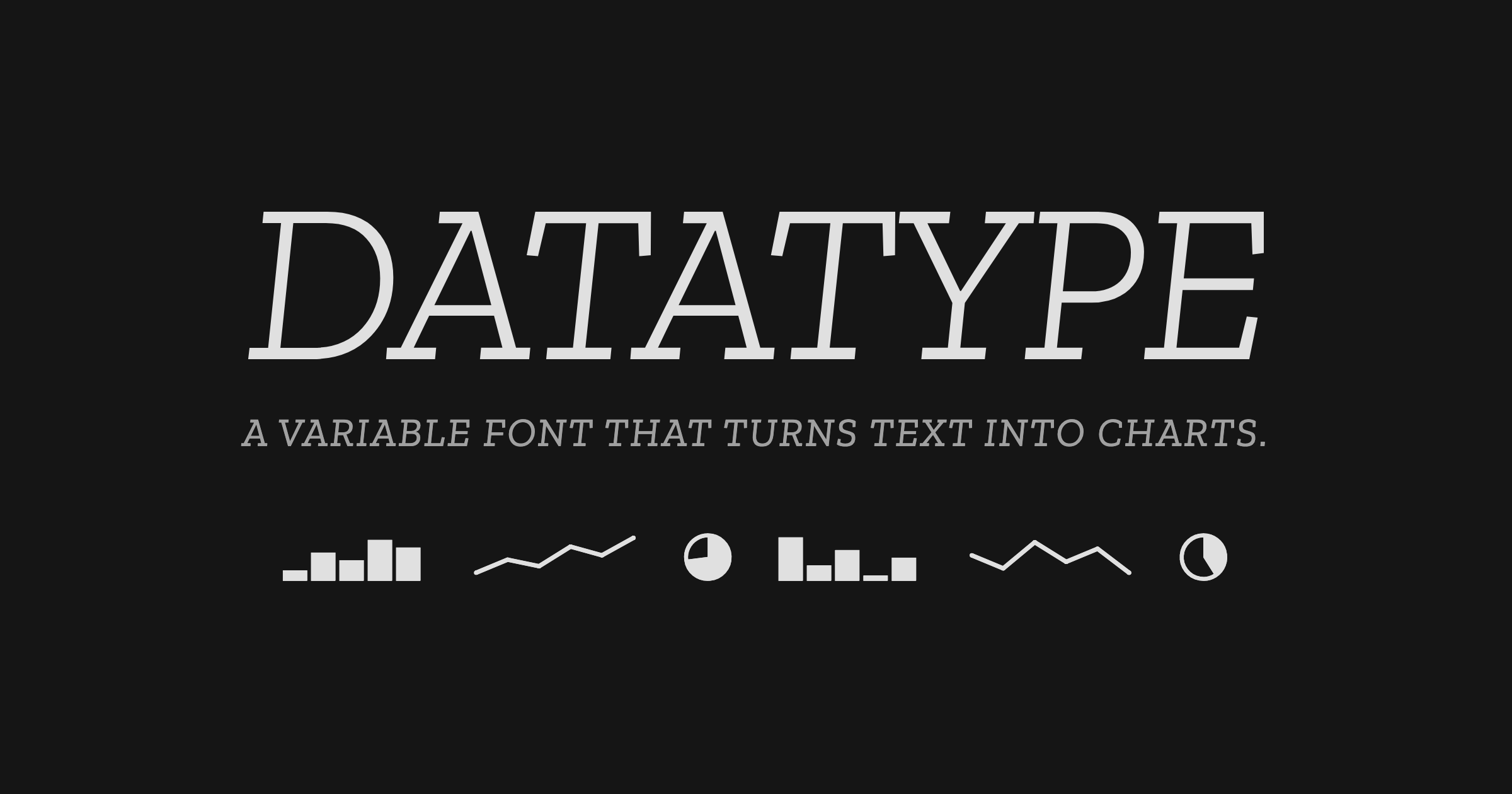
Datatype — variable font that turns text into charts
An OpenType variable font that turns simple text expressions into inline charts. No JavaScript, no images — just type.
Mathematics in type theory.
An explanation of how to set up mathematics using universes, types, and terms

Syntax and Semantics of Linear Dependent Types
A type theory is presented that combines (intuitionistic) linear types with type dependency, thus properly generalising both intuitionistic dependent type theory and full linear logic. A syntax...

GATlab: Modeling and Programming with Generalized Algebraic Theories
Categories and categorical structures are increasingly recognized as useful abstractions for modeling in science and engineering. To uniformly implement category-theoretic mathematical models in software, we introduce GATlab, a domain-specific language for algebraic specification embedded in a technical programming language. GATlab is based on generalized algebraic theories (GATs), a logical system extending algebraic theories with dependent types so as to encompass category theory. Using GATlab, the programmer can specify generalized algebraic theories and their models, including both free models, based on symbolic expressions, and computational models, defined by arbitrary code in the host language. Moreover, the programmer can define maps between theories and use them to declaratively migrate models of one theory to models of another. In short, GATlab aims to provide a unified environment for both computer algebra and software interface design with generalized algebraic theories. In this paper, we describe the design, implementation, and applications of GATlab.
Functional Query Languages with Categorical Types
We study three category-theoretic types in the context of functional query languages (typed lambda-calculi extended with additional operations for bulk data processing). The types we study are:
Random Tech Thoughts
This article is about standardisation, particularly how it relates to understanding code. I’ll first go into an historical example that highlights the lack of standardisation in an area where we take it for granted today. After that I’ll get into code, and how understanding code is like understanding data via visualisations. In both the historic … Continue reading Standardisation and code

generalized algebraic theory in nLab
A generalized algebraic theory (GAT, Cartmell 1978/86) is a dependent type theory in the syntactic sense: There are judgments declaring types and terms of types, where, critically, a type AA declared in context Γ\Gamma is allowed to depend on terms of Γ\Gamma. The only other judgments allowed are of equality (judgemental equality) of pairs of types or terms.
Relational foundations for functorial data migration | Proceedings of the 15th Symposium on Database Programming Languages
In this paper we present a simple database definition language: that of categories and functors. A database schema is a small category and an instance is a set-valued functor on it. We show that morphisms of schemas induce three ''data migration ...
The Principal Type-Scheme of an Object in Combinatory Logic
R. Hindley, The Principal Type-Scheme of an Object in Combinatory Logic, Transactions of the American Mathematical Society, Vol. 146 (Dec., 1969), pp. 29-60