Thoughtlessly repeating PR talking points and sharing guesswork as rumor is creating a trust problem.
Show your work: The new terms for trust in journalism - PressThink
The transparency movement has finally come of age. Power has shifted to the users. Their trust has to be earned in different ways now.

Fake news spreads like an epidemic. Here’s how to stop it.
Researchers study fake news the same way they study the spread of disease. When misinformation “goes viral”, it is not just a metaphor. It is what’s actually happening. via @straits_times str.sg/viz-misinformation
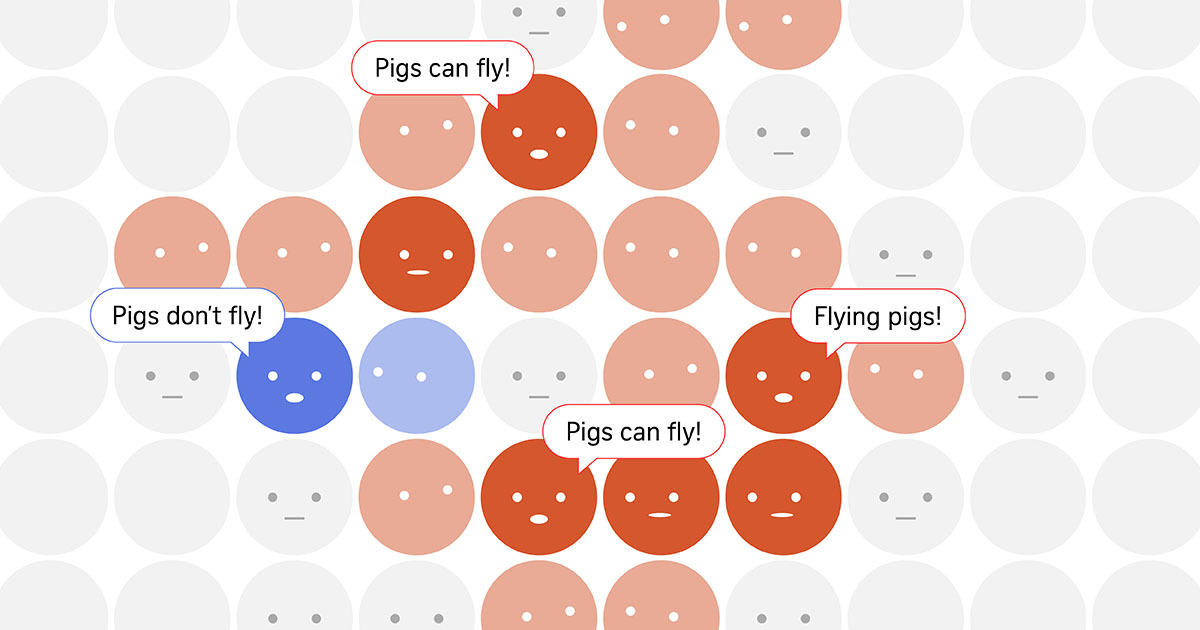
The spreading of misinformation online
Significance The wide availability of user-provided content in online social media facilitates the aggregation of people around common interests, worldviews, and narratives. However, the World Wide Web is a fruitful environment for the massive diffusion of unverified rumors. In this work, using a massive quantitative analysis of Facebook, we show that information related to distinct narratives––conspiracy theories and scientific news––generates homogeneous and polarized communities (i.e., echo chambers) having similar information consumption patterns. Then, we derive a data-driven percolation model of rumor spreading that demonstrates that homogeneity and polarization are the main determinants for predicting cascades’ size. , The wide availability of user-provided content in online social media facilitates the aggregation of people around common interests, worldviews, and narratives. However, the World Wide Web (WWW) also allows for the rapid dissemination of unsubstantiated rumors and conspiracy theories that often elicit rapid, large, but naive social responses such as the recent case of Jade Helm 15––where a simple military exercise turned out to be perceived as the beginning of a new civil war in the United States. In this work, we address the determinants governing misinformation spreading through a thorough quantitative analysis. In particular, we focus on how Facebook users consume information related to two distinct narratives: scientific and conspiracy news. We find that, although consumers of scientific and conspiracy stories present similar consumption patterns with respect to content, cascade dynamics differ. Selective exposure to content is the primary driver of content diffusion and generates the formation of homogeneous clusters, i.e., “echo chambers.” Indeed, homogeneity appears to be the primary driver for the diffusion of contents and each echo chamber has its own cascade dynamics. Finally, we introduce a data-driven percolation model mimicking rumor spreading and we show that homogeneity and polarization are the main determinants for predicting cascades’ size.

Following news on social media boosts knowledge, belief accuracy and trust
Many worry that news on social media leaves people uninformed or even misinformed. Here we conducted a preregistered two-wave online field experiment in France and Germany (N = 3,395) to estimate the effect of following the news on Instagram and WhatsApp. Participants were asked to follow two accounts for 2 weeks and activate the notifications. In the treatment condition, the accounts were those of news organizations, while in the control condition they covered cooking, cinema or art. The treatment enhanced current affairs knowledge, participants’ ability to discern true from false news stories and awareness of true news stories, as well as trust in the news. The treatment had no significant effects on feelings of being informed, political efficacy, affective polarization and interest in news or politics. These results suggest that, while some forms of social media use are harmful, others are beneficial and can be leveraged to foster a well-informed society.

How we decide what news is important, and why that process maybe flawed
Have you ever thought about the type of news that populates on your Facebook feed? Where does it come from and how is it specifically…
The Liar’s Dividend: Can Politicians Claim Misinformation to Evade Accountability?
This study addresses the phenomenon of misinformation about misinformation, or politicians "crying wolf"' over fake news. Strategic and false claims that stories are fake news or deepfakes may benefit politicians by helping them maintain support after a scandal. We posit that this benefit, known as the "liar's dividend," may be achieved through two politician strategies: by invoking informational uncertainty or by encouraging oppositional rallying of core supporters. We administer five survey experiments to over 15,000 American adults detailing hypothetical politician responses to stories describing real politician scandals. We find that claims of misinformation representing both strategies raise politician support across partisan subgroups. These strategies are effective against text-based reports of scandals, but are largely ineffective against video evidence and do not reduce general trust in media. Finally, these false claims produce greater dividends for politicians than alternative responses to scandal, such as remaining silent or apologizing.
Opinion | The hard truth: Americans don’t trust the news media
A note from our owner.

Sharing news you didn't read can feel like expertise
Social media sharers believe that they are knowledgeable about the content they share, even if they have not read it or have only glanced at a headline.
The day that CBS News became literally ‘fake news’ for America | Will Bunch
An unverified, unlikely story about the Minneapolis ICE shooter exposes the new CBS News team as Trump's state media.

News Influencers Fact Sheet
About one-in-five U.S. adults say they regularly get news from news influencers on social media, and this is especially common among younger adults.

Recent Utah, Texas incidents fuel rumors and political narratives undermining trust in election integrity
A CIP Election Rumor Rundown

The future of news is happening where no one is looking
"In 2026, more news organizations will understand that people don’t always want an article. Sometimes they just want clarity."

Fakebook: Using Data Science to Spot Fake News
Fakebook: Using Data Science to Spot Fake News
As fake news permeates throughout social media outlets (like Facebook), it's more important than ever to identify what is fact vs. fiction. This is especially true in the age of COVID where the spread of misinformation can impact the spread of the virus. Data scientists are emerging on the front lines of this fight, using programs to help them identify fake news sources. Led by Dr. Teon Brooks, Josh Modeste, and Steven Azeka from the Gotham Data Clinic (fka CiELabs), this workshop will explore the “life cycle” of scientific research and how scientists come to consensus about how we interpret data. We’ll examine what to look for in credible news sources, and the consequences of leaning on not-so-trusty pseudoscientific sources. Then you’ll put that knowledge to work by developing a rubric for identifying fake news. No experience necessary! https://www.eventbrite.com/e/fakebook-using-data-science-to-spot-fake-news-tickets-137833492687
ECHO CHAMBERS AND EPISTEMIC BUBBLES
Discussion of the phenomena of post-truth and fake news often implicates the closed epistemic networks of social media. The recent conversation has, however, blurred two distinct social epistemic phenomena. An epistemic bubble is a social epistemic structure in which other relevant voices have been left out, perhaps accidentally. An echo chamber is a social epistemic structure from which other relevant voices have been actively excluded and discredited. Members of epistemic bubbles lack exposure to relevant information and arguments. Members of echo chambers, on the other hand, have been brought to systematically distrust all outside sources. In epistemic bubbles, other voices are not heard; in echo chambers, other voices are actively undermined. It is crucial to keep these phenomena distinct. First, echo chambers can explain the post-truth phenomena in a way that epistemic bubbles cannot. Second, each type of structure requires a distinct intervention. Mere exposure to evidence can shatter an epistemic bubble, but may actually reinforce an echo chamber. Finally, echo chambers are much harder to escape. Once in their grip, an agent may act with epistemic virtue, but social context will pervert those actions. Escape from an echo chamber may require a radical rebooting of one's belief system.
Language Models Trained on State Media Sources Launder Propaganda
Tech Policy Press is a nonprofit media and community venture intended to provoke new ideas, debate and discussion at the intersection of technology and democracy. We publish opinion and analysis.