

This large gap — 81.3% compared to 58.8% — stems from the higher representation of women in skilled trades, where AI usage remains extremely low.
The AI gender gap | Datawrapper Blog
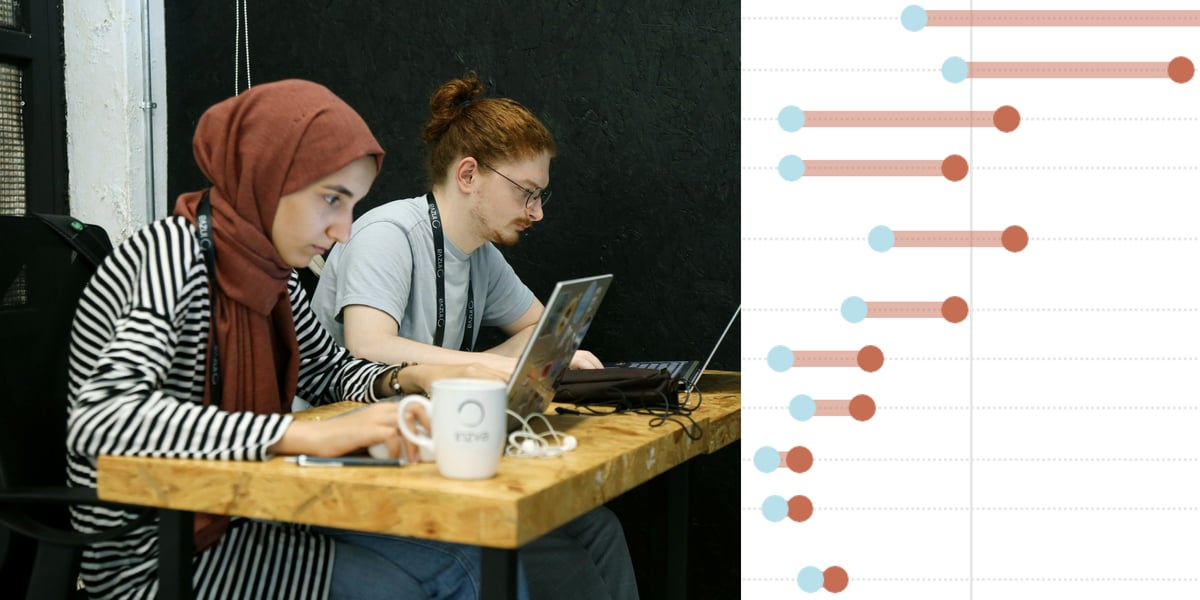
In this Weekly Chart, we examine the gender gap in AI adoption.
Women and AI: The Gender Gap in AI Adoption and Recognition [Data]
Lean In’s survey shows how women are losing out in the AI age. Learn how women and men compare in AI adoption in the workplace, recognition, and more.
Opinion: A gender gap is emerging in AI adoption, and women risk being left behind
Women appear less inclined to use AI tools, producing a disadvantage they can ill afford

The Large Gender Gap in Who Uses AI
A recent study finds that AI usage tilts heavily toward men. Part of the reason: Women worried they might be penalized for using AI.

Women executives warn AI adoption is outpacing workforce development
A Chief and Harris Poll survey reveals how women leaders are shaping AI adoption by prioritizing workforce development and ethical implementation over speed.
Why women are more skeptical of AI than men, according to a new study
Drawing on survey data, the study finds that women consistently perceive AI as riskier, especially when its economic effects are uncertain.

Why We Need More Women In The AI Revolution
Research suggests that women make up less than a third of AI professionals and only 18% of AI researchers globally.

New research reveals "staggering" gender gap in ChatGPT adoption
A study reveals that ChatGPT adoption reflects existing workplace inequalities, with younger, higher-paid men using AI more than women and lower-income employees.

Predictors of Artificial Intelligence Technology Adoption Behaviour among Female Entreprenuers in a Typical Emerging Market
Though artificial intelligence (AI) adoption among female entrepreneurs in emerging economies is still limited and poorly understood, AI presents revolutionary

A Proposed Conceptual Framework for Understanding Gender Disparities in Artificial Intelligence Adoption
This conceptual paper investigates the issue of gender disparities in artificial intelligence adoption within organizational settings. It highlights the importance of addressing these differences for workplace inclusivity and performance. The problem lies in the unequal of artificial intelligence adoption between male and female employees’ perspectives. The proposed framework is developed through a review of existing literature highlights differences between male and female employees in their artificial intelligence adoption. The methodology is based on conceptual analysis, derive on previous studies to build a comprehensive understanding of gender disparities in artificial intelligence adoption. An Independent T-Test will be used to analyze the disparities between male and female Malaysian sports graduates in testing the hypothesis development. By addressing these disparities, the paper provides insights into creating inclusive strategies that promote gender equity in the workforce. Overall, the findings aim to guide both researchers and practitioners in designing gender equality policies that address challenges to equal adoption of artificial intelligence.
Women Are Avoiding AI. Will Their Careers Suffer? | Working Knowledge
Women are adopting generative AI technology at a significantly lower rate than men, in many cases because women question whether it's ethical to use the tools, according to research by Rembrand Koning and colleagues. If women are shying away from AI, could the gender gap in pay and job opportunities continue to widen?
AI's got a gender gap: Women are more skeptical
Men are more enthusiastic about AI, while women are more skeptical, according to CNBC's 5th annual SurveyMonkey Women at Work survey.

The Beauty of AI and Why AI Needs More Women
While women remain underrepresented in the Artificial Intelligence (AI) and tech workforce, their participation is considered crucial for developing the right AI for tomorrow.

Gender differences in artificial intelligence: the role of artificial intelligence anxiety
INTRODUCTION: Artificial intelligence (AI) is having a significant impact on people's lives. Despite the benefits associated with this technological advancement, there may be gender-related inequalities in accessing and using AI systems. The present study aimed to test gender differences in factors likely to influence AI adoption, in particular, the moderating role of gender in the relationship between AI anxiety and positive attitudes toward AI. METHOD: Participants were 335 adults (52.2% women; mean age = 29.96, SD = 13.88) who filled in an online self-report anonymous questionnaire. To test the hypotheses, both a MANOVA and a moderation model were adopted. RESULTS: Results revealed significant gender differences in AI adoption dimensions, with women reporting higher AI anxiety, lower positive attitudes toward AI, lower use of AI, and lower perceived knowledge of AI. A significant negative relationship was found between AI anxiety and positive attitudes toward AI. An interaction between gender and AI anxiety was found: At low levels of anxiety, women showed lower levels of positive attitudes toward AI than men, while at high levels of AI anxiety, gender differences were less evident. DISCUSSION: These findings suggest that AI anxiety works as a "gender differences leveler." The present study contributes to expanding knowledge about gender differences in technology, which will underpin practical interventions for reducing the gender digital gap. Limitations and future research directions are discussed.

Women treat AI with greater skepticism than men do, study suggests
Women perceive artificial intelligence (AI) as riskier than men do, according to a study. Beatrice Magistro and colleagues hypothesized that women are both more exposed to risk from AI and are more averse ...

Gender differences in artificial intelligence: the role of artificial intelligence anxiety
IntroductionArtificial intelligence (AI) is having a significant impact on people's lives. Despite the benefits associated with this technological advancement, there may be gender-related inequalities in accessing and using AI systems. The present study aimed to test gender differences in factors likely to influence AI adoption, in particular, the moderating role of gender in the relationship between AI anxiety and positive attitudes toward AI.MethodParticipants were 335 adults (52.2% women; mean age = 29.96, SD = 13.88) who filled in an online self-report anonymous questionnaire. To test the hypotheses, both a MANOVA and a moderation model were adopted.ResultsResults revealed significant gender differences in AI adoption dimensions, with women reporting higher AI anxiety, lower positive attitudes toward AI, lower use of AI, and lower perceived knowledge of AI. A significant negative relationship was found between AI anxiety and positive attitudes toward AI. An interaction between gender and AI anxiety was found: At low levels of anxiety, women showed lower levels of positive attitudes toward AI than men, while at high levels of AI anxiety, gender differences were less evident.DiscussionThese findings suggest that AI anxiety works as a “gender differences leveler.” The present study contributes to expanding knowledge about gender differences in technology, which will underpin practical interventions for reducing the gender digital gap. Limitations and future research directions are discussed.
