

HyperMap is a hypermedia format that gives data the Web’s own architecture: every response carries its own links, actions, and code, so a service can constantly evolve.
All-Purpose Machines
HyperMap is a new format for REST APIs that lets you execute JavaScript and WebAssembly on the client. This gives you access to modern Web APIs like WebSockets or fetch to build APIs that can dynamically update with asynchronous or streaming data, or even push whole computations closer to the data.
Introducing the HyperMap Stack
A brief introduction to HyperMap, a new RESTful API stack which supports client-side code execution
Hypermedia Systems
The revolutionary ideas that empowered the Web. A simpler approach to building applications on the Web and beyond with htmx and Hyperview. Enhancing web applications without using SPA frameworks.
Designing and Implementing Hypermedia APIs
This article (the first in a four-part series) talks briefly about the concept of using hypermedia as an application programming interface (API) and how to design a hypermedia type to use as a basis for your API. In upcoming weekly installments of the series, details of implementing hypermedia servers and clients will be reviewed along with techniques for evolving the API safely over time.


</> htmx ~ Hypermedia APIs vs. Data APIs
In this essay, Carson Gross explores the fundamental differences between hypermedia APIs and data APIs, He explains how hypermedia APIs, which return HTML over HTTP, can embrace frequent changes due to their self-describing nature, while data APIs require more stability and versioning to avoid breaking client code. Carson argues that these distinct characteristics should inform different design approaches for each type of API.
Vision and Reality of Hypertext and GUIs: 2.1.13 Microcosm @mprove
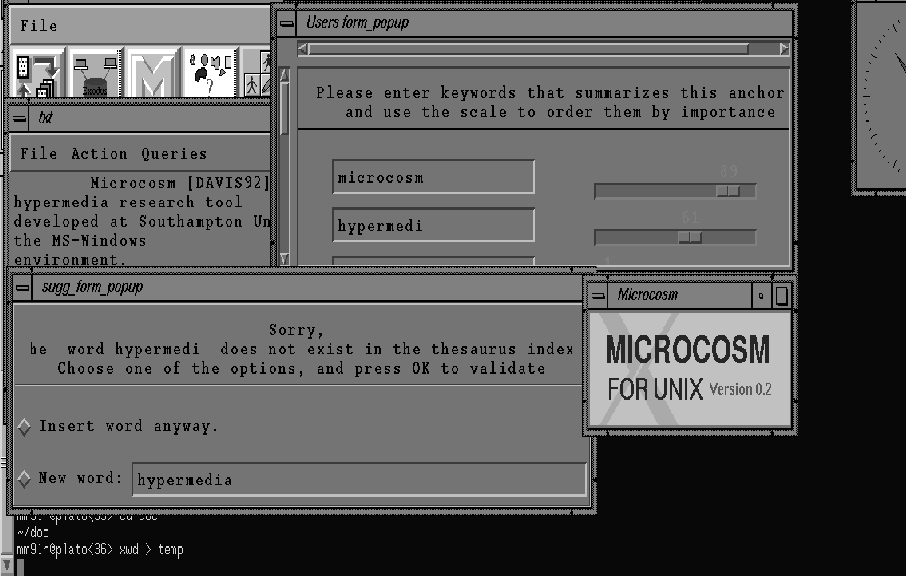
Microcosm (cf. 2.1.13) is a research project at the University of Southampton. Like Intermedia five years before, Microcosm is designed around the idea that material of diverse sources and formats should be tied together into one hypertext. To achieve this goal links have to be separated from the documents. They are stored and maintained in special link databases. In contrast to Intermedia, Microcosm plays the active role in gathering the necessary data out of the documents. For each topic it stores data on which documents contain information about it and also where inside the documents the information is located. This elaborated conception of links can be seen more as a kind of Memex’ trails than simple one-to-one links. Given this structure dynamic linking becomes possible. This means that links can be associated with generic text strings. Wherever this string shows up a link is placed automatically. This has the effect that documents that are imported for the first time into Microcosm can have links immediately.
HTTP Semantics
The Hypertext Transfer Protocol (HTTP) is a stateless application-level protocol for distributed, collaborative, hypertext information systems. This document describes the overall architecture of HTTP, establishes common terminology, and defines aspects of the protocol that are shared by all versions. In this definition are core protocol elements, extensibility mechanisms, and the "http" and "https" Uniform Resource Identifier (URI) schemes. This document updates RFC 3864 and obsoletes RFCs 2818, 7231, 7232, 7233, 7235, 7538, 7615, 7694, and portions of 7230.
The HotJava Browser: A White Paper
Browsers allow people to treat the data spread across the Internet as a cohesive whole. Web browsers integrate the function of fetching the data with figuring out what it is and displaying it. One of the most important file types browsers understand is the hypertext markup language (HTML). HTML allows text data objects to embed simple formatting information and references to other objects.
MICROCOSM: An Open Hypermedia Environment for Information Integration.
This report examines open hypermedia systems, and argues that such systems provide users with richer and more diverse ways to access and integrate information from large and dynamic data sets in a distributed, heterogeneous environment. In particular, the enhanced Microcosm model for open hypermedia is examined, and the ways in which it provides such an environment are discussed. The paper continues by investigating the advantages and the short comings of this model and identifies areas in which further work must be completed before such systems can become widely adopted, in particular the granularity of link anchors, editing, and version control. Possible solutions to these problems are presented and discussed.

</> htmx ~ When Should You Use Hypermedia?
This essay by Carson Gross explores when to use hypermedia in web development, highlighting its advantages and trade-offs. Carson discusses scenarios where hypermedia is a good fit, such as text and image-heavy UIs, CRUD applications, and nested UIs with well-defined areas. He also addresses when hypermedia may not be ideal, including situations with frequent UI state updates, offline requirements, or dynamic interdependencies. Using a 'Transitional' approach (as suggested by Rich Harris), Carson advocates for combining hypermedia with other strategies to optimize web application development, emphasizing its practical benefits and alignment with the web's architecture.
HyperCard
HyperCard is a software application and development kit for Apple Macintosh and Apple IIGS computers. It is among the first successful hypermedia systems predating the World Wide Web.
HyperCard
HyperCard is a software application and development kit for Apple Macintosh and Apple IIGS computers. It is among the first successful hypermedia systems predating the World Wide Web.
Hypermedia APIs
HyperCard Changed Everything