


Join us for the IDS Annual Lecture 2026 delivered by world-renowned political economist and author Prof Jason Hickel.
IDS Annual Lecture 2026 with Jason Hickel
IDS Annual Lecture 2026 with Jason Hickel
The Divide — Jason Hickel
The Divide: A Brief Guide to Global Inequality and its Solutions Penguin Random House UK, 2017

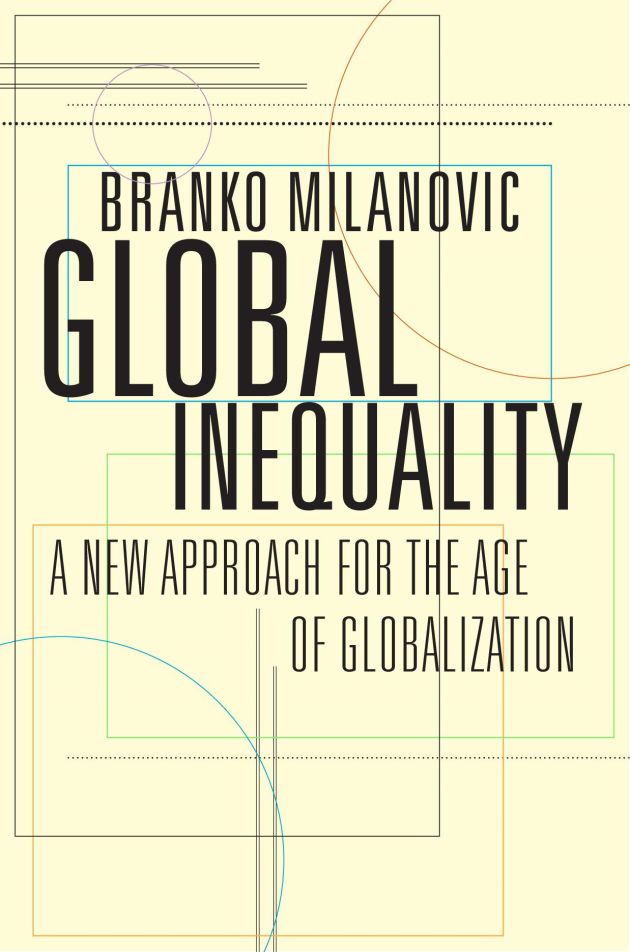
Global Inequality — Harvard University Press
Winner of the Bruno Kreisky Prize, Karl Renner InstitutA Financial Times Best Economics Book of the Year An Economist Best Book of the Year A Livemint Best Book of the YearOne of the world’s leading economists of inequality, Branko Milanovic presents a bold new account of the dynamics that drive inequality on a global scale. Drawing on vast data sets and cutting-edge research, he explains the benign and malign forces that make inequality rise and fall within and among nations. He also reveals who has been helped the most by globalization, who has been held back, and what policies might tilt the balance toward economic justice.“The data [Milanovic] provides offer a clearer picture of great economic puzzles, and his bold theorizing chips away at tired economic orthodoxies.”—The Economist“Milanovic has written an outstanding book…Informative, wide-ranging, scholarly, imaginative and commendably brief. As you would expect from one of the world’s leading experts on this topic, Milanovic has added significantly to important recent works by Thomas Piketty, Anthony Atkinson and François Bourguignon…Ever-rising inequality looks a highly unlikely combination with any genuine democracy. It is to the credit of Milanovic’s book that it brings out these dangers so clearly, along with the important global successes of the past few decades.—Martin Wolf, Financial Times
The myth of catch-up development: trends in core–periphery inequality from 1960 to 2023
The conventional narrative in international development holds that poorer countries are “catching up” with richer countries through the process of capitalist growth. This paper assesses this claim ...

Capitalism, Inequality, and the Myth of Catch-Up Development
Prevailing narratives in international development hold that poorer countries can and will "catch-up" with richer countries through the process of
Citizen Participation (@oliverescobar.bsky.social)
Professor of Public Policy and Democratic Innovation | University of Edinburgh | Working on #democracy #participation #deliberation #commons #governance #power #research | RT≠ endorse | Own views | Profile: https://www.sps.ed.ac.uk/staff/oliver-escobar

Citizen Participation (@oliverescobar.bsky.social)
Professor of Public Policy and Democratic Innovation | University of Edinburgh | Working on #democracy #participation #deliberation #commons #governance #power #research | RT≠ endorse | Own views | Profile: https://www.sps.ed.ac.uk/staff/oliver-escobar
Anthropic Economic Index: Insights from Claude 3.7 Sonnet
The second update from the Anthropic Economic Index
Boaz Barak on Twitter / X
New lectures posted on CS 2881 YouTube playlist https://t.co/yefE1GcNS6 Economic impacts with @RonnieChatterji & Bharat ChandarInterpretabilty with @NeelNanda5, @Jack_W_Lindsey, @bobabowen & @nabla_theta— Boaz Barak (@boazbaraktcs) November 11, 2025
HOME - Daniel Schmachtenberger
EXPLORATIONS ON THE FUTURE OF CIVILIZATION Some of the central questions being explored here: With the first fully globalized civilization, how do we avoid the collapse fate that has befallen all previous civilizations? What are effective types of immune systems for identifying and correcting corruption in governance systems? How do we comprehensively disincentivize misinformation and harm to … HOME Read More »

013 - Olivier De Schutter on Why the Economy Creates Poverty – and How To Fix It
Towards the Symbiocene: Building an Eco-Civilisation with thought-leader, Jeremy Lent
Jeremy Lent is a long time friend of the podcast. His new book, 'Ecocivilization: Making a World That Works for All' is coming out at the end of April 2026 and so we got together to discuss what an Ecocivilisation is, why we so badly need to become one, and how we might get there.

We will discuss this paper in the civic participation journal club. Cannot wait to read it at lunchtime tomorrow🍎

Brihi Joshi
Reasoning about the "why" behind user behavior can improve LLM personas! ✨🧠📈 📝Excited to share our new work: Improving LLM Personas via Rationalization with Psychological Scaffolds 🔗 arxiv.org/abs/2504.17993 🧵 (1/n)
Post-growth & Regenerative Economics

Articles, podcasts, papers and books about alternative, pro-social models of finance and economics.
www.sciencedirect.com

Post-growth: the science of wellbeing within planetary boundaries
SEED Founding

Making Business Personal
Think Like a Commoner | A Short Introduction to the Life of the Commons
Design principles for long-lived circular organization: An Ostromian perspective
