

Hello! What's your background, and what are you working on?Hello! 👋🏻 My name is John O'Nolan, and I run a not-for-profit technology foundation w...
How I made my first million dollars (in pro bono code)
By Michael D. Johnson I gaze down at the Potomac River from a glass-walled conference room. It’s my third week of interviews with the same firm. I’m moments away from securing the kind of prestigious consulting gig that most fresh grads from New Engl...

Tim Burks
I'm a software developer and resident of Northern California. This is my personal website. I have a tendency to tinker, and here you'll find lots of evidence of that! Here I point you to projects that I've done for work and for pleasure and share some things that I find interesting.
Andrew Yeung on Twitter / X
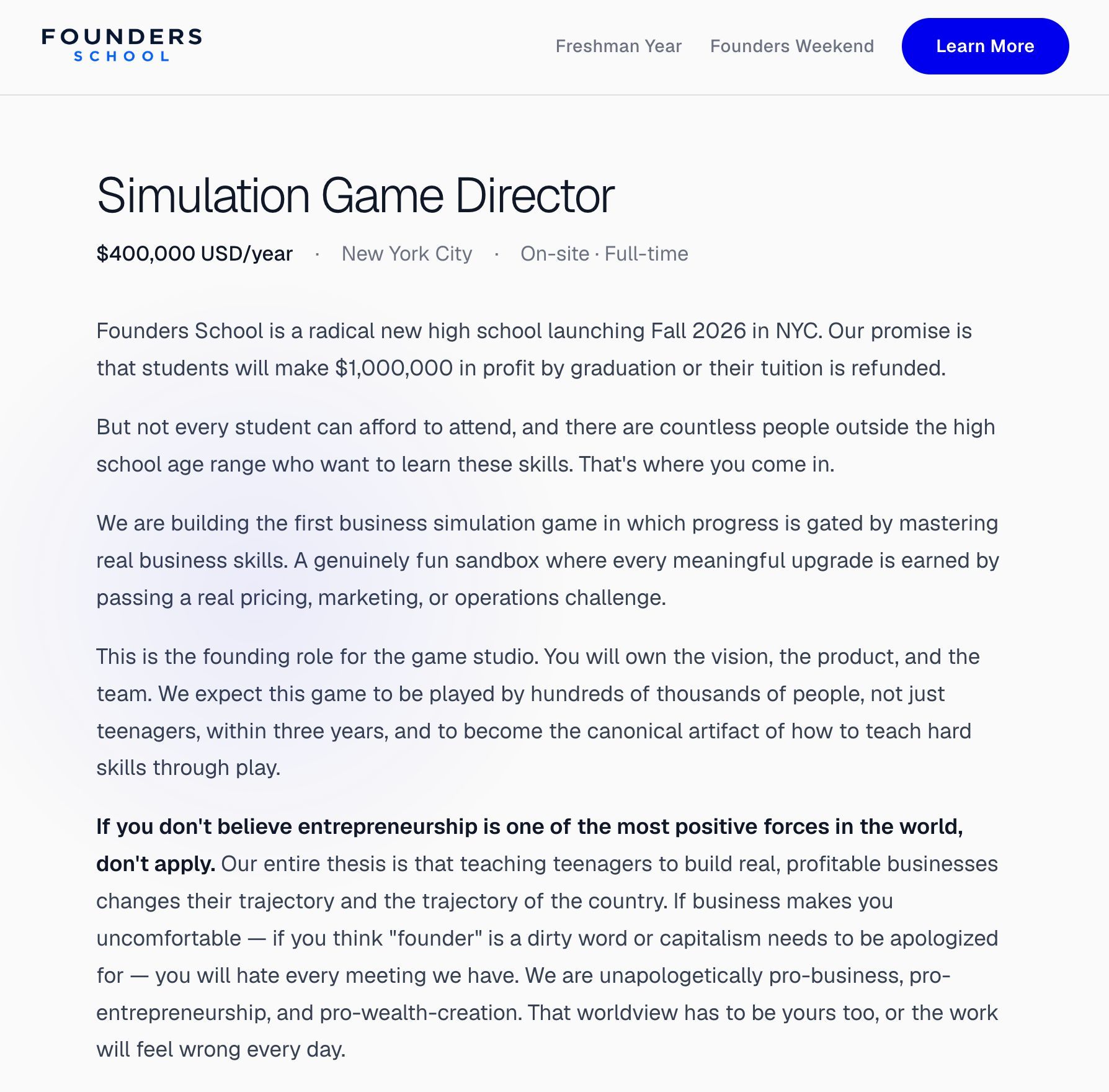
Holy crap. This is possibly the most insane job posting I've seen.Founders School is hiring a "Simulation Game Director" for $400,000 a year. That's just the base salary.If you haven't heard of Founders School, they're a radical new high school launching in New York City this… pic.twitter.com/sYjJZGkGA9— Andrew Yeung (@andruyeung) July 27, 2026
Indie Startups - Neil Thanedar
10 years ago, my entrepreneurial goal was to raise $100M+ and make one $1B+ startup. Now my goal is to 100% own many $1M+ startups.

The Everywhere Millionaire: Who Is Really Rich in America and How They Got There
From two leading economists comes a groundbreaking new portrait of the hidden fortunes of Main Street business owners—ordinary Americans who built extraordinary wealth and are quietly rewriting the rules of money and power. Most people think the path to great wealth runs through Wall Street or Silicon Valley. We’re told you must be a Zuckerberg, a Musk, or a Jamie Dimon to get rich. But this story is wrong. Drawing on unprecedented data from a decade of research and vivid real-life stories of entrepreneurs—from a self-made hot-dog stand billionaire to the heirs of an auto dealer—Zidar and Zwick reveal a surprising truth: prosperity is more attainable, more widely distributed, and closer to home than we imagine. A multitude of Americans have built staggering fortunes by running often unglamorous businesses far from the spotlight. A quiet revolution in the business world—the rise of “pass-through” firms like S-corporations and partnerships—supercharged this wealth, channeling vast income directly to business owners rather than traditional corporations.Part economic detective story, part roadmap to riches, this book reveals: —The Hidden 1%: They might be a local beer distributor, a dentist with a regional network of practices, a commercial HVAC contractor with trucks around town, or a restaurateur who keeps opening new locations. For every public company CEO, more than a thousand private business owners each have transformational wealth.— The Blueprint for Wealth: Zidar and Zwick describe where Main Street Millionaires come from, how they grew rich, and how much money they make. Their stories suggest the American Dream is not dead and many paths to prosperity remain open today. — Power Brokers: Armed with their fortunes, Main Street Millionaires wield power in city halls, statehouses, and Washington, often bending policy to protect what they’ve built. They are both growing the economic pie and grabbing bigger slices for themselves.The Everywhere Millionaire celebrates the stories of entrepreneurs who seized opportunities while asking hard questions about how concentrated wealth and power shape society. It is an essential guide to seeing the economy as it really is and recognizing the surprising paths to prosperity—and influence—everywhere.
Tom Johnson | Product Designer
Tom Johnson, a Nashville base product and UX designer currently leading design at Basedash. I work with startups, enterprises, and everything in-between to make great design systems and elevate the craft of UI design.


How To Be Successful
I’ve observed thousands of founders and thought a lot about what it takes to make a huge amount of money or to create something important. Usually, people start off wanting the former and end up...

Now Hiring: Senior Open Source Maintainer
A rare opportunity to make a real impact in a fast-paced, high-visibility role.

Samuel Krug VFX
An Extended Interview With WordPress Creator Matt Mullenweg
I sat down with Matt Mullenweg, the founder and CEO of WordPress' parent company, Automattic, for an extended interview in March, just ahead of the company's $160 million financing round a month later, which valued the company at $1.16 billion. (Apologies for posting this so long after the fact.) For a company that [...]

Developing creative identity
I was a theoretical physicist from 1992 to 2007. It was a romantic activity, exploring the fundamental nature of the cosmos! I became a university professor, wrote papers and books, and got to explore some of the most beautiful ideas ever discovered. In parallel, I also developed a fascination with the social systems humanity uses to make knowledge. Systems like the university or peer review are immensely deep inventions: our discovery system is itself one of the great inventions of humanity! But I believed a radically better discovery system must be possible. I became obsessed with this idea, eventually giving up tenure to work on it1. My first big project was to write a book helping develop and spread the fundamental ideas underlying the modern open science movement.
A letter to my younger self: big things start small
What I wish I had known when starting my career in consumer tech a decade ago…
Steve Jobs
"FROM THE AUTHOR OF THE BESTSELLING BIOGRAPHIES OF BENJAMIN FRANKLIN AND ALBERT EINSTEIN, THIS IS THE EXCLUSIVE BIOGRAPHY OF STEVE JOBS. Based on more than forty interviews with Jobs conducted over two years--as well as interviews with more than a hundred family members, friends, adversaries, competitors, and colleagues--Walter Isaacson has written a riveting story of the roller-coaster life and searingly intense personality of a creative entrepreneur whose passion for perfection and ferocious drive revolutionized six industries: personal computers, animated movies, music, phones, tablet computing, and digital publishing. At a time when America is seeking ways to sustain its innovative edge, and when societies around the world are trying to build digital-age economies, Jobs stands as the ultimate icon of inventiveness and applied imagination. He knew that the best way to create value in the twenty-first century was to connect creativity with technology. He built a company where leaps of the imagination were combined with remarkable feats of engineering. Although Jobs cooperated with this book, he asked for no control over what was written nor even the right to read it before it was published. He put nothing off-limits. He encouraged the people he knew to speak honestly. And Jobs speaks candidly, sometimes brutally so, about the people he worked with and competed against. His friends, foes, and colleagues provide an unvarnished view of the passions, perfectionism, obsessions, artistry, devilry, and compulsion for control that shaped his approach to business and the innovative products that resulted. Driven by demons, Jobs could drive those around him to fury and despair. But his personality and products were interrelated, just as Apple's hardware and software tended to be, as if part of an integrated system. His tale is instructive and cautionary, filled with lessons about innovation, character, leadership, and values"--
