

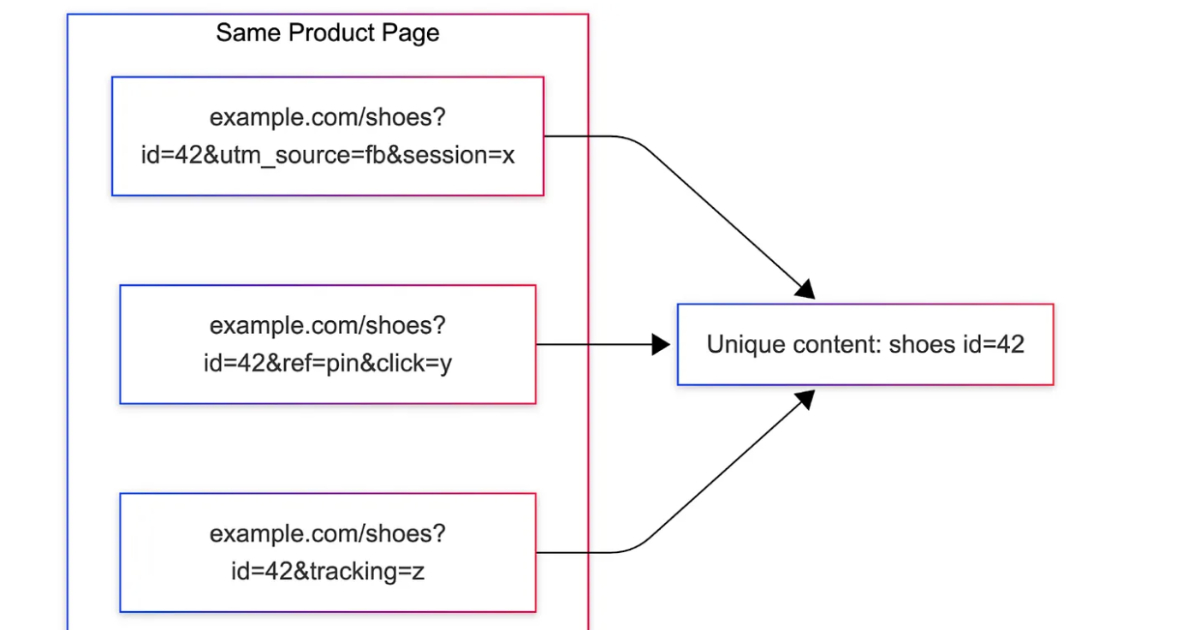
Pinterest introduced MIQPS, a URL normalization system that identifies which query parameters affect page identity using rendered content fingerprints. It reduces duplicate processing across millions of domains by replacing rule-based approaches with offline analysis, anomaly detection, and runtime parameter maps, improving ingestion efficiency and scalability in large-scale content pipelines.
Robustness of Practical Perceptual Hashing Algorithms to...
Perceptual hashing algorithms (PHAs) are widely used for identifying illegal online content and are thus integral to various sensitive applications. However, due to their hasty deployment in...

Vaulting Out of Walled Gardens with Fancy Links – Mozilla Hacks - the Web developer blog
Have you ever noticed that in Twitter, Facebook, Google and Pinterest some links are displayed quite fancily, with preview images, descriptive text summaries and other information? These ...
Am I Unique ?
Check if your browser has a unique fingerprint, how identifiable you are on the Internet
Solutions for Link Rot on the Modern Web
Web links are fundamental to the web, enabling navigation between pages and citations in research articles. However, web links suffer from "link rot", a phenomenon in which links are likely to become inaccessible over time. This can occur if a link’s site disappears, making it impossible to resolve the hostname or establish a server connection, or the linked page has been deleted, resulting in an HTTP 404 "Not Found" error. Today, a common solution to tackle link rot is to rely on web archives, which capture snapshots of web pages for future reference. However, the modern web has evolved significantly since web archives were first introduced, leading to several limitations in their effectiveness. First, the scale of the web has grown tremendously, making it infeasible to crawl every page whenever it changes. As a result, many broken links either have no archived copies, or the archived copies have stale content. Second, modern web pages rely heavily on increasingly complex and diverse JavaScript. This shift has made it more challenging for preserving fidelity in archived copies, significantly increasing both the computational cost of operating browser-based crawlers and engineering effort required to maintain accurate replay systems. This thesis presents a set of solutions to cope with link rot on the modern web. My work aims to mitigate the various limitations of web archives. First, for broken links without any archived copy, or if the archived copy includes stale content or unavailable functionalities, I built Fable. Fable revives the dead link with the new URL to the same page whenever available. Compared to prior approaches, Fable revives 4.6K broken links—a 50% increase—with much higher accuracy. Second, for pages that require dynamic crawling, I show how web archives can achieve a better tradeoff between efficiency and fidelity. By carefully choosing 8.9% of pages to crawl dynamically and strategically reusing resources from those crawls, an archive can serve 99% of the remaining statically crawled pages without any fidelity loss. Third, for fidelity violations in archived copies that are caused by incorrect edits to crawled scripts, I built FidEx. FidEx reliably detects when an archived page differs from its original version and pinpoints the root cause. After fixing the most common errors pinpointed by FidEx, I reduced the fraction of pages for which FidEx reports a violation of fidelity from 15% to 9%.
Solutions for Link Rot on the Modern Web
Web links are fundamental to the web, enabling navigation between pages and citations in research articles. However, web links suffer from "link rot", a phenomenon in which links are likely to become inaccessible over time. This can occur if a link’s site disappears, making it impossible to resolve the hostname or establish a server connection, or the linked page has been deleted, resulting in an HTTP 404 "Not Found" error. Today, a common solution to tackle link rot is to rely on web archives, which capture snapshots of web pages for future reference. However, the modern web has evolved significantly since web archives were first introduced, leading to several limitations in their effectiveness. First, the scale of the web has grown tremendously, making it infeasible to crawl every page whenever it changes. As a result, many broken links either have no archived copies, or the archived copies have stale content. Second, modern web pages rely heavily on increasingly complex and diverse JavaScript. This shift has made it more challenging for preserving fidelity in archived copies, significantly increasing both the computational cost of operating browser-based crawlers and engineering effort required to maintain accurate replay systems. This thesis presents a set of solutions to cope with link rot on the modern web. My work aims to mitigate the various limitations of web archives. First, for broken links without any archived copy, or if the archived copy includes stale content or unavailable functionalities, I built Fable. Fable revives the dead link with the new URL to the same page whenever available. Compared to prior approaches, Fable revives 4.6K broken links—a 50% increase—with much higher accuracy. Second, for pages that require dynamic crawling, I show how web archives can achieve a better tradeoff between efficiency and fidelity. By carefully choosing 8.9% of pages to crawl dynamically and strategically reusing resources from those crawls, an archive can serve 99% of the remaining statically crawled pages without any fidelity loss. Third, for fidelity violations in archived copies that are caused by incorrect edits to crawled scripts, I built FidEx. FidEx reliably detects when an archived page differs from its original version and pinpoints the root cause. After fixing the most common errors pinpointed by FidEx, I reduced the fraction of pages for which FidEx reports a violation of fidelity from 15% to 9%.
Browser Fingerprinting: An Introduction and the Challenges Ahead | Tor Project
In the past few years, a technique called browser fingerprinting has received a lot of attention because of the risks it can pose to privacy. What is it? How is it used? What is Tor Browser doing against it? In this blog post, I’m here to answer these questions.

My Fingerprint- Am I Unique ?
Check if your browser has a unique fingerprint, how identifiable you are on the Internet
Link Cleaner
Link Cleaner is a web app for removing tracking code, search parameters, and other junk from URL links.

Pixie: A System for Recommending 3+ Billion Items to 200+ Million Users in Real-Time
User experience in modern content discovery applications critically depends on high-quality personalized recommendations. However, building systems that provide such recommendations presents a major challenge due to a massive pool of items, a large
README
This is a browser extension that provides “wormhole” navigation between different AT Protocol/Bluesky services inspired by Dame’s Shortcut. The extension transforms URLs and identifiers from one service to equivalent URLs on other services.
webrecorder/browsertrix-crawler
Run a high-fidelity browser-based web archiving crawler in a single Docker container
QRCheck.ca - Scan QR Codes Safely
Scan QR codes safely and review redirect chains without exposing your URLs. Privacy-first security analysis.

Pixie: A System for Recommending 3+ Billion Items to 200+ Million...
User experience in modern content discovery applications critically depends on high-quality personalized recommendations. However, building systems that provide such recommendations presents a...
Pixie: A System for Recommending 3+ Billion Items to200+ Million Users in Real-Time
User experience in modern content discovery applications critically depends on high-quality personalized recommendations. However, building systems that provide such recommendations presents a major challenge due to a …

Into the feed of Currents, an open Pinterest alternative built on AT Protocol - Matteo Marjanovic
In this article I describe how I built the first version of Currents' feed, an open Pinterest alternative on AT Protocol, and how its personalization slider works.