Changing schemas in distributed software is hard. Could adopting bidirectional lenses help?
Symmetric lenses | Proceedings of the 38th annual ACM SIGPLAN-SIGACT symposium on Principles of programming languages
A lens is a bidirectional transformation between a pair of connected data structures, capable of translating an edit on one structure into an appropriate edit on the other. Many varieties of lenses have been studied, but none, to date, has offered a ...

blaine/relationaltext
WASM-backed rich text library with flat facets, 40+ format adapters, and a lens system for cross-format translation
panproto/crates/panproto-lens-dsl at main · panproto/panproto
One engine for schematic version control within and across any schema language. - panproto/panproto
Bidirectional Programming Languages
The need to edit source data through a view arises in a host of applications across many different areas of computing. Unfortunately, few existing systems provide support for updatable views. In practice, when they are needed, updatable views are usually implemented using two separate programs: one that computes the view from the source and another that handles updates. This rudimentary design is tedious for programmers, difficult to reason about, and a nightmare to maintain. This dissertation presents bidirectional programming languages, which provide an elegant and effective mechanism for describing updatable views. Unlike programs written in an ordinary language, which only work in one direction, programs in a bidirectional language can be run both forwards and backwards: from left to right, they describe functions that map sources to views, and from right to left, they describe functions that map updated views back to updated sources. Besides eliminating redundancy, these languages can be designed to ensure correctness, guaranteeing by construction that the two functions work well together. Starting from the foundations, we define a general semantic space of well-behaved bidirectional transformations called lenses. Then, building on this foundation, we describe a particular language for defining lenses on strings with syntax based on the familiar regular operators (union, concatenation, and Kleene star). We present extensions to the basic framework that address the subtle complications that arise when lenses are used to manipulate, data containing unimportant details, ordered data, and confidential data.
Quotient lenses | Proceedings of the 13th ACM SIGPLAN international conference on Functional programming
Bidirectional programming languages are a practical approach to the view update problem. Programs in these languages, called lenses, define both a view and an update policy - i.e., every program can be read as a function mapping sources to views as well ...

protolab
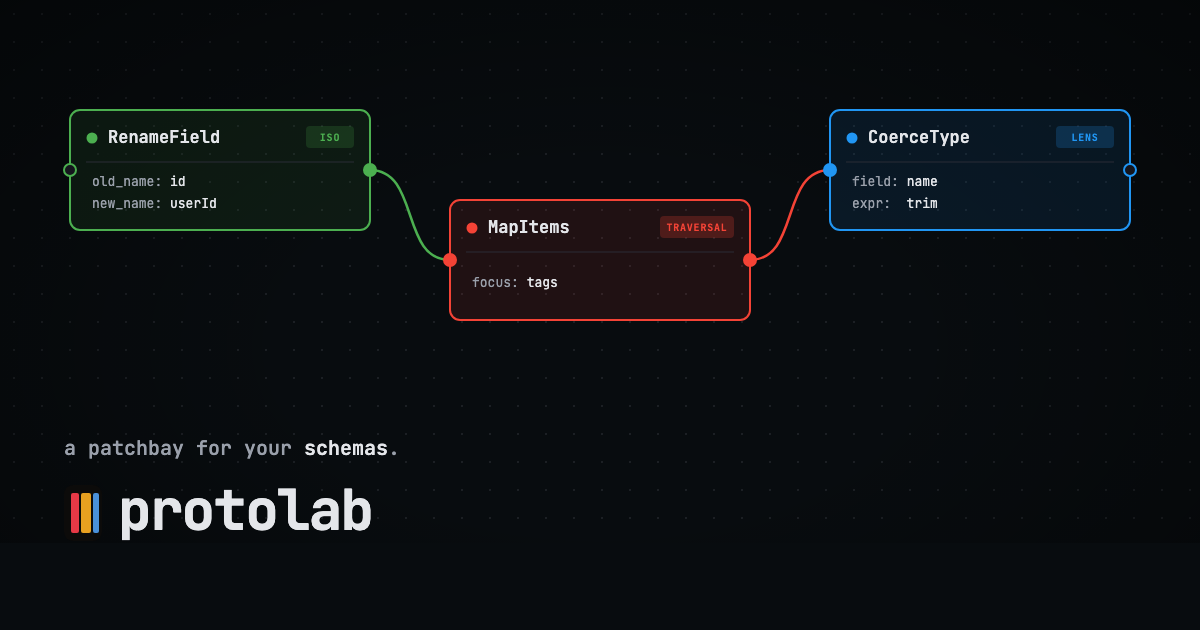
A patchbay for your schemas. Bidirectional data transformations, drawn as circuits.
protolab
A patchbay for your schemas. Bidirectional data transformations, drawn as circuits.
panproto/panproto
One engine for schematic version control within and across any schema language.
Dependent Optics
A wide variety of bidirectional data accessors, ranging from mixed optics to functor lenses, can be formalized within a unique framework-dependent optics. Starting from two indexed categories, which encode what maps are allowed in the forward and backward directions, we define the category of dependent optics and establish under what assumptions it has coproducts. Different choices of indexed categories correspond to different families of optics: we discuss dependent lenses and prisms, as well as closed dependent optics. We introduce the notion of Tambara representation and use it to classify contravariant functors from the category of optics, thus generalizing the profunctor encoding of optics to the dependent case.

Categories of Optics
Bidirectional data accessors such as lenses, prisms and traversals are all instances of the same general 'optic' construction. We give a careful account of this construction and show that it extends to a functor from the category of symmetric monoidal categories to itself. We also show that this construction enjoys a universal property: it freely adds counit morphisms to a symmetric monoidal category. Missing in the folklore is a general definition of 'lawfulness' that applies directly to any optic category. We provide such a definition and show that it is equivalent to the folklore profunctor optic laws.
Boomerang | Proceedings of the 35th annual ACM SIGPLAN-SIGACT symposium on Principles of programming languages
Bidirectional programming languages are a practical approach to the view update problem. Programs in these languages, called lenses, define both a view and an update policy - i.e., every program can be read as a function mapping sources to views as well ...

Delta Lenses over Inductive Types
Existing bidirectional languages are either state-based or operation-based, depending on whether they represent updates as mere states or as sequences of edit operations.In-between both worlds are delta-based frameworks, where updates are represented using alignment relationships between states.In this paper, we formalize delta lenses over inductive types using dependent type theory and develop a point-free delta lens language with an explicit separation of shape and data.In contrast with the already known issue of data alignment, we identify the new problem of shape alignment and solve it by lifting standard recursion patterns such as folds and unfolds to delta lenses that use alignment to infer meaningful shape updates.
Profunctor Optics: Modular Data Accessors
CONTEXT: Data accessors allow one to read and write components of a data structure, such as the fields of a record, the variants of a union, or the elements of a container. These data accessors are collectively known as optics; they are fundamental to programs that manipulate complex data. INQUIR...

Profunctor Optics, a Categorical Update
Optics are bidirectional data accessors that capture data transformation patterns such as accessing subfields or iterating over containers. Profunctor optics are a particular choice of representation supporting modularity, meaning that we can construct accessors for complex structures by combining simpler ones. Profunctor optics have previously been studied only in an unenriched and non-mixed setting, in which both directions of access are modelled in the same category. However, functional programming languages are arguably better described by enriched categories; and we have found that some structures in the literature are actually mixed optics, with access directions modelled in different categories. Our work generalizes a classic result by Pastro and Street on Tambara theory and uses it to describe mixed V-enriched profunctor optics and to endow them with V-category structure. We provide some original families of optics and derivations, including an elementary one for traversals. Finally, we discuss a Haskell implementation.

Bidirectional model transformations in QVT: semantic issues and open questions
We consider the OMG’s queries, views and transformations standard as applied to the specification of bidirectional transformations between models. We discuss what is meant by bidirectional transformations, and the model-driven development scenarios in which they are needed. We analyse the fundamental requirements on tools which support such transformations, and discuss some semantic issues which arise. In particular, we show that any transformation language sufficient to the needs of model-driven development would have to be able to express non-bijective transformations. We argue that a considerable amount of basic research is needed before suitable tools will be fully realisable, and suggest directions for this future research.

panproto | schematic version control
One engine for schematic version control within and across any schema language.