

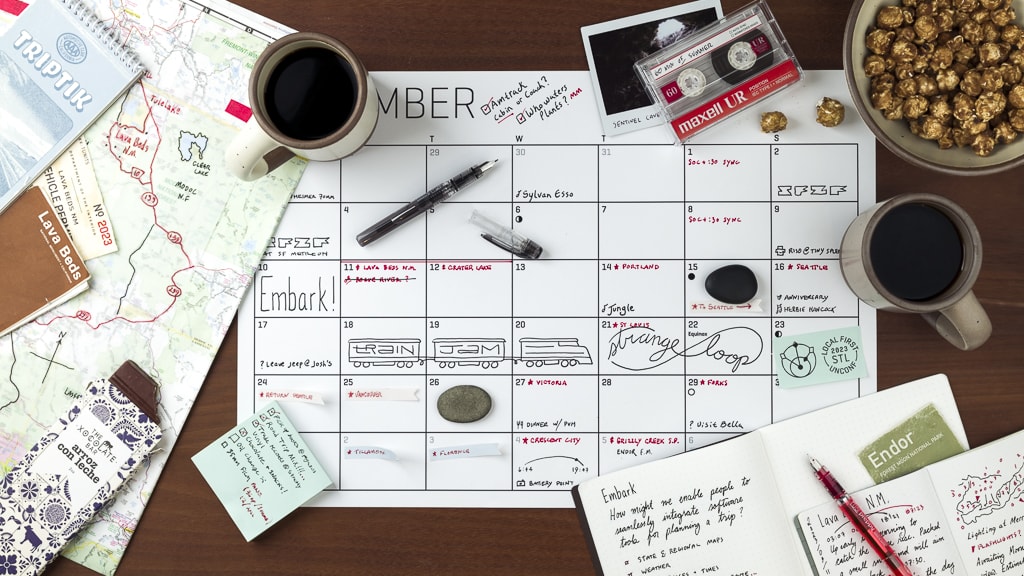
Gradually enriching a text outline with travel planning tools.
Roadbook — Plan your next adventure together
A social road trip planner with collaborative suggestions and privacy-first sharing. Built on AT Protocol.

Creative Reading: Scaffolding Reading for Transformation
However, recent work on augmenting reading largely focuses on making reading more efficient, especially in knowledge-intensive contexts where people must rapidly make sense of research papers and other complex documents (Lo et al., 2024). These systems often aim to help readers skim, summarize, and synthesize large volumes of information in order to reduce cognitive effort and accelerate document- and corpus-level sensemaking at scale (Gu et al., 2025; Lo et al., 2024; Fok et al., 2023). At one extreme, the form of reading implicitly envisioned by these systems may resemble what we call “reading to discard”: extracting the essential, actionable informational core of a document as quickly and efficiently as possible, so that the rest can be swiftly tossed aside—much like we often process inbound mail. This motivates us to ask what scaffolding approaches might resist “reading to discard,” what alternative forms of reading we might scaffold, and what alternative views and values of reading might guide the conversation.
Potluck: Dynamic documents as personal software
Gradually enriching text documents into interactive applications
Malleable Overview Detail Interfaces
A Local-First Task Planner On ATProto - tyler's blog
Structured planning and debugging | Proceedings of the 5th international joint conference on Artificial intelligence - Volume 2
We introduce a new approach to planning in STRIPS-like domains based on constructing and analyzing a compact structure we call a Planning Graph. We describe a new planner, Graphplan, that uses this paradigm. Graphplan always returns a shortest-possible ...
The Future of Text
We are a community dedicated to working on how we can better develop text to augment our capabilities and we invite you to join us. We believe that the potential of richly interactive text to truly augment how we think & communicate is massive. Text after all, is externalized symbols we can interact with to extend our mind’s reach. Therefore text is not just a medium, it is also a tool for thought, and we are looking Beyond Visual Range.
Planning - The Core Reason Why Gameplay Feels Good
In this post I dig into planning, and how it is a fundamental part of what makes a game engaging. Planning affects many aspects of what is s...

OASIS Darwin Information Typing Architecture (DITA) TC — Subcommittee | OASIS
Advancing a document creation and management specification that builds content reuse into the authoring process
textcamp!
The lofty ambition of Textcamp is to create text-based adventure games that can be enjoyed by everyone, everywhere.
Words that Work: Using Large Language Models to Generate and Refine Hypotheses from Text
In this paper, we introduce a data-driven framework for generating and refining hypotheses from text. Our three-step approach–Hypothesize, Intervene, and Predic

Goals Garden: Sow far, sow good - Sri's leaflets
Calendar Favicons, No EXIF, Alt Text, ATProto Lexicons, Migration
Chasing RATs: Tracing Reading for and as Creative Activity
Creativity research has privileged making over the interpretive labor that precedes and shapes it. We introduce Reading Activity Traces (RATs), a proposal that treats reading -- broadly defined to include navigating, interpreting, and curating media across interconnected sources -- as creative activity both for future artifacts and as a form of creation in its own right. By tracing trajectories of traversal, association, and reflection as inspectable artifacts, RATs render visible the creative work that algorithmic feeds and AI summarization increasingly compress and automate away. We illustrate this through WikiRAT, a speculative instantiation on Wikipedia, and open new ground for reflective practice, reader modeling, collective sensemaking, and understanding what is lost when human interpretation is automated -- towards designing intelligent tools that preserve it.

How I draft stories
I discovered that trying to write one big blob does not work for me. I can get as far as 2000 words before the volume overwhelms. As with many things in life, breaking it down into pieces helps a lot! This is where most outlining writers suggest a big bulleted
I’ve been talking to @jimray.bsky.team & @pfrazee.com about ways to spreads the word on atproto — this could definitely work as a format challenges themselves are fun (could base them in cities with active atproto communities) & we could probably make some extras to highlight builders in the space
