


Research & build tools that let AI agents negotiate using confidential, verifiable data.
How to build an AI scientist: first peer-reviewed paper spills the secrets
AI Scientist, an autonomous research tool, first released in 2024, has now undergone peer review, highlighting its strengths and limitations.

Private AI engineering and product notes
First-hand engineering notes about private AI, end-to-end encryption, confidential computing, encrypted memory, and Confer.

We Can Just Build Things
Build the tools your community needs — production-grade, privacy-respecting freedom tech, made with an AI agent and grounded in a verified, values-aligned catalog (Nostr, AT Protocol, and beyond).

OpenScience.ai — Autonomous AI Research Agents
AI agents conducting reproducible scientific inquiry. Full provenance, executable notebooks, peer validation.

2389 Research, Inc
2389 Research is an applied AI lab in Chicago. It builds tools for AI agents, publishes research, and teaches engineering teams to work with coding agents.

The 2025 AI Agent Index Documenting Technical and Safety Features of Deployed Agentic AI Systems
Agentic AI systems are increasingly capable of performing professional and personal tasks with limited human involvement. However, tracking these developments is difficult because the AI agent ecosystem is complex, rapidly evolving, and inconsistently documented, posing obstacles to both researchers and policymakers. To address these challenges, this paper presents the 2025 AI Agent Index. The Index documents information regarding the origins, design, capabilities, ecosystem, and safety features of 30 state-of-the-art AI agents based on publicly available information and email correspondence with developers. In addition to documenting information about individual agents, the Index illuminates broader trends in the development of agents, their capabilities, and the level of transparency of developers. Notably, we find different transparency levels among agent developers and observe that most developers share little information about safety, evaluations, and societal impacts. The 2025 AI Agent Index is available online at https://aiagentindex.mit.edu.
AI agents team up in Agent Laboratory to speed scientific research
Johns Hopkins University and AMD have developed Agent Laboratory, a new open-source framework that pairs human creativity with AI-powered workflows.

The 2025 AI Agent Index: Documenting Technical and Safety Features of Deployed Agentic AI Systems
Agentic AI systems are increasingly capable of performing professional and personal tasks with limited human involvement. However, tracking these developments is difficult because the AI agent ecosystem is complex, rapidly evolving, and inconsistently documented, posing obstacles to both researchers and policymakers. To address these challenges, this paper presents the 2025 AI Agent Index. The Index documents information regarding the origins, design, capabilities, ecosystem, and safety features of 30 state-of-the-art AI agents based on publicly available information and email correspondence with developers. In addition to documenting information about individual agents, the Index illuminates broader trends in the development of agents, their capabilities, and the level of transparency of developers. Notably, we find different transparency levels among agent developers and observe that most developers share little information about safety, evaluations, and societal impacts. The 2025 AI Agent Index is available online at https://aiagentindex.mit.edu
The lethal trifecta for AI agents: private data, untrusted content, and external communication
If you are a user of LLM systems that use tools (you can call them “AI agents” if you like) it is critically important that you understand the risk of …
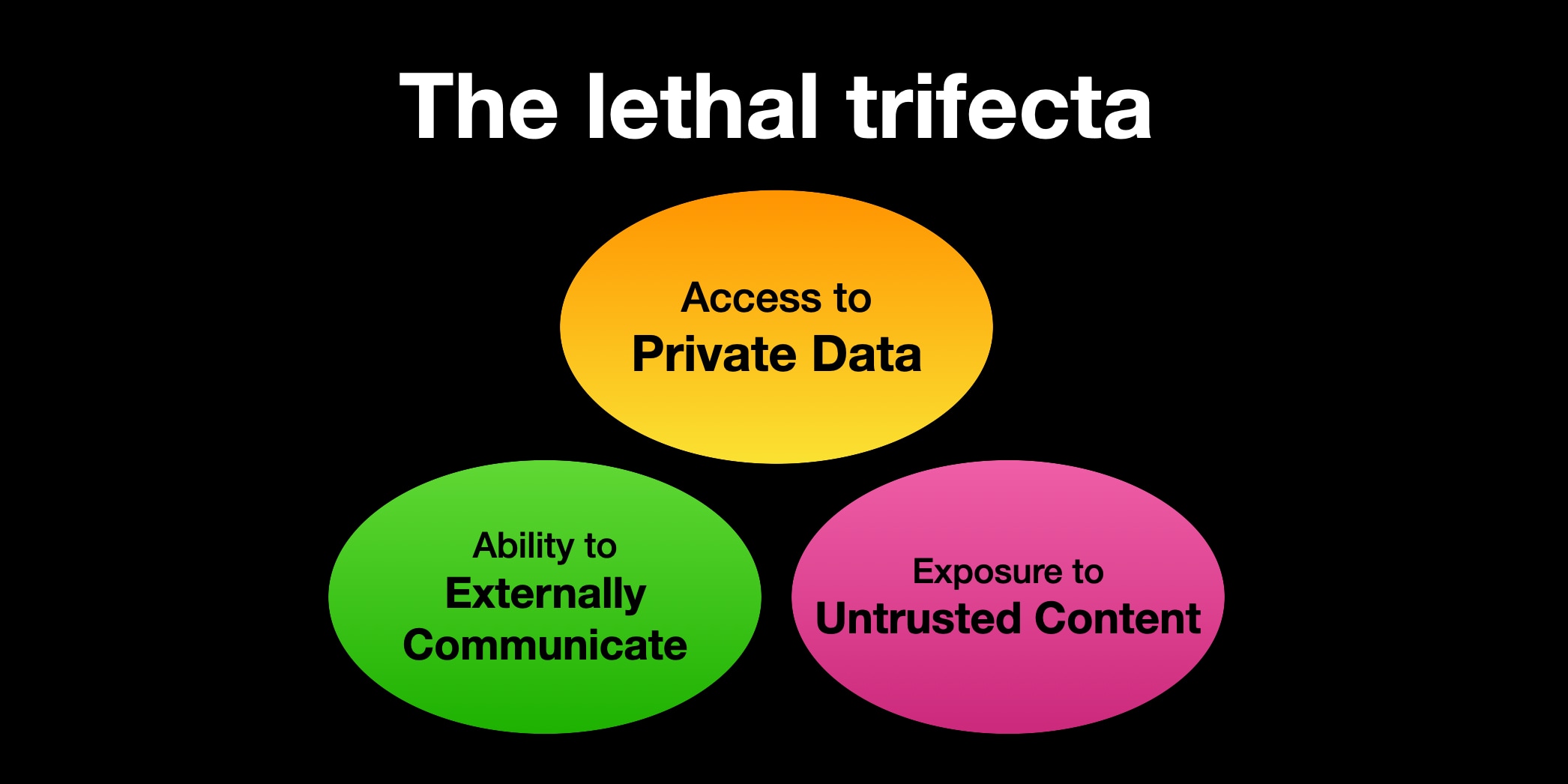
The lethal trifecta for AI agents: private data, untrusted content, and external communication
If you are a user of LLM systems that use tools (you can call them “AI agents” if you like) it is critically important that you understand the risk of …
Impressions from visiting OpenAI, Anthropic, & Cursor
A peek into where software engineering is headed from inside the sector’s leading AI labs. Agents running in the cloud are a major trend, while coding harnesses are spreading beyond the craft
Meeting where AI eyes can't follow
I applied to the Community Privacy Residency, and the past projects reminded me of a cryptographic exploration I come back to every once in a while, just for...

Anatomy of a Frontier Lab Agent Intrusion: A Technical Timeline of the July 2026 Incident
We’re on a journey to advance and democratize artificial intelligence through open source and open science.
