


Some explorations of new editor interactions for writing science papers, and a trio of projects advancing the future of Automerge.
Synchronized editing: the future of collaborative writing
A growing suite of tools allows teams of researchers to work collectively to edit scientific documents.

Scientific Content Management System | Curvenote
Create, manage, and publish interactive research with connected workflows, modular content, and built-in provenance. Book a demo
PaperOrchestra: A Multi-Agent Framework for Automated AI Research Paper Writing
Synthesizing unstructured research materials into manuscripts is an essential yet under-explored challenge in AI-driven scientific discovery. Existing autonomous writers are rigidly coupled to specific experimental pipelines, and produce superficial literature reviews. We introduce PaperOrchestra, a multi-agent framework for automated AI research paper writing. It flexibly transforms unconstrained pre-writing materials into submission-ready LaTeX manuscripts, including comprehensive literature synthesis and generated visuals, such as plots and conceptual diagrams. To evaluate performance, we present PaperWritingBench, the first standardized benchmark of reverse-engineered raw materials from 200 top-tier AI conference papers, alongside a comprehensive suite of automated evaluators. In side-by-side human evaluations, PaperOrchestra significantly outperforms autonomous baselines, achieving an absolute win rate margin of 50%-68% in literature review quality, and 14%-38% in overall manuscript quality.

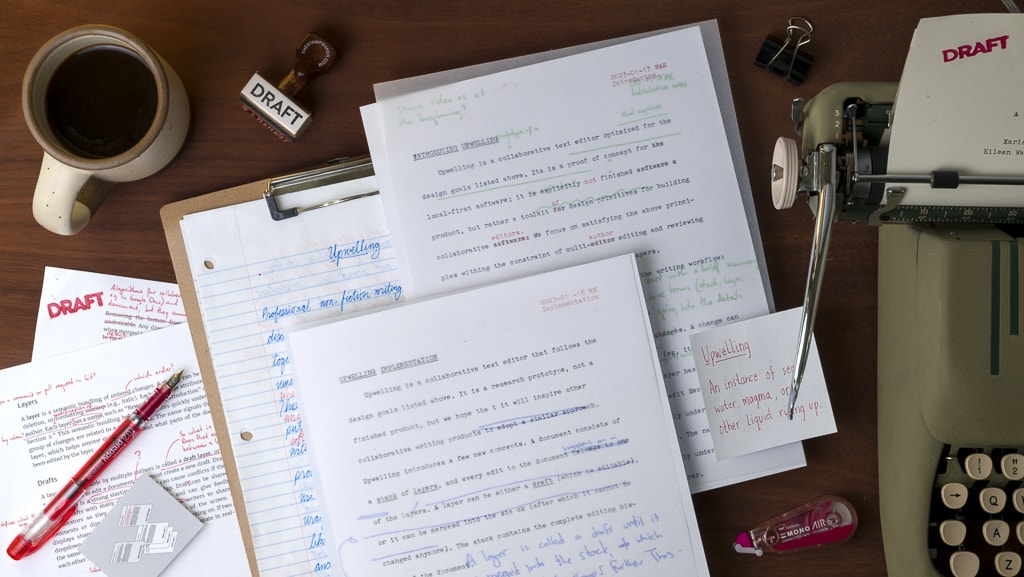
Upwelling: Combining real-time collaboration with version control for writers.
Collaborative writing tools don’t work well for writers or editors. With Upwelling, we demonstrate a design that gives writers privacy while still offering editors transparency into how a document is changing.
Welcome to Automerge
Automerge is a library for building collaborative, local-first applications.
Hyperlink Academy
It's a lightweight collaborative publishing tool for quick tiny docs that can grow into rich creative surfaces ✨🌱
Jupyter Notebooks – a publishing format for reproducible computational workflows
It is increasingly necessary for researchers in all fields to write computer code, and in order to reproduce research results, it is important that this code is published. We present Jupyter notebooks, a document format for publishing code, results and explanations in a form that is both readable and executable. We discuss various tools and use cases for notebook documents.
Towards End-to-End Automation of AI Research
The automation of science is a long-standing ambition in the field of AI. While the community has made significant progress in automating individual components of the scientific process, a system that autonomously navigates the entire research lifecycle -- from conception to publication -- has remained out of reach. Here, we present the strongest demonstration to date toward automating the entire process end-to-end. We present The AI Scientist, which creates research ideas, writes code, runs experiments, plots and analyzes data, writes the entire scientific manuscript and performs its own peer review. Its ideas, execution, and presentation are of sufficient quality to produce a manuscript generated by an AI system that passes the first round of peer review at a major machine learning conference workshop. The workshop has an acceptance rate of 70 percent. Our system leverages modern foundation models within a complex agentic system. We evaluate The AI Scientist in two settings: a focused mode using human-provided code templates as an initial scaffold to conduct research on a specific topic, and a template-free, open-ended mode that leverages agentic search for wider scientific exploration. Both settings produce diverse ideas and automatically test, report on, and evaluate them. This achievement demonstrates AI's growing capacity for scientific contribution and signifies a potential paradigm shift in how research is conducted. As with any impactful new technology, there could be significant risks, including taxing overwhelmed review systems and adding noise to scientific literature. However, if developed responsibly, such autonomous systems could greatly accelerate scientific discovery.
Building Scholar-Ready AI: A Conversation with Todd Toler - The Scholarly Kitchen
A conversation on AI retrieval, the provenance problem, and the shared infrastructure scholarly publishing needs.

Lab Notes #004: Semble Updates - Notifications, Provenance and Indie Integrations - Cosmik Labs
Spreading good attention karma with new Semble notifications and provenance, and some cool indie Semble integrations
Automerge 3.0 Beta, Sketchy Calendar, and a lab website refresh
Some major updates to our open-source Automerge library, an introduction to Sketchy Calendars, and a peek at our work on collaborative game development. Also some meta content—a refreshed website, and a talk about how we work.
Metagov x Future of Science Seminar - Discourse Graphs with Matt Akamatsu
NLnet; Nanoarguments
Scientific knowledge is currently scattered across papers, repositories, and disconnected platforms, with no structured way to trace how claims connect to evidence or how arguments develop. Nanoarguments builds a framework and tools for creating, browsing, and contributing to a global, federated graph of scientific discourse and evidence. Researchers and their communities can collaboratively structure claims, evidence chains, and discussion as nanopublications, which are small, cryptographically signed Linked Data snippets with precise provenance and authorship, published to a decentralized peer-to-peer network. The project builds upon the Nanodash interface to help users browse, edit, and aggregate discourse and evidence graphs, and integrates with dokieli to enable in-context authoring of nanopublications as inline annotations while reading or writing a document. A bidirectional ActivityPub connector bridges the nanopublication network and the fediverse, allowing discourse threads to start as social exchanges and crystallize into persistent, machine-readable evidence records. The project will be piloted with early adopter research groups in discourse and evidence modeling. All components will be released as open-source modules that other systems can build upon.
Towards Automating Scientific Review with Google's Paper Assistant Tool
Artificial intelligence is driving a revolution in scientific discovery, accelerating everything from hypothesis generation to mathematical theorem proving. However, this rapid acceleration is creating a systemic challenge: traditional human peer review cannot scale to match the influx of AI-assisted science. Ultimately, to resolve this tension, we must also deploy AI to accelerate the verification and review process itself. To frame the discussion around this transition, we propose a taxonomy consisting of four progressive levels of AI-human collaboration in scientific evaluation, and discuss various trade-offs involved with each. As a step toward this future, we introduce the Paper Assistant Tool (PAT), an agentic AI framework built for deep scientific review and verification. PAT ingests full scientific manuscripts and produces a comprehensive evaluation, checking theoretical results, validating experiments, suggesting improvements, and identifying potential flaws. By utilizing inference scaling techniques, PAT is able to identify deeper issues than a single model call alone, achieving a 34% improvement over zero-shot recall on mathematical errors in the SPOT benchmark. Pilot deployments of PAT as a pre-submission tool for authors at two major Computer Science conferences -- STOC and ICML -- demonstrate its ability to identify critical errors and suggest substantive improvements to research papers. By catching errors early, PAT eases the cognitive burden placed on referees, while preserving their control over the outcomes of the review process.
What can we learn from automating an entire quantitative social science paper, from prompt to finished product? Thread about ongoing work with @natewilmers.bsky.social 1/12 Paper: osf.io/preprints/socarxiv/24xfq
