We believe that simple, powerful, universal version control tools could help all kinds of creators produce better work.
Universal Version Control
Building tools to help people explore alternatives, keep track of history, and collaborate better, across all kinds of media.

Redesigning source control at Anthropic
As our merges per day grew more than tenfold, source control became our biggest development bottleneck. Here, we share how we migrated to an in-house version control system in five months.
v2 Editor Manifesto
The manifesto for our brand new rich text editor with version control capabilities, v2. In this post, we describe the basic principles, design decisions and our vision for v2, alongside reflecting on the current state and potential future of knowledge production in society.
Why Pijul - The Pijul manual
Pijul is the first distributed version control system to be based on a sound mathematical theory of changes. It is inspired by Darcs, but aims at solving the soundness and performance issues of Darcs.
Software Is Made Between Commits
From the Zed Blog: Agents turned the conversation into the real source of our software. DeltaDB is the version control built for it.
Learn about Lore: next-generation open source version control
Maintained by Epic Games, Lore is designed for unprecedented scalability of both data and teams. It’s optimized for projects that combine code with large binary assets.
Differ - Adaptive Software
Build software that adapts to each user — without forks or feature flags. One codebase, infinite variants.

Differ - Adaptive Software
Build software that adapts to each user — without forks or feature flags. One codebase, infinite variants.
Home – DVC
Open-source version control system for Data Science and Machine Learning projects. Git-like experience to organize your data, models, and experiments.
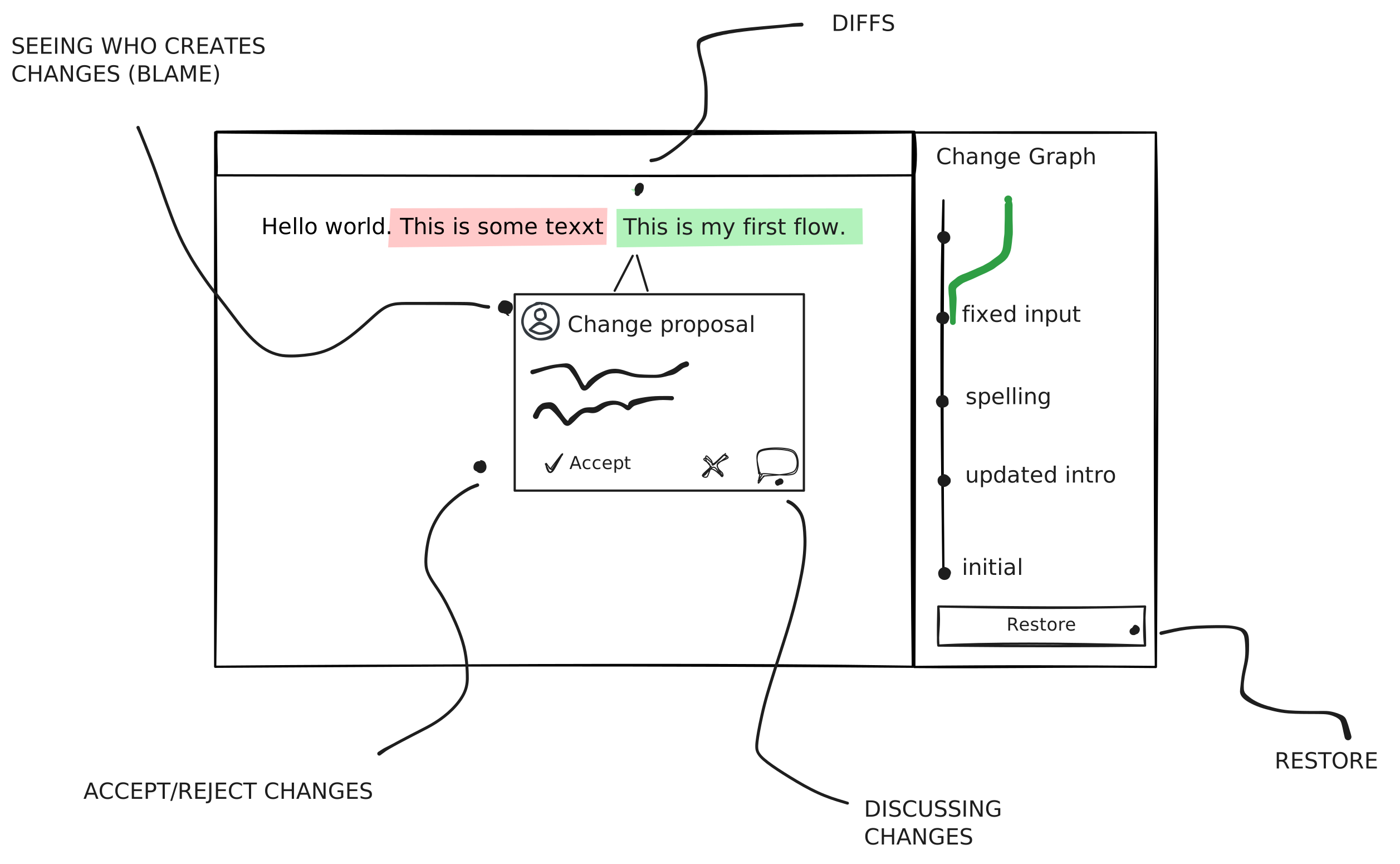
Lix | Version control system for every file format
Lix tracks, reviews, branches, merges, and rolls back changes across Markdown, DOCX, XLSX, JSON, PDFs, and custom file formats.
panproto/panproto
One engine for schematic version control within and across any schema language.
A Categorical Theory of Patches
When working with distant collaborators on the same documents, one often uses a version control system, which is a program tracking the history of files and helping importing modifications brought by others as patches. The implementation of such a system requires to handle lots of situations depending on the operations performed by users on files, and it is thus difficult to ensure that all the corner cases have been correctly addressed. Here, instead of verifying the implementation of such a system, we adopt a complementary approach: we introduce a theoretical model, which is defined abstractly by the universal property that it should satisfy, and work out a concrete description of it. We begin by defining a category of files and patches, where the operation of merging the effect of two coinitial patches is defined by pushout. Since two patches can be incompatible, such a pushout does not necessarily exist in the category, which raises the question of which is the correct category to represent and manipulate files in conflicting state. We provide an answer by investigating the free completion of the category of files under finite colimits, and give an explicit description of this category: its objects are finite sets labeled by lines equipped with a transitive relation and morphisms are partial functions respecting labeling and relations.
panproto | schematic version control
One engine for schematic version control within and across any schema language.