We're supposed to live it up in our 20s and "own" 40. But what about the in-between?
Welcome to the Millennial Midlife Crisis
As we enter our 40s, we’re being forced to confront something awful — not our mortality. Our finances.

Does adolescence really last until age 32?
Those “turning points” in brain aging aren’t quite what you think

Open source confronts its midlife crisis | The Observation Deck
Midlife is tough: the idealism of youth has faded, as has inevitably some of its fitness and vigor. At the same time, the responsibilities of adulthood have grown: the kids that were such a fresh adventure when they were infants and toddlers are now grappling with their own transition into adulthood – and you try to remind yourself that the kids that you have sacrificed so much for probably don’t actually hate your guts, regardless of that post they just liked on the ‘gram. Making things more challenging, while you are navigating the turbulence of teenagers, your own parents are likely entering life’s twilight, needing help in new ways from their adult children. By midlife, in addition to the singular joys of life, you have also likely experienced its terrible sorrows: death, heartbreak, betrayal. Taken together, the fading of youth, the growth in responsibility and the endurance of misfortune can lead to cynicism or (worse) drastic and poorly thought-out choices. Add in a little fear of mortality and some existential dread, and you have the stuff of which midlife crises are made…
36 important life and work lessons a top tech executive learned before turning 30
The days are long but the decades are short.
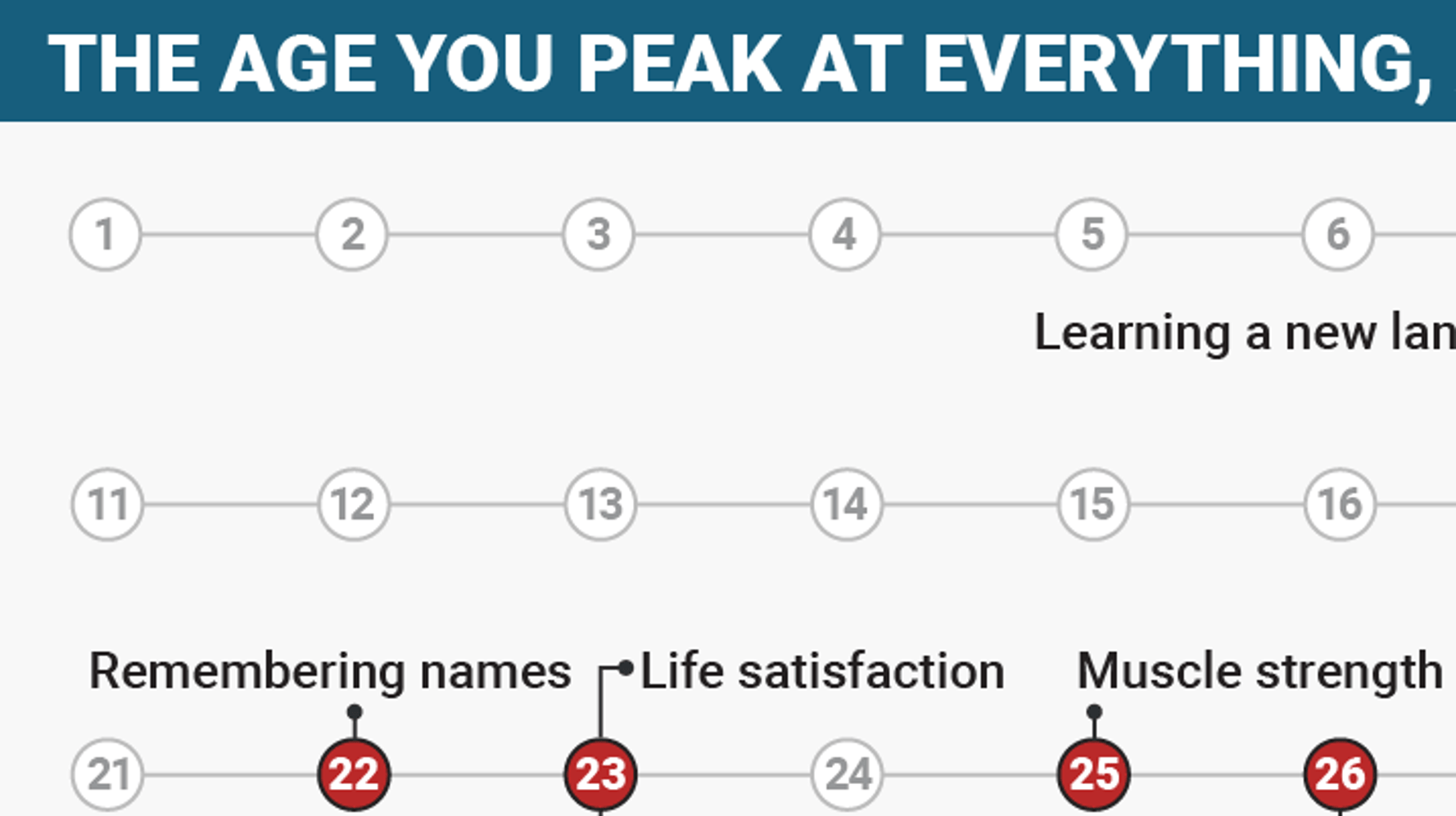
This Chart Shows Why You Should Never Worry About Getting Older
Some of life's biggest peaks come in later years.
Yes, You Do Become More Introverted With Age
Even for extroverts, this shift is healthy and natural.

Just You Wait, by Chris Shiflett
On turning 50: a personal story about luck, curiosity, disillusionment, and hope.
Use it or lose it: How cognitive skills change with age
Cognitive skills are commonly assumed to begin deteriorating from the age of 30, which could pose a significant challenge for rapidly ageing populations. But this assumption relies largely on cross-sectional data that cannot distinguish between ageing patterns and cohort differences. Using German longitudinal data, this column finds that skills, on average, increase markedly into one’s 40s before decreasing slightly in literacy and more severely in numeracy. In addition, skills decline at older ages only for those with below-average skill usage, outlining a clear policy pathway for avoiding skill declines.

Why 30 is the decade friends disappear — and what to do about it
Vox is a general interest news site for the 21st century. Its mission: to help everyone understand our complicated world, so that we can all help shape it. In text, video and audio, our reporters explain politics, policy, world affairs, technology, culture, science, the climate crisis, money, health and everything else that matters. Our goal is to ensure that everyone, regardless of income or status, can access accurate information that empowers them.

The Global Decline in the Mental Health of the Young
One of the major findings in wellbeing research until recently was that happiness was U-shaped by age and unhappiness hump-shaped by age. There was a midlife crisis — a finding reported in well over 600 published papers using data on 145 countries. It was present in both developing and developed countries. And it was persistent over time. The finding of a peak in ill-being in midlife was consistent with Anne Case and Angus Deaton’s work on mortality and the so-called “deaths of despair.”1 In the US in particular and to a lesser extent in other countries, White prime-aged individuals without a college degree had high death rates from suicide, drug overdoses, and cirrhosis of the liver. Drug overdose deaths in the US, for example, peaked at midlife ages. In 2023, the Centers for Disease Control and Prevention (CDC) reported that overdose death rates per 100,000 by age rose from 13.5 for 15-to-24-year-olds to 45.6 for 25-to-34-year-olds and 60.8 for 35-to-44-year-olds, and then declined to 53.3 for 45-to-54-year-olds, 49.2 for 55-to-64-year-olds, and 14.7 for those over the age of 65.2 The morbidity data matched the mortality data.

Don't Judge Millennials For Finding Adulting So Hard
Millennials have been complaining a lot about “adulting” lately. The term has caught steam online, and has started entering daily vocabulary. In short, adulting is the concept of completing the responsibilities an adult is expected to handle, from…

Why older people are happier and what we can learn from them | Psyche Ideas
Around the world, happiness tends to peak later in life. It has more to do with balancing priorities than elderly wisdom

Learning From Older Adults: An Intergoal Compatibility Account for Successful Happiness Pursuit
Academic Abstract People want to pursue happiness but often fail, a phenomenon known as the paradox of pursuing happiness. The mechanisms underlying this paradox remain elusive. Age differences in happiness—specifically that older adults appear more successful in pursuing happiness (the emotion paradox of aging)—provide valuable insights into effective happiness pursuit. Drawing on this literature, we propose an intergoal compatibility account to interpret both paradoxes through the lens of intergoal interactions, an intuitively critical yet underexplored factor in existing interpretations. This account asserts that greater compatibility (fewer conflicts and greater facilitation) between happiness pursuit and other important personal goals enhances the effectiveness of happiness pursuit, and such compatibility can be enhanced through contextual influences (e.g., age-graded developmental tasks) and strategic self-regulation (e.g., goal adjustments). This account generates testable predictions and practical implications for enhancing happiness pursuit across the lifespan. Public Abstract Why do people often struggle to achieve happiness? And why are older adults happier than younger adults, even though they face more losses in life? While these questions have drawn extensive attention, they remain puzzling. A crucial yet insufficiently explored factor in successful happiness pursuit is intergoal compatibility —the extent to which the pursuit of happiness aligns or conflicts with other important personal goals. For younger adults, the demands of age-related developmental tasks (e.g., educational and career aspirations) often create conflicts with the pursuit of happiness, diminishing its effectiveness. Conversely, in older adults, happiness becomes more prioritized and compatible with other important personal goals, thereby enhancing the effectiveness of pursuing happiness. A lesson we can learn from older adults is to pursue happiness in ways compatible with other important personal goals.

Everyone’s talking about the polls: The Age does it differently
Where voters will ultimately land on the question of Victoria’s leadership is becoming increasingly difficult to predict. Fortunately, Age readers are in good hands when it comes to assessing the political mood.

Measuring Self-Control Problems
We develop a survey instrument to measure self-control problems in a sample of highly educated adults. This measure relates in the manner that theory predicts to liquid wealth accumulation and personality measures. Yet while self-control problems are typically seen as resulting in overconsumption and low wealth, we identify a significant group who underconsume and thereby accumulate high levels of wealth. In addition, self-control problems are smaller in scale for older than for younger respondents. Those who put money aside in retirement accounts may be delaying access to a point at which self-control problems are no longer important. (JEL D12, D14)
I Outsourced My Emotions to a Digital Avatar. You Should Too.
I turned 30 this past year, and like many Americans who are finally ready to grow up, I created a tiny little version of myself. Ever since she came...