


A recent talk I gave on model training, reasoning, and the next frontier.
A taxonomy for next-generation reasoning models
Where we've been and where we're going with RLVR.

Build a Reasoning Model (From Scratch)
"An exceptional deep dive into the next frontier of AI.” —Aman Chadha, Google Build a Reasoning Model (From Scratch) is a practical guide to understanding how modern reasoning-oriented LLMs work by building their core methods step by step. The book tells a clear engineering story: start with a conventional pre-trained LLM, learn how text generation works, build reliable evaluation tools, improve reasoning through inference-time methods, then move into training-based approaches such as reinforcement learning and distillation. The progression is deliberate. Early chapters establish the baseline model and explain text generation, KV caching, and evaluation with math verifiers. The middle chapters show how reasoning can be improved without changing model weights, using chain-of-thought prompting, sampling, self-consistency, response scoring, and self-refinement. Later chapters move to changing the model itself through reinforcement learning with verifiable rewards, GRPO improvements, format rewards, and finally distillation from stronger reasoning models into smaller ones. The book is especially useful because it implements the core methods from scratch rather than treating them as black-box library calls. Readers see how self-consistency, self-refinement, Best-of-N, and training-based methods actually work, including their cost and latency trade-offs. It also discusses common failure modes, including cases where refinement can make answers worse. Difficult concepts such as softmax, temperature, and top-p sampling are clarified with code-linked explanations and diagrams, and visual workflows make pipelines and scoring methods easier to follow. Reading the book feels like following a guided technical build rather than a loose survey of AI topics. Each concept is introduced because the project now needs it. Diagrams, roadmaps, code listings, exercises, and repeated workflow summaries help readers stay oriented through advanced material. This structure reflects Sebastian Raschka’s professional strength: explaining complex machine learning topics by making every detail concrete and showing exactly where each section fits in the larger story. He does not treat mechanisms like evaluation, log-probabilities, KL regularization, or distillation as isolated abstractions; he connects them to the goal of making reasoning models understandable and implementable. Physically and organizationally, the book has eight chapters and seven substantial appendixes. That design keeps the main narrative focused while moving supporting material like references, exercise solutions, model source code, larger models, batching, evaluation alternatives, and chat interfaces into ordered appendixes. The result is a logically flowing book that remains hands-on, navigable, and technically deep without constantly interrupting the central build.
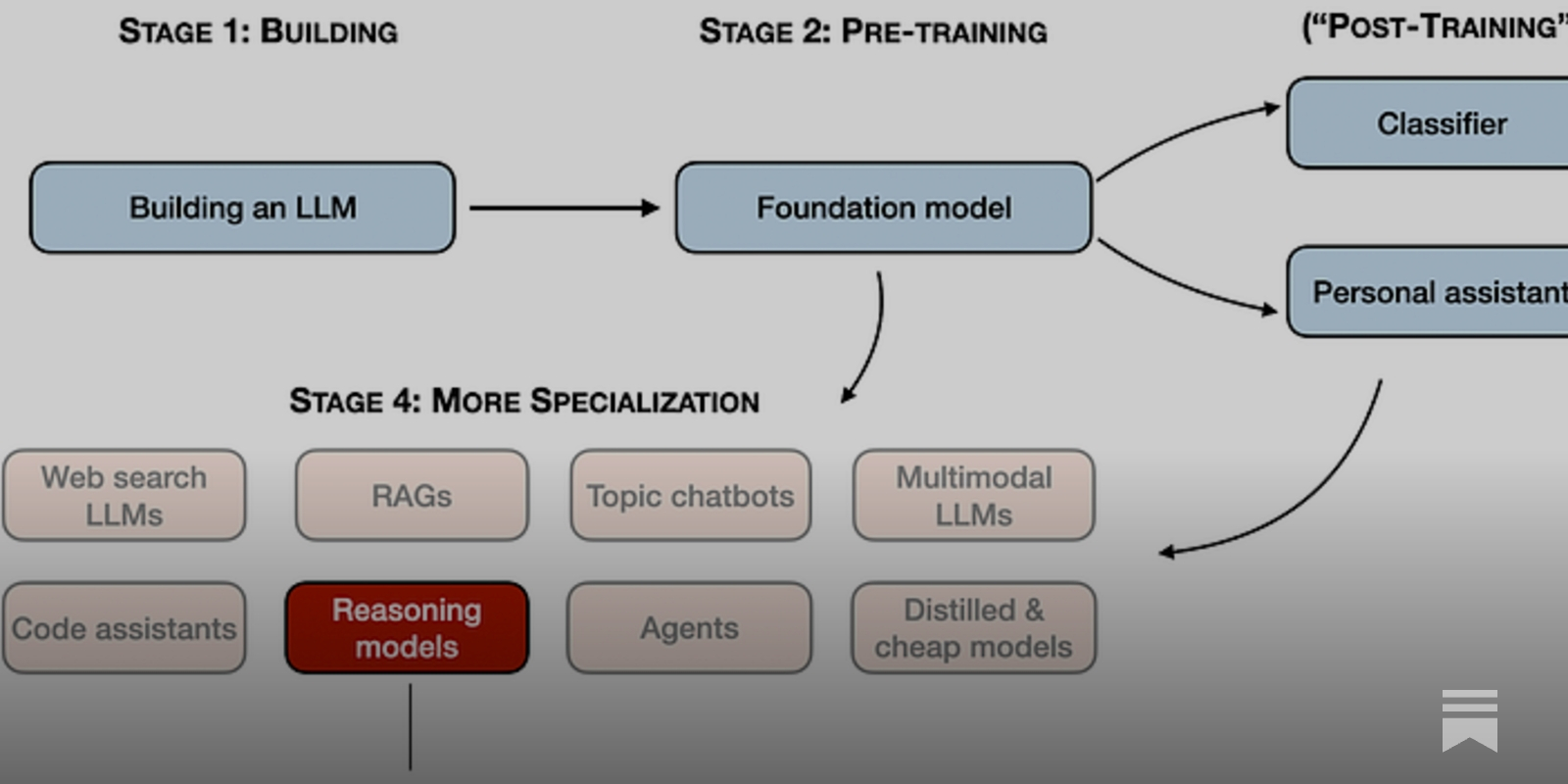
Understanding Reasoning LLMs
Methods and Strategies for Building and Refining Reasoning Models
Models
Amp uses the best model for each task: leading generalist foundation models for complex reasoning and planning, and smaller specialized models for fast, accurate responses in specific domains.

The Illusion of Thinking: Understanding the Strengths and Limitations of Reasoning Models via the Lens of Problem Complexity
Recent generations of frontier language models have introduced Large Reasoning Models (LRMs) that generate detailed thinking processes…

Nathan Lambert on Twitter / X
Reasoning model reports I recommend reading:2025-01-22 - DeepSeek R1 - https://t.co/FanOPm8R472025-01-22 - Kimi 1.5 - https://t.co/NN8Nr1E2xi2025-03-31 - Open-Reasoner-Zero - https://t.co/H5ycSmzMHk2025-04-10 - Seed-Thinking 1.5 - https://t.co/t1ytgV1ZZK2025-04-30 - Phi-4…— Nathan Lambert (@natolambert) January 2, 2026
On the Paradox of Learning to Reason from Data
Logical reasoning is needed in a wide range of NLP tasks. Can a BERT model be trained end-to-end to solve logical reasoning problems presented in natural language? We attempt to answer this...

OpenThoughts: Data Recipes for Reasoning Models — Ryan Marten, Bespoke Labs
Open models by OpenAI
Advanced open-weight reasoning models to customize for any use case and run anywhere.

Mental Models: The Best Way to Make Intelligent Decisions (~100 Models Explained)
The smartest people in the world use mental models to make intelligent decisions, avoid stupidity, and increase productivity. Let's take a look at how ...
The Great Mental Models
The Great Mental Models project is the clearest way to change the way you see the world, avoid problems before they happen, and make better decisions.

Introducing Muse Spark 1.3
Introducing Muse Spark 1.3, with max reasoning for challenging reasoning and agentic tasks and improved real-world usability.

Training Agentic Reasoners — Will Brown, Prime Intellect
Position: Stop Anthropomorphizing Intermediate Tokens as Reasoning/Thinking Traces!
Intermediate token generation (ITG), where a model produces output before the solution, has become a standard method to improve the performance of language models on reasoning tasks. These intermediate tokens have been called \say{reasoning traces} or even \say{thinking traces} -- implicitly anthropomorphizing the traces, and implying that these traces resemble steps a human might take when solving a challenging problem, and as such can provide an interpretable window into the operation of the model's thinking process to the end user. In this position paper, we present evidence that this anthropomorphization isn't a harmless metaphor, and instead is quite dangerous -- it confuses the nature of these models and how to use them effectively, and leads to questionable research. We call on the community to avoid such anthropomorphization of intermediate tokens.
> Making the models smarter doesn't solve the problem. It makes the problem harder to see. So many relatable sentences here.

Mary Berk
I found this article so, so helpful at explaining why slogging through is the best way to learn (and so much more): ergosphere.blog/posts/the-machines-are-fine/

