

Crafting a good (reasoning) model
A recent talk I gave on model training, reasoning, and the next frontier.

The Illusion of Thinking: Understanding the Strengths and Limitations of Reasoning Models via the Lens of Problem Complexity
Recent generations of frontier language models have introduced Large Reasoning Models (LRMs) that generate detailed thinking processes…

Training Agentic Reasoners — Will Brown, Prime Intellect
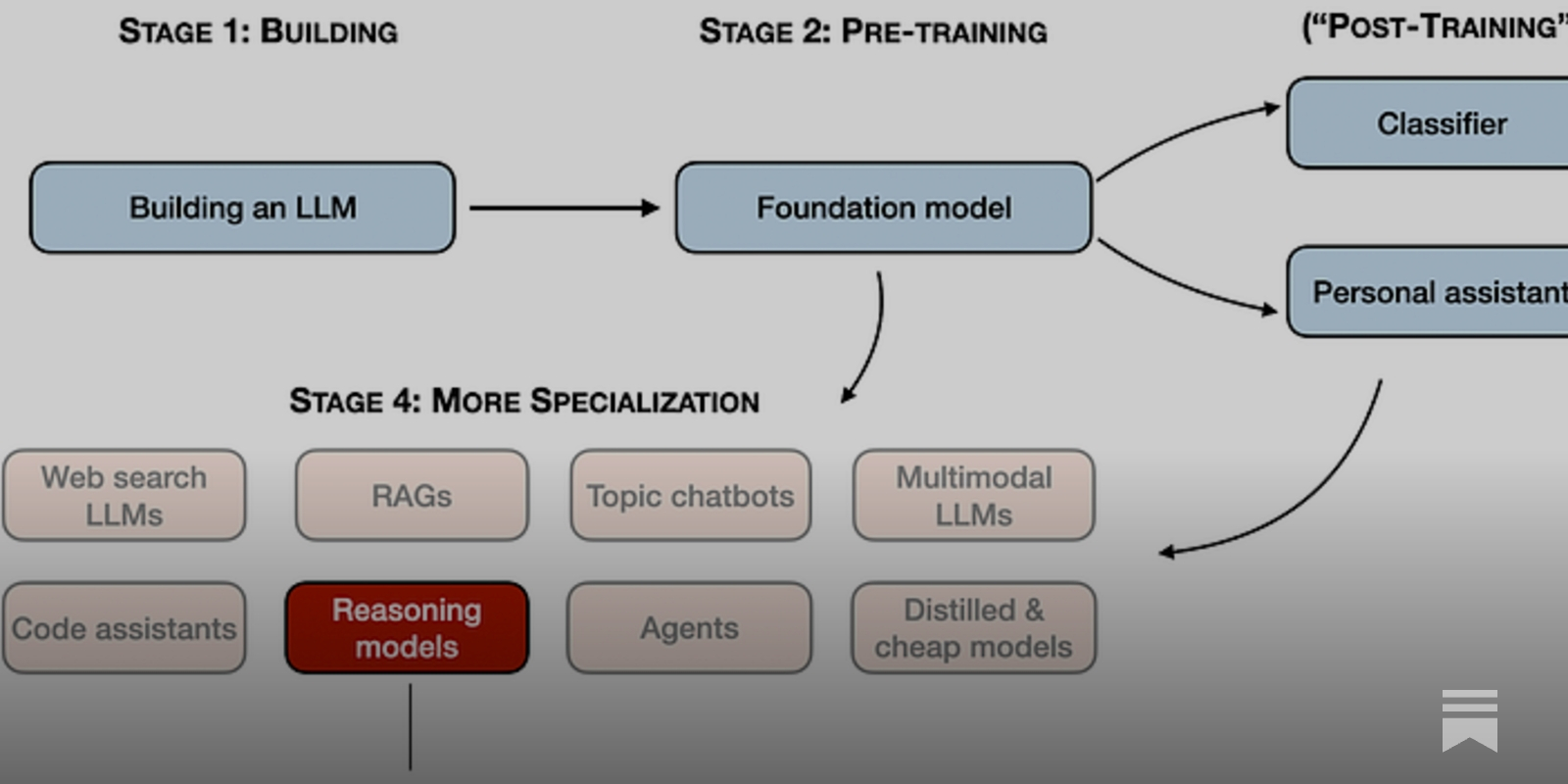
Understanding Reasoning LLMs
Methods and Strategies for Building and Refining Reasoning Models
Eliciting Reasoning in Language Models with Cognitive Tools
The recent advent of reasoning models like OpenAI's o1 was met with excited speculation by the AI community about the mechanisms underlying these capabilities in closed models, followed by a rush of replication efforts, particularly from the open source community. These speculations were largely settled by the demonstration from DeepSeek-R1 that chains-of-thought and reinforcement learning (RL) can effectively replicate reasoning on top of base LLMs. However, it remains valuable to explore alternative methods for theoretically eliciting reasoning that could help elucidate the underlying mechanisms, as well as providing additional methods that may offer complementary benefits. Here, we build on the long-standing literature in cognitive psychology and cognitive architectures, which postulates that reasoning arises from the orchestrated, sequential execution of a set of modular, predetermined cognitive operations. Crucially, we implement this key idea within a modern agentic tool-calling framework. In particular, we endow an LLM with a small set of "cognitive tools" encapsulating specific reasoning operations, each executed by the LLM itself. Surprisingly, this simple strategy results in considerable gains in performance on standard mathematical reasoning benchmarks compared to base LLMs, for both closed and open-weight models. For instance, providing our "cognitive tools" to GPT-4.1 increases its pass@1 performance on AIME2024 from 32% to 53%, even surpassing the performance of o1-preview. In addition to its practical implications, this demonstration contributes to the debate regarding the role of post-training methods in eliciting reasoning in LLMs versus the role of inherent capabilities acquired during pre-training, and whether post-training merely uncovers these latent abilities.

Sebastian Raschka on Twitter / X
Pretty cool. I think 2025-2026 will be a stronger focus on these in open source tooling.I.e. having LLMs delegate knowledge-based queries to search, which in turn frees up model capacity to improve reasoning capabilities and tool use. https://t.co/wNTg283mb2— Sebastian Raschka (@rasbt) August 12, 2025
Build a Reasoning Model (From Scratch)
"An exceptional deep dive into the next frontier of AI.” —Aman Chadha, Google Build a Reasoning Model (From Scratch) is a practical guide to understanding how modern reasoning-oriented LLMs work by building their core methods step by step. The book tells a clear engineering story: start with a conventional pre-trained LLM, learn how text generation works, build reliable evaluation tools, improve reasoning through inference-time methods, then move into training-based approaches such as reinforcement learning and distillation. The progression is deliberate. Early chapters establish the baseline model and explain text generation, KV caching, and evaluation with math verifiers. The middle chapters show how reasoning can be improved without changing model weights, using chain-of-thought prompting, sampling, self-consistency, response scoring, and self-refinement. Later chapters move to changing the model itself through reinforcement learning with verifiable rewards, GRPO improvements, format rewards, and finally distillation from stronger reasoning models into smaller ones. The book is especially useful because it implements the core methods from scratch rather than treating them as black-box library calls. Readers see how self-consistency, self-refinement, Best-of-N, and training-based methods actually work, including their cost and latency trade-offs. It also discusses common failure modes, including cases where refinement can make answers worse. Difficult concepts such as softmax, temperature, and top-p sampling are clarified with code-linked explanations and diagrams, and visual workflows make pipelines and scoring methods easier to follow. Reading the book feels like following a guided technical build rather than a loose survey of AI topics. Each concept is introduced because the project now needs it. Diagrams, roadmaps, code listings, exercises, and repeated workflow summaries help readers stay oriented through advanced material. This structure reflects Sebastian Raschka’s professional strength: explaining complex machine learning topics by making every detail concrete and showing exactly where each section fits in the larger story. He does not treat mechanisms like evaluation, log-probabilities, KL regularization, or distillation as isolated abstractions; he connects them to the goal of making reasoning models understandable and implementable. Physically and organizationally, the book has eight chapters and seven substantial appendixes. That design keeps the main narrative focused while moving supporting material like references, exercise solutions, model source code, larger models, batching, evaluation alternatives, and chat interfaces into ordered appendixes. The result is a logically flowing book that remains hands-on, navigable, and technically deep without constantly interrupting the central build.
Introducing Muse Spark 1.3
Introducing Muse Spark 1.3, with max reasoning for challenging reasoning and agentic tasks and improved real-world usability.

Muse Glimmer: Meta’s 30B Model Built for Efficient Inference
Inside Meta’s 30B local reasoning model and its tiny KV cache

ReAct: Synergizing Reasoning and Acting in Language Models
While large language models (LLMs) have demonstrated impressive capabilities across tasks in language understanding and interactive decision making, their abilities for reasoning (e.g. chain-of-thought prompting) and acting (e.g. action plan generation) have primarily been studied as separate topics. In this paper, we explore the use of LLMs to generate both reasoning traces and task-specific actions in an interleaved manner, allowing for greater synergy between the two: reasoning traces help the model induce, track, and update action plans as well as handle exceptions, while actions allow it to interface with external sources, such as knowledge bases or environments, to gather additional information. We apply our approach, named ReAct, to a diverse set of language and decision making tasks and demonstrate its effectiveness over state-of-the-art baselines, as well as improved human interpretability and trustworthiness over methods without reasoning or acting components. Concretely, on question answering (HotpotQA) and fact verification (Fever), ReAct overcomes issues of hallucination and error propagation prevalent in chain-of-thought reasoning by interacting with a simple Wikipedia API, and generates human-like task-solving trajectories that are more interpretable than baselines without reasoning traces. On two interactive decision making benchmarks (ALFWorld and WebShop), ReAct outperforms imitation and reinforcement learning methods by an absolute success rate of 34% and 10% respectively, while being prompted with only one or two in-context examples. Project site with code: https://react-lm.github.io
Models
Amp uses the best model for each task: leading generalist foundation models for complex reasoning and planning, and smaller specialized models for fast, accurate responses in specific domains.

Open models by OpenAI
Advanced open-weight reasoning models to customize for any use case and run anywhere.

OpenAI's open source LLM is a reasoning model, coming Next Thursday!
1.1K votes, 257 comments. 756K subscribers in the LocalLLaMA community. Subreddit to discuss locally hostable AI.
Introducing Model Council
Today we are launching Model Council, a multi-model research feature that brings several models together for one answer.

gpt-oss:20b
OpenAI’s open-weight models designed for powerful reasoning, agentic tasks, and versatile developer use cases.

Performance of a large language model on the reasoning tasks of a physician
More than 65 years ago, complex clinical diagnostic reasoning cases were introduced as the gold standard for the evaluation of expert medical computing systems, a standard that has held ever since. In this study, we report the results of a physician ...


Where we've been and where we're going with RLVR.