

AUGMENTING HUMAN INTELLECT : A Conceptual Framework Dr. Engelbart 1962
Complementary Intelligence
In the following, I will try sketch a way of thinking about human intelligence and human nature through emphasizing its difference from the...

Augmented human intelligence goes beyond the AGI mirage
This paper argues that contemporary Artificial General Intelligence (AGI) approaches face significant challenges that make Augmented Human Intelligence (AHI) a more promising and practically beneficial alternative. Drawing on phenomenological insights from Peter-Paul Verbeek’s technological mediation theory and comprehensive empirical evidence from decades of AI development, we argue that current AGI projects encounter recurring difficulties that may stem from attempting to replace rather than enhance human intelligence. Through analysis of mediation theory’s core concepts, systematic examination of recent AI performance data, and comprehensive review of human–AI collaboration studies, we show why augmentation approaches consistently outperform replacement attempts across domains requiring creativity, judgment, and contextual understanding. Prioritizing sophisticated AHI development over AGI pursuit represents not a compromise but a fundamental reorientation toward more effective and ethically sound approaches to artificial intelligence that better serve human flourishing.

Towards Critical Artificial Intelligence Literacies
Critical Artificial Intelligence Literacies (CAILs) is the collection of ways of thinking about and relating to so-called artificial intelligence (AI) that rejects dominant frames presented by the technology industry, by naive computationalism, and by dehumanising ideologies. Instead, CAILs centre human cognition and uphold the integrity of academic research and education. We present a selection of CAILs across research and education, which we analyse into the following non-orthogonal dimensions: conceptual clarity, critical thinking, decoloniality, respecting expertise, and slow science. Finally, we note how we see the present with and without a wider adoption of CAILs — a fundamental aspect is the assertion that AI cannot be allowed to drive change, even positive change, in education or research. Instead cultivation of and adherence to shared values and goals must guide us. Ultimately, CAILs minimally ask us to contemplate how we as academics can stop AI companies from wielding so much power.
Air pollution causes ‘huge’ reduction in intelligence, study reveals
Impact of high levels of toxic air ‘is equivalent to having lost a year of education’

AI Literacy Across the Curriculum
As you have no doubt seen, AI is becoming ubiquitous in our lives and in the technologies we use every day. Generative AI is no longer an experimental tool, but a deployed technology in many of the…

A.I. Is Homogenizing Our Thoughts
Recent studies suggest that tools such as ChatGPT make our brains less active and our writing less original.
You Can Increase Your Intelligence: 5 Ways to Maximize Your Cognitive Potential
ChatGPT's Impact On Our Brains According to an MIT Study
The study, from MIT Lab scholars, measured the brain activity of subjects writing SAT essays with and without ChatGPT.

What Makes Us Smart?
Human creativity does not solely rely on our individual cognitive abilities, but instead emerges from the recombination of ideas, practices, and approaches that result from social interactions and id...


Opinion | Can You Get Smarter? (Published 2015)
There is much that you can do to keep cognitively sharp.

A Treatise on AI Chatbots Undermining the Enlightenment
On chatbot sycophancy, passivity, and the case for more intellectually challenging companions
A Treatise on AI Chatbots Undermining the Enlightenment
On chatbot sycophancy, passivity, and the case for more intellectually challenging companions
Thinking is not only writing
Generative artificial intelligence (AI) raises valid concerns about the loss of cognitive work embedded in scholarly writing. However, universally dismissing AI-assisted drafting mistakenly conflates writing with thinking itself and reinforces existing inequities in who can transform their ideas into polished text. Academic authorship should depend more on the depth and creativity of human intellectual engagement than on the medium through which first drafts are produced.
Collective Intelligence Research

Explorations into the idea that a group of humans is "more intelligent" than the sum of their "IQ" (i.e. "groups of individuals doing things collectively that seem intelligent")
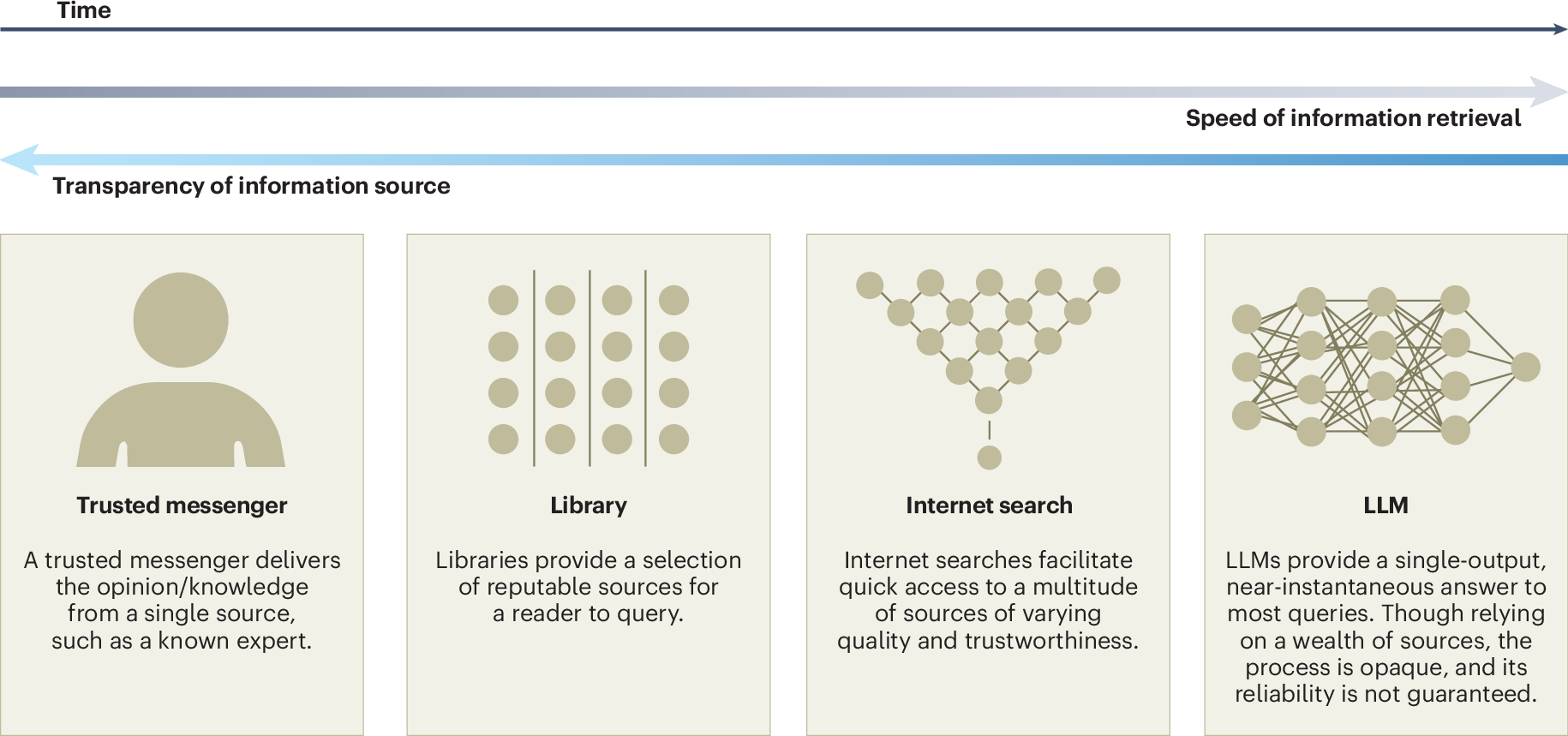
How large language models can reshape collective intelligence

Sharing Notes about Collective Intelligence — Pop Junctions

Socially Minded Intelligence: How Individuals, Groups, and Artificial Intelligence Can Make Each Other Smarter (or Not)

Profile: Adrien Treuille

NOVA | The Wisdom of the Crowds | Season 45 | Episode 6
Mapping Citizen Science through the Lens of Human-Centered AI