Build the substrate open science depends on.
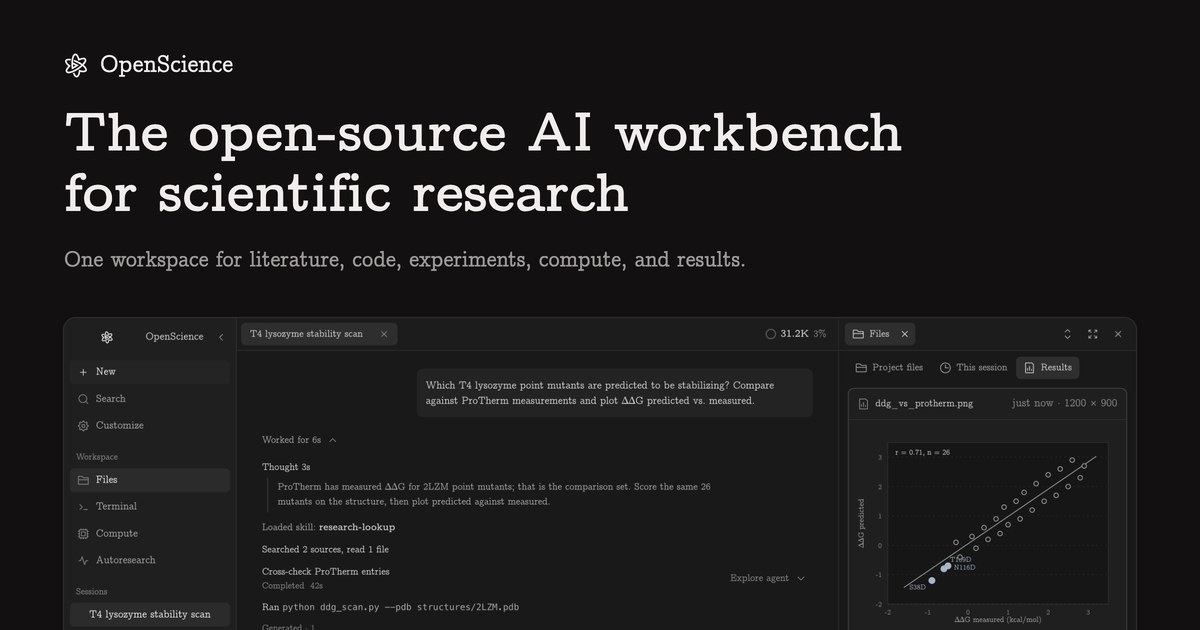
OpenScience | Open-source AI co-scientist for research
OpenScience is the open-source AI co-scientist. Free models included or connect any model from any provider, including Claude, GPT, Gemini and more.
IOSP 2026: Institute of Open Science Practices (space) | nanodash
An event, a community, and a coordinating institute for the people building, using, and advancing the infrastructure open science depends on. IOSP 2026 is the third edition, held 12-15 October 2026 in Leiden: the Poortgebouw of the University of Leiden and GO FAIR host 12, 13 and 15 October, while 1…

Open Science Needs Open Compute
Why independent science will depend on compute, not just funding, and why providing it is the best bet we can currently make.
Open Science Needs Open Compute
Why independent science will depend on compute, not just funding, and why providing it is the best bet we can currently make.
Center for Open Science
At the Center for Open Science, our mission is to increase openness, integrity, and reproducibility of scholarly research. Promoting these practices within the research funding and publishing communities accelerates scientific progress

Academic Lexicon & Feature expansion · Issue #119 · singi-labs/sifa-workspace
Summary Together with #ATScience, we see a huge opportunity for academics to use open AT protocol to collaborate, protect and show their work. Sifa could help our by providing the functionality tha...
Pitfalls and chances in creating optimal conditions for openness and collaboration in science
Marion Poetz on what it takes to foster innovation in Science and how to make it more interesting for companies and organizations.