

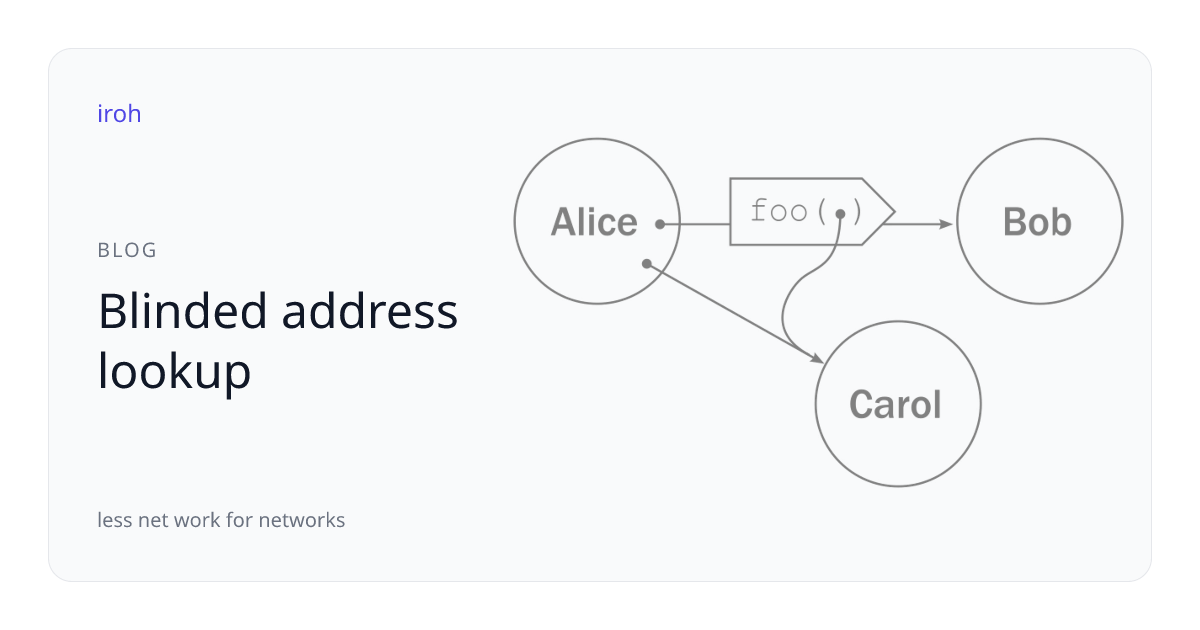
Iroh public keys are not (yet?) secrets.
blog.trillia.net
Sorrel is an idea for device management in applications that use Iroh. Iroh facilitates direct connections between devices using key pairs for identity/addressing. Once a device knows the public key of another device, Iroh will reliably (magically) connect them. But the device first needs to know which device it wants to talk to.
Address Lookup - iroh
Use this file to discover all available pages before exploring further.

Revisiting Keyed-Verification Anonymous Credentials
This summary was generated using automated tools and was not authored or reviewed by the article's author(s). It is provided to support discovery, help readers assess relevance, and assist readers from adjacent research areas in understanding the work. It is intended to complement the author-supplied abstract, which remains the primary summary of the paper. The full article remains the authoritative version of record. Click here to learn more.

Whisper - keith.is
End-to-end encrypted P2P chat using Iroh and Bluesky identity. No servers, no logs. Your ATProto DID is your address book, Iroh handles the rest.

Keyoxide Docs
Keyoxide is a privacy-friendly tool to create and verify decentralized online identities.
Revisiting Keyed-Verification Anonymous Credentials
As part of the Digital Library's transition to Open Access, new features for researchers are available in the Premium Edition. Click here to learn more.
iroh 1.0
I Was Right About ATProto Key Management - nora's notes
Note: this post has been revised to be split into two sections: a description of what happened, and my analysis. I hope to make it clear that, while I do not like ATProto in general, I am trying to make good-faith critcisms of specific design decisions and outcomes, and in fact, this post getting updoots on HackerNews appears to have gotten the attention of the team, so, mission accomplished. ref, ref My account has since been manually reinstated; this has not happened for any of the other users that have had this issue, as far as I know.
Hashing PII does not Protect Privacy | Rainbow table attack
It's trivial to reverse cryptographic hash functions if you know the input consists of names, social security numbers, etc. from a limited set of possible values.
The road to iroh 1.0
It is done. After four years of work and various pivots we have released iroh 1.0.
Reverse-engineering Find My People to stalk ̶m̶y̶ ̶e̶x̶ a friend, cause I can
How I registered a Linux machine with Apple's private services, received an existing Find My People key over IDS, and decrypted the live location without a Mac.
Tools from EFF's Tech Team
EFF’s team of technologists and computer scientists engineers solutions to the problems of sneaky tracking, inconsistent encryption, and more. Where users face threats to their privacy and security

Ok, riffed on a plan with Pi. I think this makes sense? Header envelope tracks session tree. Blake3 hash addressing using same address format that Iroh uses (lowercase hex). gist.github.com/gordonbrander/70b3caf6ee5414e…

Pi hash-addressed sessions
gist.github.comYikes. For anyone interested in more information about this, I recommend checking out @privacyguides.org : discuss.privacyguides.net/t/privacy-com-uses-identity-v…

Privacy.com uses identity verification service Persona, which will keep biometric information for "up to" 3 years
discuss.privacyguides.net
