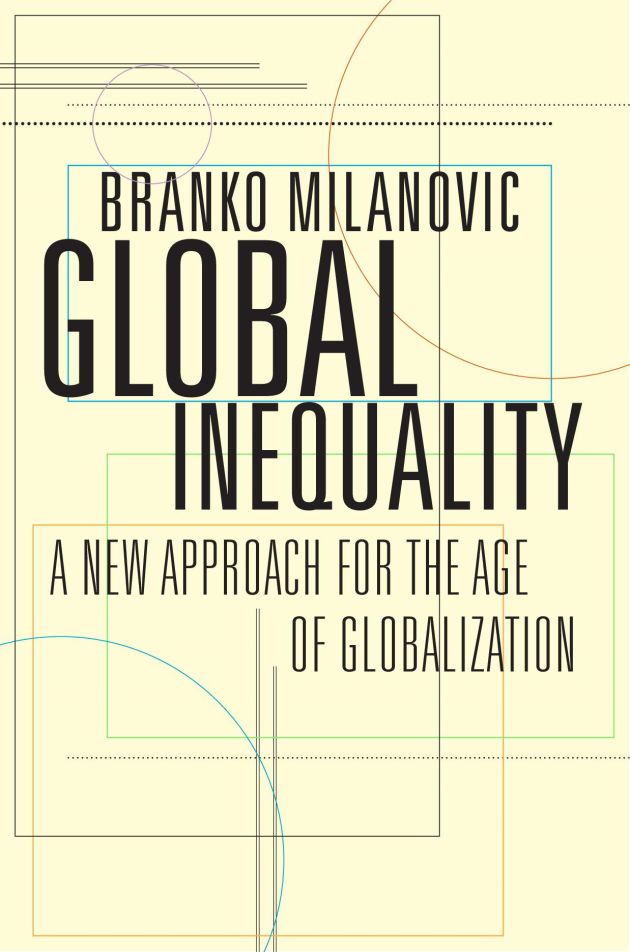
The Divide: A Brief Guide to Global Inequality and its Solutions Penguin Random House UK, 2017
Global Inequality — Harvard University Press
Winner of the Bruno Kreisky Prize, Karl Renner InstitutA Financial Times Best Economics Book of the Year An Economist Best Book of the Year A Livemint Best Book of the YearOne of the world’s leading economists of inequality, Branko Milanovic presents a bold new account of the dynamics that drive inequality on a global scale. Drawing on vast data sets and cutting-edge research, he explains the benign and malign forces that make inequality rise and fall within and among nations. He also reveals who has been helped the most by globalization, who has been held back, and what policies might tilt the balance toward economic justice.“The data [Milanovic] provides offer a clearer picture of great economic puzzles, and his bold theorizing chips away at tired economic orthodoxies.”—The Economist“Milanovic has written an outstanding book…Informative, wide-ranging, scholarly, imaginative and commendably brief. As you would expect from one of the world’s leading experts on this topic, Milanovic has added significantly to important recent works by Thomas Piketty, Anthony Atkinson and François Bourguignon…Ever-rising inequality looks a highly unlikely combination with any genuine democracy. It is to the credit of Milanovic’s book that it brings out these dangers so clearly, along with the important global successes of the past few decades.—Martin Wolf, Financial Times
IDS Annual Lecture 2026 with Jason Hickel
IDS Annual Lecture 2026 with Jason Hickel
New Capitalism II: Compositional vs income inequality
Are all class-based societies unequal?
IDS Annual Lecture 2026 with Jason Hickel - Institute of Development Studies
Join us for the IDS Annual Lecture 2026 delivered by world-renowned political economist and author Prof Jason Hickel.

Rapport du World Inequality Lab : 50 ans après, le nouveau rapport Meadows ?
le World Inequality Lab (WIL) a lancé le « Global Justice Project », un programme destiné à « stimuler la recherche, l'élaboration des
Is Inequality Inevitable?
Wealth naturally trickles up in free-market economies, model suggests
The Missing Institution: A Global Dividend System for the Age of Transformative AI — Digitalist Papers
How do we share prosperity in society if work no longer sits at the center of people’s lives? In this essay, Anna Yelizarova explores one provocative possibility: a “global dividend.” If transformative AI shows little respect for national borders, with effects that spill across countries, then we ne

Thomas Piketty Knew This Was Coming
The scholar of inequality warned us that our economic systems couldn’t withstand a global catastrophe.
The myth of catch-up development: trends in core–periphery inequality from 1960 to 2023
The conventional narrative in international development holds that poorer countries are “catching up” with richer countries through the process of capitalist growth. This paper assesses this claim ...

A fact-based worldview for all | Gapminder
We live in a globalized world, not only in terms of trade and migration. More people than ever care about global development. But most people have severe misconceptions about contemporary global development. We know, because we have tested people’s knowledge. One of the main reasons for this is that students don’t learn to understand the world based on statistics and facts. Instead, we have a dramatic worldview formed by outdated school books and sensationalist news-stories. People intuitively believe that most things are getting worse. The dramatic worldview leads to irrational decisions by individuals, nonprofits, governments and business. For the first time in human history reliable statistics exist. There’s data for almost every aspect of global development. The data shows a very different picture: a world where most things improve; a world that is not divided; and a world where the fast population growth will soon be over. The world has never been less bad. But that doesn’t mean it’s perfect.
‘Self-termination is most likely’: the history and future of societal collapse
An epic analysis of 5,000 years of civilisation argues that a global collapse is coming unless inequality is vanquished

Preface | The World After Capital
Since publishing the previous version of The World After Capital, I have met with people across the political spectrum to discuss the ideas from the book. When I present these in person, I emphasize that the ideas are neither left nor right but forward (credit to Scott Santens who first used this phrase about Universal Basic Income). My writing, however, at times has alienated readers who identify as being more on the right. In this new edition, I am therefore making an extra effort to emphasize how both my diagnosis of where we are at and my suggestions for how to move forward do not map onto the existing political divides. Instead this is a new way of understanding our challenges and opportunities that can be the basis for movements and parties that are not trapped in Industrial Age ideology.
Power Laws, Weblogs, and Inequality - Clay Shirky
Diversity plus freedom of choice creates inequality.
Unequal exchange of labour in the world economy
Researchers have argued that wealthy nations rely on a large net appropriation of labour and resources from the rest of the world through unequal exchange in international trade and global commodity chains. Here we assess this empirically by measuring flows of embodied labour in the world economy from 1995–2021, accounting for skill levels, sectors and wages. We find that, in 2021, the economies of the global North net-appropriated 826 billion hours of embodied labour from the global South, across all skill levels and sectors. The wage value of this net-appropriated labour was equivalent to €16.9 trillion in Northern prices, accounting for skill level. This appropriation roughly doubles the labour that is available for Northern consumption but drains the South of productive capacity that could be used instead for local human needs and development. Unequal exchange is understood to be driven in part by systematic wage inequalities. We find Southern wages are 87–95% lower than Northern wages for work of equal skill. While Southern workers contribute 90% of the labour that powers the world economy, they receive only 21% of global income.

Beyond GDP: Measuring and Valuing What Really Matters
Rethinking the UN’s “beyond GDP” agenda and the case for putting wealth at the centre